Newsflash from Saturday, 7 February 2026:
Residents and visitors in Eastern Crete experienced an unsettling Friday evening as three earthquakes struck the sea area south of the Lasithi prefecture in rapid succession. The tremors occurred within just ten minutes of each other, rattling coastal towns and reaching as far as Heraklion.
If you felt the ground move yesterday, here is the breakdown of the seismic activity recorded south of Ierapetra.
A Ten-Minute Seismic Sequence
The seismic activity began shortly after 7:30 PM, with three distinct tremors recorded by the Geodynamic Institute.
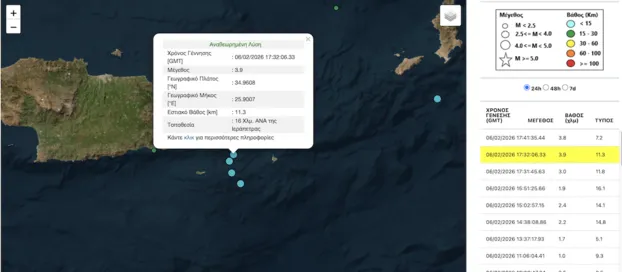
* 7:31 PM: The sequence started with a weak tremor measuring 3.0 on the Richter scale. The epicenter was located 17 kilometers east of the island of Chrysi.
* 7:32 PM (The Strongest Quake): Only sixty seconds later, the strongest earthquake of the evening occurred. Measuring 3.9 Richter, the epicenter was located in the sea area east-southeast of Ierapetra, with a focal depth of 11.3 kilometers.
* 7:41 PM: The activity concluded with a third tremor measuring 3.8 Richter, centered 23 kilometers east-southeast of Chrysi.
Impact and Observations
Despite the moderate magnitude, the tremors were widely felt due to their relatively shallow focal depth. Reports confirm that the shaking was noticeable across the coasts of Eastern Crete and in the city of Heraklion.
Fortunately, there have been no reports of injuries or significant structural damage following the triple event.
Staying Safe in a Seismic Zone
Crete is located in a seismically active region, and clusters of small to moderate quakes like these are not uncommon. Seismologists monitor these “swarms” closely to determine if they are part of a larger sequence or simply a localized release of energy.
What to do during a tremor:
* Drop, Cover, and Hold On: If you are indoors, stay there. Get under a sturdy piece of furniture.
* Stay Clear of Glass: Move away from windows or heavy furniture that could fall.
* If Outdoors: Move to an open area away from buildings, trees, and power lines.
Local authorities continue to monitor the situation south of Lasithi. For now, life in Ierapetra and the surrounding regions has returned to normal, but the evening served as a brief reminder of the island’s dynamic geological nature.
Did you feel the tremors yesterday? Let us know in the comments where you were and what you experienced.
Magnitude: 3.9
Depth: 11.3 km
Epicentre: 34.9333°N / 25.9244°E (Latitude/longitude)
Intensity: III (Weak near the epicentre)
Nearby places | Distance | Intensity |
|---|---|---|
Agios Panteleimon Makry Gialou | 11 km | III |
Ierapetra | 19 km | III |
34 km | III | |
35 km | III | |
46 km | III | |
57 km | III |
General information: CreteTip only reports earthquakes with a magnitude of 4.0 or higher, or earthquake swarms close to this threshold!
The reason for this is that earthquakes of lower intensity pose no danger whatsoever and are hardly noticeable after a longer stay in Crete.
Understanding Intensity and the Modified Mercalli Intensity Scale
Ever wonder what exactly people mean when they talk about the “strength” of an earthquake? That’s called its intensity—basically, how much shaking folks actually feel where they are.
Intensity isn’t the same thing as magnitude, which is all about the energy released at the quake’s source. Intensity is more personal; it’s about how strongly the quake hit a specific spot.
The Modified Mercalli Intensity (MMI) scale is the usual go-to for describing this. It ranks shaking from I (not felt) to X (extreme shaking). The scale uses Roman numerals and sometimes colors to help visualize it, which is kind of handy:
- I to II: Not felt or barely felt
- III to IV: Weak to light shaking
- V and above: Moderate to strong shaking
How intense the shaking feels depends on a mix of things—how powerful the quake was, how deep underground it started, and how far away you are from the epicentre.

If you’re close to the epicentre, chances are you’ll feel it more. Not exactly a surprise, right?
Recent earthquakes near Crete:
Earthquake simulator at the Natural History Museum:
More about Earthquakes on Crete and Crete is a risk area for strong earthquakes and tsunamis.
How do you protect yourself during earthquakes?
Protection from earthquakes involves preparation before an earthquake and acting safely during an earthquake. Here’s what you should do:
Before an earthquake
1) Prepare an emergency kit: Include water, food, a torch, batteries, first aid supplies, important documents and medications.
2) Secure the room:
– Fasten shelves securely to the walls.
– Place heavy objects on the lower shelves.
– Secure televisions, computers and other heavy items.
– Know how to switch off gas, water and electricity.
3) Create a family emergency plan:
– Know safe places in each room (under sturdy tables, on interior walls).
– Plan and practise evacuation routes.
During an earthquake
If you are in the house:
DROP, COVER, and HOLD ON:
– Drop to your hands and knees (before you’re knocked down).
– Cover your head and neck under a sturdy table or desk. If there’s nothing to hide under, cover your head and neck with your arms and crouch in an inside corner of the building.
– Hold On to your shelter until the shaking stops.
– Keep away from windows, glass and heavy objects that could fall.
– Do not run outside during the quake.
If you are outdoors:
– Move to an open area away from buildings, trees, streetlights and power lines.
– Stay there until the quake stops.
If you are in a vehicle:
– Stop as quickly and safely as possible.
– Stay inside the vehicle.
– Avoid stopping on bridges, in tunnels or under overpasses.
After an earthquake
– Check yourself and others for injuries.
– Be prepared for aftershocks.
– Inspect the house for damage and hazards (gas leaks, fire, etc.).
– Listen to emergency announcements for information and instructions.
– Use the telephone only in emergencies.
Important notes:
Most earthquake injuries are caused by falling objects and debris, not building collapses. Protect your head and neck and stay calm.
 Information from the Greek Civil Protection for earthquakes (in English)