Discover why Cretan honey is Greece’s most precious natural wonder.

High in the rugged mountains of Crete, where ancient olive groves meet wildflower meadows, a man named Theodoros tends to his bees in one of Greece’s most remote and beautiful locations. His story is the story of Cretan honey—a golden treasure passed down through generations, crafted by nature and perfected by tradition.
A Three-Hour Journey to Paradise
Theodoros’s beehives aren’t located in some convenient valley or accessible hillside. Instead, they sit perched on a steep, rocky slope overlooking the Samaria Gorge—one of Europe’s most dramatic natural formations. To reach his apiary, one must hike for three hours through some of Crete’s most pristine wilderness.
This remote location, however, is precisely what makes Cretan honey so extraordinary.
Nature’s Pharmacy: The Herbs That Make the Magic
The bees that work Theodoros’s hives have direct access to the rich vegetation of the Samaria National Park, where they feast on an extraordinary variety of wild herbs and flowers. These aren’t ordinary plants—they’re the botanical treasures of Crete’s mountains:
– Thyme (specifically the rare white thyme of the White Mountains)
– Oregano (rigani)
– Sage (faskomilia)
– Savory (throumpi)
– Marjoram (mantzouana)
– Mallow (malothira)
Each plant imparts its own unique flavor profile and medicinal properties to the honey, creating a complex, aromatic product that tastes nothing like mass-produced honey from lowland apiaries.
“The bees work these herbs, and the result is honey that tastes like the very essence of Crete itself.”*
A Labor of Love: The Annual Honey Cycle

From wild thyme-covered mountains to rugged herbal landscapes, Crete’s bees are back—carrying tiny drops of something extraordinary. 🌿💛
Each return to the hive is the final step in a journey across oregano, sage, marjoram, and rare mountain thyme. The result? Rich, aromatic Cretan honey that tastes like the island itself. 🇬🇷🍯
This isn’t just honey—it’s nature, tradition, and thousands of tiny flights woven into one golden spoonful.
Theodoros follows an ancient rhythm that governs the honey-making year. The cycle begins in February, when bee populations reproduce and expand, and culminates with the August harvest—a grueling multi-day process that demands physical endurance and deep knowledge of the craft.
The Infrastructure: Simplicity Meets Ingenuity
What’s most striking about Theodoros’s operation is how deliberately humble it remains:
– Three honey extractors—the essential machinery
– Generator-powered electricity—no grid connection
– A winch system—for hauling materials up the treacherous slope
– Human backs—for carrying what the winch cannot
Everything that cannot be loaded onto the winch must be carried on people’s backs up the mountainside. It’s backbreaking work, but it preserves the integrity of the honey and keeps the operation in harmony with its natural surroundings.
The Magic of the Harvest: August Nights Under the Stars

When harvest season arrives, Theodoros and his friends—volunteers who journey to help him—camp in a natural cave carved into the rock face. From this vantage point, they have unobstructed views of the vertical cliff walls on the opposite side of the gorge. It’s a setting that feels suspended between earth and sky.
The Night of the Extraction
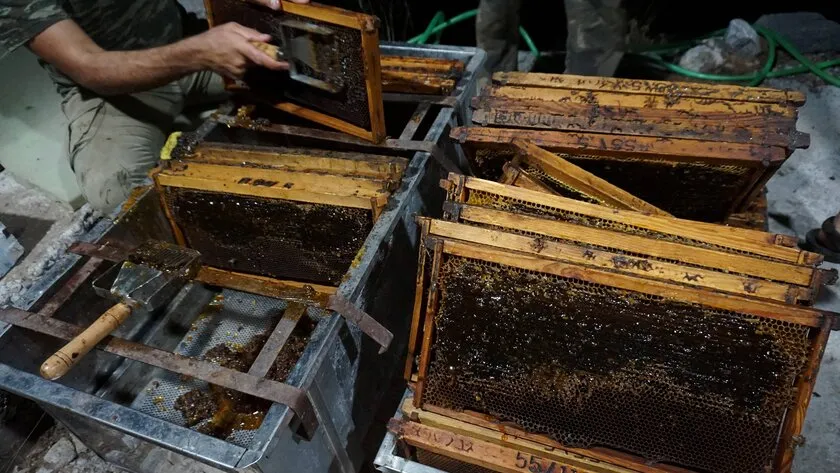
As the bees sleep, a small team of workers springs into action. Using scrapers, they methodically remove the wax capping from each honeycomb cell, exposing the liquid gold beneath. Once prepared, the combs are placed into the three extractors.
As these machines spin at high speed, something magical happens: the night air fills with an intoxicating sweetness—the aroma of wild herbs and pure honey. The golden liquid flows thick and slow from the extractor’s spout, catching the light like liquid amber.
The team works through the night with headlamps and determination, while their harvest accumulates in containers below.
The Great Journey: Three Days Down the Mountain
With the first light of dawn, the extraction work stops. Now comes the monumental task of transporting the honey down the mountainside.
Mules become the honey’s vehicles, carefully navigating the treacherous paths toward the coastal settlement of Agia Roumeli. This journey takes approximately three days, and it’s conducted with meticulous respect for the animals’ wellbeing. There’s no rushing, no shortcuts—just steady, careful progress down the mountain.
For Theodoros, this slow descent is non-negotiable. The honey has already traveled through time and tradition; it deserves a respectful passage to the world.
The Weight of Worry: Climate and the Future
Despite his deep connection to his craft and the land, Theodoros faces modern challenges that threaten to overshadow his achievements. His greatest concerns are:
Prolonged drought in recent years has stressed the wildflower populations, reducing the nectar flow that his bees depend on. Climate change poses an existential threat to the delicate ecosystem that makes his honey possible.
The future of this ancient craft remains uncertain—a poignant reminder that some treasures, once lost, can never be reclaimed.
Why Cretan Honey Stands Apart
In a world of industrial honey production, Cretan honey—especially that produced by traditional beekeepers like Theodoros—represents something increasingly rare: authenticity, sustainability, and a direct connection to the land.
When you taste true Cretan honey, you’re not just consuming a sweetener. You’re tasting:
– The wildflowers of the White Mountains
– The dedication of a beekeeper who walks three hours to tend his craft
– The patience of a harvest that takes weeks to complete
– The wisdom of traditions that have survived centuries
– The soul of an island that refuses to be industrialized
Supporting Cretan Beekeepers
If you’re moved by Theodoros’s story, the best way to support traditional Cretan beekeeping is simple: seek out authentic, locally-produced honey. Look for labels that indicate small-scale, mountain-sourced production. Ask questions about where the honey comes from and how it was made.
Every purchase of genuine Cretan honey is a vote for tradition, sustainability, and the preservation of one of Greece’s most precious natural resources.
Quick Facts About Cretan Honey:
– Harvest Season: August
– Primary Herbs: Thyme, oregano, sage, savory, and marjoram
– Production Method: Traditional, small-scale beekeeping
– Best Uses: Raw consumption, drizzled over yogurt, in traditional Greek dishes, medicinal applications
– Storage: Cool, dark place; honey lasts indefinitely
Have you ever tasted authentic Cretan honey? Share your experiences in the comments below. And if you’re planning a trip to Crete, seek out local beekeepers—supporting them ensures this magnificent tradition survives for generations to come.
Discover Crete. Taste tradition. Support sustainability. Choose Cretan honey. 🍯
Best Cretan Honey: Guide to the Finest Varieties and Producers
Cretan honey comes from the wild hills and flowering fields of Crete. Bees feed on thyme, pine, and other native plants.
This honey has a rich, complex flavor. It can range from light and floral to dark and herbal, all depending on where and when it’s harvested.
What makes Cretan honey stand out? It’s become a favorite for cooks and food lovers who want something with real character.
When you’re choosing Cretan honey, notice the floral source, harvest year, and whether it’s raw or blended. These details shape the taste, texture, and even the health perks.
Go for single-origin, raw honey with clear labeling of region and floral type if you want the real Cretan flavor.
We tried several jars and compared taste, texture, and value. Here’s what we found for drizzling, baking, or just eating by the spoonful.
Best Cretan Honey
Here’s our list of the best Cretan honey we found. We picked jars that show off true Cretan flavor, good quality, and clear sourcing, so you can pick the best one for your taste.
Meligyris Cretan Forest Honey

If you want a rich, herbal Cretan honey that tastes of pine and thyme, this is a solid pick. It works well on toast or in tea.
Pros
- Deep, aromatic flavor that feels authentically Cretan.
- Thick, unfiltered texture that spreads well and looks natural.
- Made by artisan beekeepers and comes in a sturdy glass jar.
Cons
- Quite expensive compared with everyday table honey.
- Very viscous — can be sticky if the jar leaks in transit.
- Some people may notice a less floral, more treacly note than expected.
We opened the jar and got hit with a strong herbal scent. The thyme and pine come through clearly, giving a warm, almost savory sweetness that lifted our tea and Greek yogurt.
The texture felt dense and glossy. A spoonful coated toast without running off, and the raw, unfiltered body made it feel like a real artisanal product, not just another supermarket blend.
The price is a bit steep, but honestly, a small jar lasts a while. If you want a distinctive Cretan honey for special breakfasts or gifting, this one really tastes like the island.
Miterra Cretan Thyme Honey, 400 g
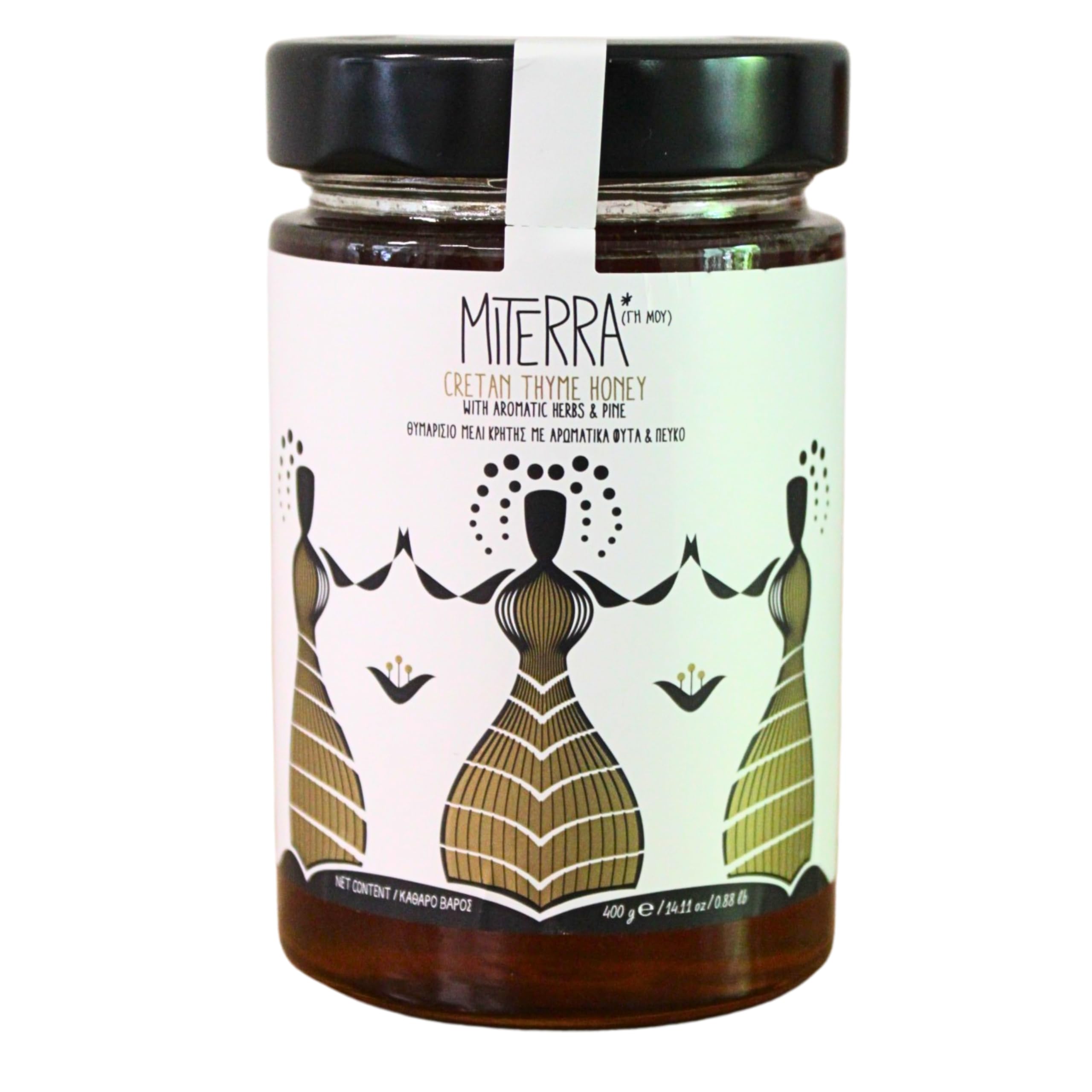
This one’s for you if you love a fragrant, full-flavored Cretan honey for breakfast and baking.
Pros
- Very aromatic thyme and herbal flavor.
- Thick, spreadable texture that clings to toast and yogurt.
- Feels authentic and small-batch from Crete.
Cons
- Strong flavor may be too intense for some.
- Quite thick; needs warming to pour easily.
- Jar size is modest for daily use.
We tried this on yogurt and toast and got a bold thyme note right away. The pine and herbs added a clean, slightly sharp edge that made simple food taste more interesting.
Our jar was pretty dense and almost creamy. That texture stayed on a spoon and made it good for scooping, but it didn’t drip easily into a cup of tea without a quick stir or gentle warming.
We used it in herbal tea and a baking recipe. It sweetened well and left a clear herbal aftertaste. If you prefer mild honey, this may be stronger than you expect, but it’s true to Cretan thyme honey.
Toplou Thyme Honey, 950g

If you want a fragrant, authentic Cretan thyme honey for breakfasts and baking, this is a good bet.
Pros
- Strong, floral thyme aroma that lifts porridge and yogurt.
- Thick, full-bodied texture that feels natural and unprocessed.
- Versatile for cooking, drizzling or a daily spoonful.
Cons
- Jar can arrive with leaks if packaging is poor.
- Natural crystallization may require gentle warming.
- Best-before date on some listings may be old.
We used this jar on toast and stirred it into tea. The thyme note came through clearly but didn’t overpower anything. It has a warm, herbal flavor that makes basic breakfasts feel a bit special.
The texture was pleasantly thick. When we refrigerated it, it started to granulate a bit, but a short bain-marie brought it back to smooth syrup without changing the taste.
One delivery came with sticky residue on the box, so now we check seals on arrival. Still, the honey itself tasted clean, rich, and true to Cretan thyme for sauces, sweets, and daily use.
Meli Serron Blossom & Thyme Honey

Pick this jar if you want a rich, floral Greek honey with clear thyme notes and natural texture.
Pros
- Distinct thyme aroma and complex flavor.
- Big 920 g glass jar — lasts a long time.
- Feels natural and minimally processed.
Cons
- Crystallizes over months — needs gentle warming.
- Glass jar is heavy to handle.
- Flavour may be strong for mild-honey fans.
We tried this honey on toast, stirred into yogurt, and straight from a spoon. The thyme hits first, then a mellow blossom sweetness. It tasted more layered than supermarket blends and gave us a clear sense of place.
The texture sits between runny and set when new. After a few weeks it began to thicken and form fine crystals. We warmed it in a bowl of warm water and it returned to smooth without losing flavor.
The packaging felt sturdy and the jar kept it fresh. The large size meant we reached for it often. If you want a bold, authentic Greek honey that works well in cooking and as a table honey, this is worth a try.
Melissokomiki Dodecanesse Thyme Honey — “Miracle of Gods”

We’d buy this if we wanted a true Cretan/Aegean thyme honey with a bright floral aroma. Expect to pay a premium for an imported gourmet jar, though.
Pros
- Clear thyme aroma and a smooth, golden texture.
- Feels pure and natural — no odd aftertastes or additives.
- Versatile in breakfasts, dressings, and straight off a spoon.
Cons
- Pricey compared with local purchases in Greece.
- Some jars can be less aromatic than others.
- Crystallizes over time, so you may need to warm it gently.
We opened the jar and the scent hit us right away — that warm, herbal thyme note you expect from the islands. The texture was silky when runny and pleasantly grainy after partial crystallization, which felt authentic, not off.
We used it on yogurt and toast and it uplifted both without overpowering them. A spoonful on its own tasted like a small reminder of time spent in Rhodes, though a few jars we tried were milder than others.
We warmed a crystallized jar in a bain-marie and it returned to a smooth, pourable state without losing flavor. If you want a genuinely Mediterranean thyme honey and don’t mind paying a bit more for the origin and awards, this is a solid pick.
Buying Guide
We always check the label first. Look for the harvest year and the floral source—like thyme or pine.
Find out if the honey’s raw or pasteurised. That makes a difference in taste and how you’ll use it.
We like jars with sealed lids and tamper-evident packaging. A tight seal keeps things fresh, and glass jars let you see the colour and texture better than plastic ever could.
Texture and colour tell you a lot. Thick, slow-moving honey usually means more pollen inside.
Darker honey? It almost always packs a stronger flavour than the paler stuff.
We always read the label for origin and certifications. Details like protected designation or local producer info make us feel more confident about what we’re buying.
Organic or quality marks can hint at fewer additives. It’s not a guarantee, but it’s a start.
Think about flavour and how you plan to use it. Lighter honey works for tea or baking, but if you want something punchy for cheese or marinades, go for the robust, aromatic types.
We compare price per weight instead of just the jar price. Those little jars? Sometimes they cost way more per gram.
Extremely cheap honey can be a red flag—it might be mixed or even fake.
We like buying from reputable sellers or local markets when we can. Sampling helps a ton if that’s an option.
Ask about storage and shelf life—sometimes the answers surprise you.
Feature to check | Why it matters |
|---|---|
Harvest year | Fresher honey keeps more aroma |
Floral source | Shapes the flavour profile |
Raw vs pasteurised | Changes texture and nutrients |
Packaging | Seals in freshness and shows clarity |
Certifications | Signals quality and authenticity |
The Immortal Sweetness: Why Honey Never Goes Bad

The Science Behind Nature’s Most Stable Food—A 3,000-Year-Old Mystery Revealed
Imagine opening a sealed container and discovering honey that’s been sitting untouched for over 3,000 years—and it’s still perfectly edible. This isn’t fantasy. It’s archaeological fact.
When researchers excavated the tombs of Egyptian Pharaohs in ancient times, they discovered clay jars filled with honey that had survived millennia. The most astonishing revelation? The honey inside was still safe to eat. No mold, no fermentation, no spoilage of any kind. Just pure, golden sweetness, exactly as it had been when sealed in the tomb.
This incredible feat of preservation isn’t luck or magic. It’s pure science—and understanding it reveals one of nature’s most fascinating secrets.
The Perfect Storm of Preservation: Three Factors That Make Honey Immortal
Honey’s extraordinary resistance to spoilage comes down to three interconnected properties that work in perfect harmony:
1. Extremely Low Moisture Content
Bacteria and fungi need water to survive and reproduce. They require moisture to activate their cellular processes and multiply. Honey, however, contains less than 18% water content—far too little for microorganisms to thrive.
In fact, honey is so effective at drawing moisture away from its environment that it can actually preserve other foods by dehydrating any bacteria or mold spores that come into contact with it. This is why ancient civilizations stored fruits, meats, and other perishables submerged in honey—the honey would literally extract the moisture from any microorganisms, preventing spoilage.
2. Natural Antibacterial Properties
Honey contains a remarkable compound called glucose oxidase, an enzyme that produces hydrogen peroxide when honey is diluted. Hydrogen peroxide is a potent antimicrobial agent—it’s the same substance we use in modern wound care.
Additionally, honey contains compounds called polyphenols, which are powerful antioxidants that inhibit bacterial growth. These natural antimicrobial agents work continuously, preventing any pathogens from establishing a foothold.
3. High Acidity (Low pH)
With a pH between 3.2 and 4.5, honey is acidic enough to inhibit the growth of most bacteria and fungi. Most pathogens cannot survive in such acidic environments—they simply cannot reproduce.
The combination of low pH, low moisture, and antimicrobial compounds creates an environment so hostile to microbial life that spoilage becomes virtually impossible.
The Perfect Seal: Anaerobic Storage
When honey is stored in an airtight container, it becomes even more protected. Without oxygen, fermentation—one of the few processes that can affect honey—is severely limited. This is why archaeologists found honey in sealed tombs: the airtight conditions, combined with honey’s natural properties, created preservation so complete that 30 centuries couldn’t diminish the honey’s quality.
What Makes Honey Unique Among Foods?
Most foods eventually spoil because they provide ideal conditions for microbial growth: adequate moisture, neutral pH, and available oxygen. Honey does none of these things.
Consider what happens to other “forever foods”:
– Salt is stable but has no nutritional value beyond minerals
– Sugar can crystallize and absorb moisture from air
– Oils can become rancid through oxidation
– Dried goods can still support mold growth if moisture is introduced
Honey alone offers the perfect combination: stability *and* remarkable nutritional density.
A Living Legacy: What’s Inside That Golden Drop?
But honey’s immortality is only part of its story. What makes it truly special is what it contains—a complete biological inheritance packed into every spoonful:
Nutritional Treasures:
– Antioxidants that protect cells from damage
– Vitamins and minerals (B vitamins, iron, magnesium, potassium, zinc)
– Amino acids that support protein synthesis
– Enzymes that aid digestion
– Polyphenols that reduce inflammation
This means honey isn’t just preserved—it’s nutrition frozen in time. A jar of honey from decades ago contains essentially the same vitamins and minerals as honey produced today.
The Ancient Apothecary: How Honey Was Used as Medicine
For thousands of years, before modern pharmaceuticals existed, honey was humanity’s go-to remedy for countless ailments. And remarkably, **modern medicine has validated many of these ancient uses**:
Wound Healing
Ancient peoples applied honey directly to cuts, burns, and wounds. Modern medical research confirms that honey accelerates wound closure, reduces infection risk, and promotes tissue regeneration. Medical-grade honey is now used in hospitals worldwide.
Sore Throats and Coughs
The classic remedy of warm milk or mountain tea with honey remains effective. Honey’s antimicrobial and soothing properties genuinely alleviate throat irritation and suppress coughs.
Skin Care and Beauty
Cleopatra famously bathed in milk and honey to maintain soft, radiant skin. The moisturizing and antioxidant properties of honey make it as effective today as it was in ancient Egypt.
Energy and Endurance
Ancient Olympic athletes drank melicration—water mixed with honey—to boost performance and recovery. Modern sports nutritionists recognize honey as an excellent source of quick carbohydrates for athletic performance.
General Health and Longevity
Beyond specific ailments, honey was regarded as a tonic for overall vitality. Recent research suggests that the antioxidants and antimicrobial compounds in honey may indeed support immune function and reduce inflammation—contributing to better long-term health.
The Sacred Substance: Honey in Ritual and Religion
Honey’s extraordinary properties didn’t escape the notice of ancient peoples. Many cultures regarded it as sacred:
– Greeks and Romans called honey “the food of the gods”
– Egyptians offered honey at temples and tombs as a symbol of purity and gratitude
– Jewish tradition associates honey with abundance and divine blessing
– Islamic tradition references honey as a source of healing
This reverence wasn’t superstition—it was recognition of something genuinely extraordinary in nature’s pantry.
How to Store Honey Properly
If you’re concerned about preserving your honey, the good news is: you barely need to do anything.
Best Practices:
– Keep it sealed in an airtight container
– Store in a cool, dark place (room temperature is fine)
– Avoid direct sunlight (UV light degrades antioxidants over time, though spoilage won’t occur)
– Don’t refrigerate (cold temperatures cause crystallization, though this doesn’t affect safety or nutrition)
Honestly? Even if you ignore all of these suggestions, your honey will almost certainly remain safe and edible for years or decades.
The Modern Paradox: Why Some Honey Goes Bad
You might be wondering: if honey never goes bad, why do some honey products spoil?
The answer reveals the difference between pure honey and commercial honey products:
Pure honey (especially raw, unprocessed varieties) has all the properties described above and will remain stable indefinitely.
Processed honey products (honey-sweetened drinks, honey mixed with other ingredients, flavored honey spreads) may contain added water, ingredients, or have been heat-treated in ways that compromise honey’s natural preservation abilities. These products *can* spoil.
The lesson: seek out raw, unfiltered, pure honey from trusted sources—and you’ll have a product that truly lasts forever.
A Gift Across the Centuries
Every jar of honey you consume is, in a sense, a gift from the natural world—a substance so stable that it literally transcends human lifespans. The honey on your shelf today could theoretically be consumed by your great-great-grandchildren, untouched by time.
In a world of planned obsolescence and expiration dates, honey stands as a remarkable exception: a food that refuses to surrender to decay, spoilage, or time itself.
From ancient Egyptian tombs to your kitchen pantry, honey carries with it an unbroken chain of nourishment, healing, and pure, unadulterated sweetness.
Quick Facts About Honey’s Preservation:
– Oldest Edible Honey Found: 3,000+ years old (Egyptian tombs)
– Water Content: Less than 18% (too low for microbes)
– pH Level: 3.2–4.5 (too acidic for most pathogens)
– Shelf Life: Indefinite (essentially forever)
– Best Storage: Sealed container, room temperature, dark location
– Why It Works: Low moisture + antimicrobial compounds + high acidity = perfect preservation
Have you experienced honey crystallizing in your pantry? That’s not spoilage—just harmless crystallization! Simply warm it gently to return it to liquid form. And if you’ve found old honey in your cabinet, rest assured: it’s still safe to enjoy.
Treasure your honey. It’s nature’s immortal gift! 🍯
Frequently Asked Questions

People ask about health effects, where to find real jars, what makes thyme honey unique, and how to spot top quality. We’ve also got a few favourite Cretan brands and some traits that set Cretan honey apart.
What are the health benefits of consuming Cretan honey?
Cretan honey gives us natural antioxidants and a bit of vitamins and minerals. Thyme honey, especially, tends to have more antioxidants and some mild antibacterial qualities.
Where can I purchase authentic Cretan honey?
We usually buy straight from Cretan beekeepers’ shops or certified producers on the island. Some specialist online retailers and reputable UK farmers’ markets stock properly labelled Cretan honey too.
How does Cretan thyme honey differ from other varieties?
Cretan thyme honey stands out with its strong, herbal aroma and a floral, slightly spicy taste. It crystallises a bit differently and can be anywhere from pale amber to dark gold, depending on the harvest.
What should I look for when choosing high-quality Cretan honey?
We always check for clear labelling that lists Crete as the origin and the botanical source—like thyme or wildflower. Look for protected designation or certification, the producer’s name, and the harvest year right on the jar.
Can you recommend some reputable brands of Cretan honey?
We usually go for well-known producers like Meligyris, Meteora Apiaries, and Kydon. Small family-run brands from Chania and Rethymno with transparent sourcing and good reviews are also worth a try.
What are the unique characteristics of honey produced in Crete?
We pick up strong floral notes from thyme and the aromatic herbs scattered across Cretan hills.
The island’s warm, dry climate mixes with wild local plants, giving the honey its bold flavors and that natural color you just don’t see everywhere.