

News brief from Monday, 23 November 2026 (traffic law):
Drivers in Greece and people seeking a local driving licence may be affected by a proposed package of road-law changes. The transport ministry’s draft, reported by Creta Times and Anatolh, covers practical tests, novice drivers, parking penalties and speed limits. It is under public consultation, so the measures described are proposals rather than confirmed current rules.
Practical car-driving tests would be recorded using the examiner’s tablet and a portable 360-degree camera focused on the pedals and the instructor’s position. QR-code checks are proposed to authenticate the examiner, vehicle and candidate’s training and test record. An automated system would check whether the cameras are correctly positioned and working. Recordings would be kept for no more than six months, and a digital register of driving-school vehicles is also planned.
New drivers would have to display a special identifying sign on the car for one year after obtaining a licence. To drive a car with more than 340 horsepower, a person would need to be at least 22 and to have held the relevant category of licence for at least three years.
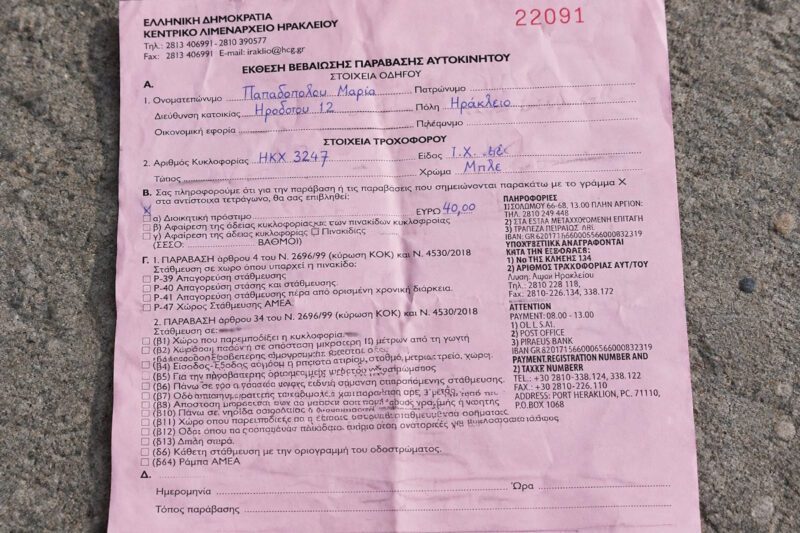
For certain less serious parking offences, the draft proposes a €60 fine without a temporary licence suspension. Examples include parking on safety islands or in spaces designated for charging electric vehicles. More severe penalties would remain for parking on pavements, pedestrian crossings, bus lanes or access ramps for people with disabilities. Where several parking offences occur at once, the most serious would generally be recorded; a further offence could be issued if illegal parking continued for more than three hours.
Drivers using a vehicle without the required licence category would initially lose their licence for one month. After 30 days, they could apply to add the required category, and the suspension would end after they passed any required theory and practical tests. The draft also proposes a €2,000 fine and a 60-day licence suspension for vehicles with number plates that cannot be clearly seen or recognised by enforcement technology.
The proposal specifies where urban speed limits of 30 km/h and 50 km/h would apply, depending on the road’s lanes and whether it has a central divider. It would also allow roadside-assistance vehicles to use the hard shoulder when responding to motorway incidents.
What does this mean for visitors or expats?
These are proposed measures, not confirmation that the rules are already in force. Drivers should continue to follow current signs and requirements, and check whether any changes have been approved before relying on the draft provisions.



