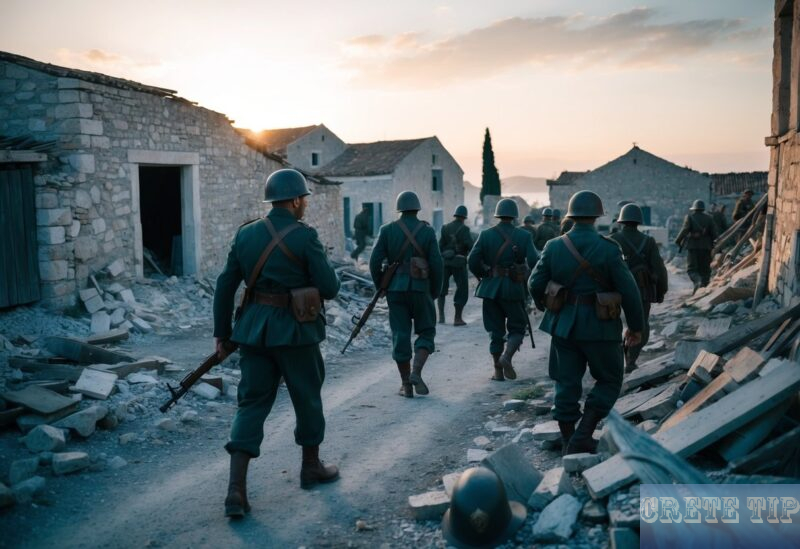
Some events leave a mark on a landscape that never quite fades. In the hills of eastern Crete, a scatter of quiet villages carries one of these marks: three days in September 1943 when German forces killed more than 500 civilians and burned entire communities to the ground.

The Viannos massacre in Crete, September 1943, remains one of the deadliest reprisal actions carried out anywhere in occupied Greece, and its memory still shapes how this part of the island is understood today.
For anyone travelling through the Viannos and Ierapetra areas, or researching Crete’s World War II history in more depth, the events of that September are not a footnote. They shaped villages, families and local memory in ways that are still visible at memorials and museums across the region.
Understanding what happened, and why, helps explain why so many Cretan communities mark this history with such quiet seriousness.

What Happened in Eastern Viannos and Western Ierapetra?

The most recent Greek sources put the number of victims at 401 or 461.
Operations spread from staging points near Ano Viannos into remote mountain communities, leaving devastating destruction behind them.

The Dates, Places and Scale of the Massacre
The executions unfolded across a mountainous stretch of southeastern Crete, between the slopes of Mount Dikti and the Libyan Sea coastline. Villages including Amiras, Kato Symi, Vachos, Kefalovryssi, Pefkos and Krevatas were among those affected, alongside Sykologos, Loutraki, Riza, Kalami, Gdochia and coastal settlements such as Myrtos.
Sources place the death toll at over 500 non-combatants, with figures varying slightly between accounts depending on how later deaths and missing persons are counted. Historical records agree on the scale: this was one of the largest single massacres of civilians on Greek soil during the German occupation, ranking second only to the massacre of Kalavryta on the mainland.

The German Operation of 14–16 September 1943
On September 14, 1943, German troops began moving through the district, executing men and, in some areas, making no distinction by age or sex. Troops from the 22nd Air Landing Division, including the 65th Infantry Regiment, swept through Ano Viannos and neighbouring settlements.
Soldiers from the 65th Regiment carried out the sweeps ruthlessly. Their orders explicitly called for the shooting of all males over the age of 16.
In more remote parts of western Ierapetra, soldiers were told to show no mercy to anyone in the affected villages. Later research has treated this as evidence of the operation’s severity, which went beyond the standard reprisal ratios used elsewhere in occupied Europe.
For several isolated hamlets, the punitive raid became a mass extermination campaign. Entire family lines disappeared alongside the systematic destruction of their homes.
Occupation, Resistance and the Road to Reprisals

The massacre did not occur in isolation. It followed more than two years of foreign rule during the brutal Axis occupation of Greece.
A shift in Axis control from Italian to German hands, together with an escalation in Cretan resistance across eastern Crete during the summer of 1943, set the stage for German reprisals.
Crete After the Battle of Crete
Crete fell to the Axis powers in May 1941 following the Battle of Crete, which had been carried out by German paratroopers to drive out the British troops stationed there. Following the invasion, the island was divided into occupation zones as the German command turned it into Festung Kreta.
Initially, Viannos and the neighbouring Lasithi prefecture came under Italian control. The Italians generally administered their zone less severely than German forces did in areas under direct control.
The relatively lighter Italian presence in the Viannos district gave local resistance networks more room to organise. Villages in the area became known for sheltering fighters and supporting clandestine activity against the occupying powers.
Resistance Groups and the Clash at Kato Symi

Cretan resistance fighters were active across the Viannos region through 1942 and 1943. They worked with British agents from the Special Operations Executive and local andartes to disrupt the occupying forces.
Although nationwide organisations such as EAM and its armed wing ELAS shaped Greek resistance, Crete often relied on independent regional networks. A prominent partisan band operated under Manolis Bandouvas, who coordinated ambushes against German patrols.
Tensions reached their peak in Kato Symi – also spelled Kato Simi – where Cretan partisans led by Manolis Bandouvas clashed with German troops after they had previously ambushed and murdered two German sentries on the south coast.
There are no clear sources regarding the exact German casualties during the raid; only the two sentries murdered earlier and the twelve Germans taken prisoner are mentioned, alongside the remark that the German unit suffered heavy losses (between 40 and 200 men). If just over 50 German soldiers were killed, this would account for the figure of at least 500 civilians subsequently killed in retaliation, as a ratio of ten to one was usually applied.
The guerrilla warfare, which contravened international law, prompted the German commanders to launch punitive expeditions between 14 and 16 September 1943.
The Italian Armistice and German Control of Eastern Crete

Italy’s surrender to the Allies on 8 September 1943 transformed the military situation on Crete within days. Italian units stationed on the island suddenly found themselves without clear orders. Some surrendered to German forces, while others tried to join Cretan resistance groups or sought evacuation altogether.
German forces moved quickly to fill the vacuum left by the Italian collapse, taking direct control of areas including Viannos and Ierapetra that had previously experienced lighter Italian administration. Securing the southern coastline of Festung Kreta became an urgent priority for German commanders worried about Allied naval movements.
This transfer of control came just days before the massacre. It placed the district under a German command structure prepared to respond to resistance activity with far greater force than the Italians had shown.
Martial Law, Partisans and Collective Reprisal

For the German occupying forces, resistance attacks in the vicinity of Kato Symi – which contravened international law – was as the trigger for a large-scale punitive operation carried out under martial law. Across occupied Europe, this framework allowed commanders to order reprisal killings against civilian populations in areas where resistance activity had occurred, regardless of individual guilt.
How Occupying Armies Framed Irregular Warfare
Military doctrine during World War II treated resistance fighters as illegitimate combatants outside the protections of conventional warfare. Commanders used this time-honoured customary law of war to justify operations against entire communities suspected of harbouring or supporting partisans, rather than directly pursuing individual fighters – which, given the conditions of war and limitations, was mostly a lost cause anyway.
From the mid-18th century to the present day, the central principle on which everything else is based is that the military constitutes an independent legal entity which, amongst all state organs, is the only one authorised to wage war.
Under modern international law, persons who do not belong to the armed forces or are not subject to a corresponding established authority are not permitted to take up arms, fight or offer resistance in any way.
At the Nuremberg Trials, the court concluded that, under the laws of war in force at the time (Hague Convention No. IV of 1907), the partisans in south-eastern Europe could not be regarded as lawful belligerents within the meaning of Article 1 of that Convention – namely, as part of the armed forces or another corresponding established authority.
This doctrine was applied with particular severity in Crete, where the island’s rugged terrain and strong local support for the Cretan resistance had frustrated occupying forces since 1941.
Across the fortified garrison of Festung Kreta, military authorities treated any civilian cooperation with guerrillas as an existential danger that warranted harsh retaliation.
Why Reprisals Followed Attacks on Occupying Soldiers
Attacks on German personnel, including the clash at Kato Symi, triggered a standard occupation-era response: German reprisals calculated as a multiple of the occupying casualties. Commanders on Crete, including General Friedrich-Wilhelm Müller, ordered operations intended to punish entire districts rather than identify those directly responsible for specific attacks.
The scale of the Viannos operation, spanning around 20 villages over three days, reflects this collective approach rather than a targeted pursuit of individual resistance fighters.
Reprisals against the enemy civilian population had been customary law for centuries, although no generally accepted ‘quotas’ existed. In the Wehrmacht, commanders usually assumed a quota of 10 civilians for every soldier killed. French troops in southern Germany, for example, shot four civilians for every soldier in 1945.
In the Red Army in eastern Germany in 1945, standard practice under Zhukov’s orders treated all civilians present in the combat zone as partisans. Soldiers could shoot them.
As regards the taking of hostages, the Nuremberg Tribunal concluded that, under certain circumstances, taking hostages and even carrying out retaliatory executions could constitute a permissible response to guerrilla attacks. In the Tribunal’s view, however, several conditions applied to taking hostages and killing them in retaliation.
The tribunal also noted that both the British Manual of Military Law and the US Basic Field Manual (Rules of Land Warfare) permitted retaliatory measures against civilians. The British manual did not mention killing, but the US manual included it as a possible form of retaliation.
In its reasoning for the judgement, the court stated that it was not authorised to create new international law but had to apply existing law. The practice of killing hostages was described as a ‘barbaric relic’ in the law of war.
In the Geneva Convention of 12 August 1949 relative to the Protection of Civilian Persons in Time of War, customary law on hostage-taking was finally removed from the list of permissible reprisals.
Destruction, Loss and Responsibility

The three days of killing in September 1943 left a trail of executed civilians, looted homes and burned villages across the Viannos and Ierapetra districts.
The destruction deepened the human loss, stripping surviving families of shelter, stored food and upcoming harvests. Without basic resources, many displaced villagers faced severe famine and exposure as winter approached.
Executions, Looting and Burned Villages

Soldiers from the 65th Infantry Regiment moved from village to village, rounding up men and executing them, often in front of remaining family members. They looted homes before setting them alight, and destroyed or took livestock and stored crops, leaving little for those who survived.
Around 20 villages were affected during the operation. In Amiras alone, soldiers executed 117 male residents, a figure that gives some sense of the concentrated loss experienced by individual communities within the wider massacre.
Neighbouring settlements such as Kefalovryssi and Pefkos also suffered severe devastation. They lost dozens of civilian lives while troops burned homes and storehouses to ash.
Villages such as Sykologos and Loutraki endured heavy losses of life and property. In western Ierapetra, settlements including Malles, Mournies and Gdochia suffered devastating executions and destruction.
Further south, troops swept across the coastal zone and reduced the seaside village of Myrtos to ruins. Hamlets such as Riza and Kalami faced severe devastation as well, with German units executing civilians and burning homes.
Friedrich-Wilhelm Müller and Post-War Accountability

German General Friedrich-Wilhelm Müller ordered the mass executions and village destruction carried out during the operation. Known to history as the Butcher of Crete, Müller commanded the 22nd Infantry Division, formally known as the 22nd Luftlande Infanterie-Division, under island commander Bruno Bräuer.
Müller bore direct operational responsibility for the brutal reprisals across Viannos and western Ierapetra.
After the war, a Greek military tribunal tried Müller and Bruno Bräuer for war crimes committed on Crete. Both men were convicted and executed in Athens in 1947, providing a measure of legal accountability for the wartime atrocities.
Even so, authorities never formally identified or tried many of the individual soldiers who carried out the mass executions.
Amiras and the Living Memory of Viannos

Amiras stands today as the centre of remembrance for the Viannos massacre, home to both a memorial and a small museum dedicated to preserving this history. Set at 680 metres on the southern slopes of Mount Dikti, the village lost 117 male residents in the September 1943 killings.
The Viannos Massacre Memorial at Amiras
The Panprovincial Memorial at Seli, near Amiras, commemorates victims of the wider massacre across the Viannos district. The site displays photographs of victims, including some children, alongside inscriptions listing those killed in September 1943.
Local communities hold annual commemorative events at the memorial. These gatherings show that the history remains part of local life, not a closed historical episode.
Mousío Olokavtómatos Viánnou
The Mousío Olokavtómatos Viánnou, the Museum of the Holocaust of Viannos, stands near the memorial site at Meliana, close to Amiras. In Greece, people widely know the tragedy as the Viannos Holocaust.
Local memory uses the term holocaust to describe these events. The word reflects the scale and deliberate nature of the destruction, rather than suggesting a direct historical parallel with the Holocaust of European Jews.
The museum holds photographs, personal items and documentary material about the massacre. Together, these materials offer visitors a focused account of what happened in the surrounding villages.

Visiting a Place of Remembrance Respectfully
Approach the Amiras memorial and museum as places of mourning for a local community, not as general tourist attractions. Quiet, respectful behaviour is appropriate, and visitors should consider photography carefully because of the personal nature of the images and names on display.
Local residents across Ano Viannos, Amiras and the surrounding hamlets still carry direct family memories of these events. Visitors researching this history, including through detailed accounts published on sites such as CreteTip, should treat a visit as an act of remembrance rather than a stop on a sightseeing itinerary.
Why the Memory of Viannos Endures
The Viannos massacre endures in local memory because it touched nearly every family across a cluster of close-knit mountain communities. These losses aren’t distant statistics. People still name them, connect them to specific villages and mark them each year, often through descendants who continue to live in the area.
More than 500 civilians died and around 20 villages burned within three days, placing Viannos among the most severe reprisal actions of the German occupation of Greece. Historians often compare it with the massacre of Kalavryta on the mainland, since both followed a similar logic of collective punishment against entire districts.
Other communities across the island faced comparable tragedies. The pattern began early, when German paratroopers razed Kandanos in 1941. Later massacres in villages such as Kallikratis and Kali Sykia showed the brutal reach of collective punishment throughout Crete.
Post-war accountability came through the trial and execution of General Müller, the Butcher of Crete, and offered a measure of formal justice. It could never restore what individual families had lost in the massacres.
The community continues to maintain the Amiras memorial and the Mousío Olokavtómatos Viánnou. That work keeps this history visible instead of allowing it to fade with the generation that lived through it.
For visitors exploring the Viannos region today, olive groves and quiet stone villages stand alongside these sites of memory. Reading the history before visiting helps explain why these places receive such careful, deliberate commemoration.
Frequently Asked Questions

What was the Viannos massacre?
The Viannos massacre, often called the Viannos Holocaust, was a series of reprisal killings carried out by German Wehrmacht forces against civilians in around 20 villages across eastern Viannos and western Ierapetra, Crete, between 14 and 16 September 1943.
German troops executed men and boys, burned homes, and destroyed crops and livestock across the affected districts.
How many people were killed in the Viannos massacre?
Historical accounts place the death toll at more than 500 civilians, though exact figures vary slightly between sources. The executions focused on around 20 villages, with Amiras alone losing 117 male residents.
Why did German forces carry out reprisals in Viannos?
German commanders ordered the operation in response to resistance activity in the district, including a clash between resistance fighters and occupying troops at Kato Symi. The reprisals followed the collapse of Italian control after Italy’s armistice on 8 September 1943, when German forces took direct command of the area.
Where is the Viannos massacre memorial in Crete?
The main memorial, the Panprovincial Memorial, stands near Meliana, close to the village of Amiras, in the Viannos municipality of Heraklion regional unit. The site lies just east of Ano Viannos on the southern slopes of Mount Dikti, surrounded by olive groves.
What is the Mousío Olokavtómatos Viánnou?
The Mousío Olokavtómatos Viánnou is the Museum of the Holocaust of Viannos, located near the memorial site at Meliana. It holds photographs, personal items and documentary material relating to the September 1943 massacre and its victims.
Who was responsible for the Viannos massacre?
German General Friedrich-Wilhelm Müller ordered the mass executions and village destruction during the operation. Forces including the 65th Infantry Regiment carried out those orders on the ground. Known as the Butcher of Crete, Müller later faced trial for war crimes committed on Crete and was executed in Athens in 1947.