

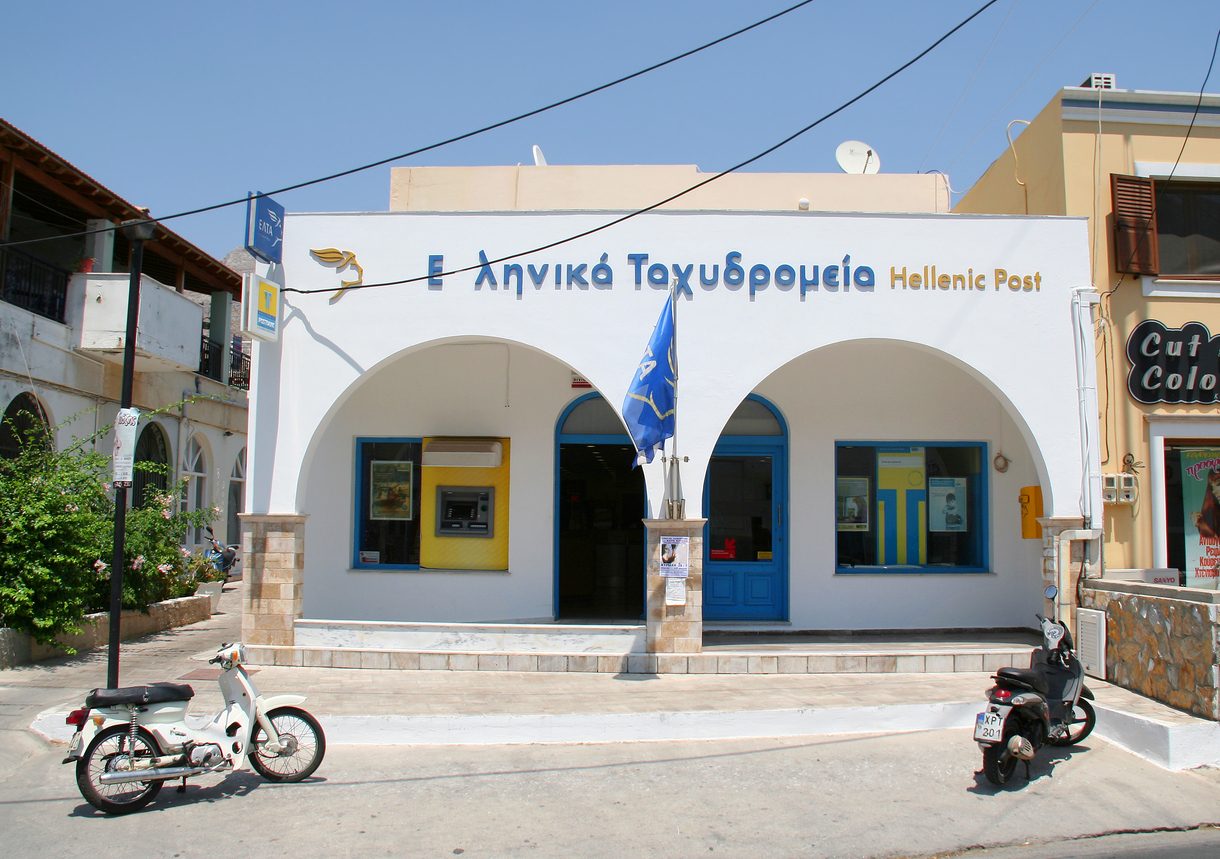
What is the situation regarding the use of Greek postal services? Local resistance to the numerous planned closures, including in Elounda and Neapoli, and the threat of bankruptcy facing Hellenic Post (ELTA).
More than thirty years ago, the Eastern Bloc collapsed. At that time, M. left her remote village in the mountains of Bulgaria and set off on the long journey to Greece to work as a cleaner.
For her, the postal service was not just a service, but in a sense the state itself. Her village was closely connected by the postman, who came once a month.
When he suddenly stopped coming, she felt that an era had come to an end. That may sound dramatic, but that’s how it was.
Today, in 2025, Greece and Bulgaria can hardly be compared to the early 1990s. Digitalisation has turned communication on its head.
The closure of 204 post offices in Greece has reignited the debate about the importance and volume of postal services. Politicians claim that the volume of mail has declined significantly.
Upward trend in postal services
Postal services in Greece have been growing for years. In 2023, total revenue was €729 million, an increase of 11.3% compared to 2022.
The number of items transported also rose to 316 million, 2% more than in the previous year.
Key figure | Value 2023 | Change compared to 2022 |
|---|---|---|
Revenue (in millions of euros) | 729 | +11.3% |
Shipments transported | 316 million | +2% |
Revenue from postal services has increased by almost €200 million since 2015. Parcel volumes and employment figures are also rising steadily.
Universal services, especially those provided by ELTA, are showing a decline. This is hardly surprising given the extent to which the industry is changing.
Traditional letter correspondence is declining due to digital communication. Nevertheless, people still send a lot of letters – around 71% of all postal items are envelopes.
In the area of universal services, 79% of ELTA’s work is accounted for by these mandatory tasks. That is quite a lot.
Courier services, on the other hand, are currently experiencing a boom. Around 720 companies are now active in the courier market, and e-commerce is growing rapidly.
This is causing a significant shift from traditional retail to online shops. Who would have thought that twenty years ago?
Important points at a glance:
- Steadily increasing sales and parcel volumes
- Decline in universal services, especially at ELTA
- Courier services as a growing and lucrative market
- 71% of shipments are still letters
- 42.3% of private households received personal mail in 2019
Requiem for Greek postal services
The use of postal services in Greece has changed considerably. Many people consider services such as pension collection or proximity to a post office to be of little importance – somewhere between 2.4% and 4.5%.
However, the situation is quite different in rural areas. There are simply fewer alternatives there.
In regions with very low population densities, the authorities make exceptions to the so-called universal service. Private individuals and companies often collect their post from other locations.
64.3% of private customers and 85.7% of companies are happy with this arrangement. However, 35.7% of private customers and 14.3% of companies have problems as a result – they report losses and delays in their shipments.
Many users would like to see more staff in post offices, shorter queues and longer opening hours. The branches themselves score 4.38 out of 5 points – which speaks for the dense branch network.
Important facts at a glance
Topic | Value/share |
|---|---|
Importance of proximity to the post office (general) | 2.4% – 4.5% |
Private customers with no problems in exceptional cases | 64.3% |
Companies with no problems in exceptional cases | 85.7% |
Customers who want more staff | High (no exact figure) |
Satisfaction with the post office network | 4.38 out of 5 |
The number of letters and communications is declining, but they remain important nonetheless. Parcels, on the other hand, are growing significantly, mainly due to online shopping.
The parcel business operates independently of universal postal services. Around 720 companies are involved, and it’s worth it – traditional postal services tend to make losses.
The cost of parcel delivery is rising faster than the number of parcels. As a customer or business owner, you notice this immediately in your wallet.
The branch network continues to influence the relationship between citizens and the postal service. Before the management was restructured, customer behaviour in branches was a major issue.
For many, the post office remains the visible point of contact with the organisation. Whether this will remain the case depends on how everything develops.
Challenges at a glance
- Declining letter mail: Fewer letters mean less revenue.
- Rising parcel costs: Shipping is becoming more expensive, which is putting pressure on customers.
- Regional differences: Rural areas are less well served.
- Staff shortages: Too few employees lead to long waiting times.
- Opening hours: Users would like longer opening hours.
Intervention by the Mayor of Agios Nikolaos to preserve the ELTA branches in Neapoli and Elounda

Manolis Menegakis, the mayor of Agios Nikolaos, is clearly committed to preserving the Greek post offices (ELTA) in Neapoli and Elounda.
He is offering to provide municipal premises on a temporary basis so that the branches can continue to operate.
In doing so, he wants to ensure that these important services for residents do not simply disappear.
These post offices are indispensable, especially for older people living in remote areas and small businesses.
If the branches close, it will have a significant impact on the daily lives of these groups.
The mayor emphasises:
- The city is working closely with ELTA management and other authorities.
- They want to find solutions that work not only in the short term, but also in the long term.
- The initiative is not pursuing commercial interests, but aims to save public services.
- This cooperation is intended to ensure that postal services remain part of social life.
Key issues | Details |
|---|---|
Aim of the intervention | Preservation of the ELTA branches in Neapoli and Elounda |
Mayor’s offer | Temporary provision of municipal premises |
Importance of post offices | Services for senior citizens, rural areas, businesses |
Cooperation | Close coordination with ELTA management and authorities |
No commercial objectives | Focus on social and public services |
The city is currently reviewing various municipal properties that might be suitable for the post office.
Discussions with ELTA and the authorities are ongoing, but it remains to be seen how quickly everything will work out.
The aim is to keep residents regularly informed about how the measures are progressing.
The whole initiative comes after repeated media reports of possible closures or mergers of ELTA branches across the country.
The municipality is responding quickly and trying to minimise the impact on local people.
Links and sources: Anatolh
If ELTA is not restructured, it will be closed in favour of private interests

Prime Minister Mitsotakis says quite clearly that the postal company ELTA is currently facing a real challenge.
Without a clear restructuring plan, the company will go bankrupt and be shut down. In the end, private interests will benefit from this.
He makes no secret of the fact that opponents of the restructuring plan are actually playing into the hands of private actors.
This shows how urgently ELTA needs to reorganise its operations.
The nature of postal services has changed. Of course, ELTA’s network must somehow keep up with this.
Regional characteristics play a role, especially in rural areas.
The goal is to reduce the network while still creating alternatives. No one should be left without postal services.
People in peripheral areas in particular should not feel left behind.
The Ministry of Economic Affairs is working with the supervisory fund to find a solution.
They intend to present a plan in the coming months. Technical problems such as restrictions on state support for ELTA are on the agenda.
EU legislation also plays a role. It makes it possible to house post offices in other facilities.
Perhaps ELTA branches will appear in places such as citizens’ offices in the future. Who knows?
Mitsotakis believes that the planned restructuring needs to be discussed openly on the ground.
You really have to look at each branch individually to see how the service can continue.
Topic | Statement |
|---|---|
Necessity of restructuring | Without restructuring, there is a risk of insolvency and closure in favour of private interests |
Opponents of restructuring | Indirectly support private competitors |
Adaptation to new requirements | Network must be adapted regionally and flexibly |
Alternative solutions | No one should be left without postal services, even in remote regions |
Cooperation | Ministry of Economy and supervisory fund are working on a plan |
Legal restrictions | ELTA cannot receive certain types of state aid |
EU legislation | Allows new forms of branch integration |
Public discourse | Discussion at local level is necessary |



