

Newsflash from Saturday, 9 May 2026:

1 in 4 Greeks at Risk of Poverty: New Data Ranks Greece Among EU’s Worst Performers
The economic landscape in Greece remains a significant challenge for millions of citizens. According to the latest data from Eurostat, the statistical office of the European Union, more than one in four people in Greece faced the risk of poverty or social exclusion in 2025.
With a staggering 27.5 percent of the population affected—roughly 2.8 million people—Greece now holds the somber title of having the second-highest poverty risk rate in the entire European Union.
A Closer Look at the Numbers
The Eurostat report highlights a stark contrast between Greece and its European neighbors. While the broader EU average for poverty risk sits at 20.9 percent, Greece’s figures are significantly higher.
Only Bulgaria recorded a worse performance, with 29.0 percent of its population at risk. On the other end of the spectrum, countries like Czechia (11.5%), Poland (15.0%), and Slovenia (15.5%) reported the lowest rates, showcasing a widening gap in social stability across the bloc.
What Defines “At Risk”?
Eurostat’s indicator isn’t just about income. To be considered at risk of poverty or social exclusion, a household must meet at least one of three specific conditions:
1. Income poverty (living below the poverty threshold).
2. Severe material and social deprivation (inability to afford basic goods or services).
3. Very low work intensity (households where adults work very little).
Who is Most Vulnerable?
The data reveals that the burden of poverty is not shared equally. Specific demographics in Greece and across the EU are facing much higher levels of exposure:
* Gender: Women are at a higher risk (21.9%) compared to men (19.8%).
* Age: Young adults aged 18 to 24 are the most vulnerable age group, with 26.3 percent at risk. Children under 18 follow closely at 24.3 percent.
* Education: Perhaps the most significant factor is educational attainment. More than one-third (34.2%) of adults with low education levels are at risk, compared to just 10.3 percent for those with higher education degrees.
In 2025, 92.7 million people in the EU (20.9% of the population) were at risk of poverty or social exclusion.
Highest shares in:
🇧🇬Bulgaria (29.0%)
🇬🇷Greece (27.5%)Lowest in:
🇨🇿Czechia (11.5%)
🇵🇱Poland (15.0%)Read more 👉 https://t.co/qPZUmHMhD3 pic.twitter.com/fOZ83AgslD
— EU_Eurostat (@EU_Eurostat) April 30, 2026
The Path Forward
While the EU as a whole saw a modest improvement—with the total number of people at risk declining by about 600,000 year-over-year—Greece’s position remains precarious. The data underscores the urgent need for targeted social policies and economic reforms to protect the country’s most vulnerable populations, particularly the youth and those with limited access to higher education.
As Greece continues to navigate these turbulent economic waters, the 2025 Eurostat report serves as a wake-up call for policymakers in Athens and Brussels alike.
A Tale of Two Greeces: Ultra-Wealthy Population Skyrockets Amid Poverty Crisis

Greece is currently witnessing a staggering economic paradox. While a significant portion of the population struggles to make ends meet, the number of ultra-wealthy individuals in the country has reached historic highs.
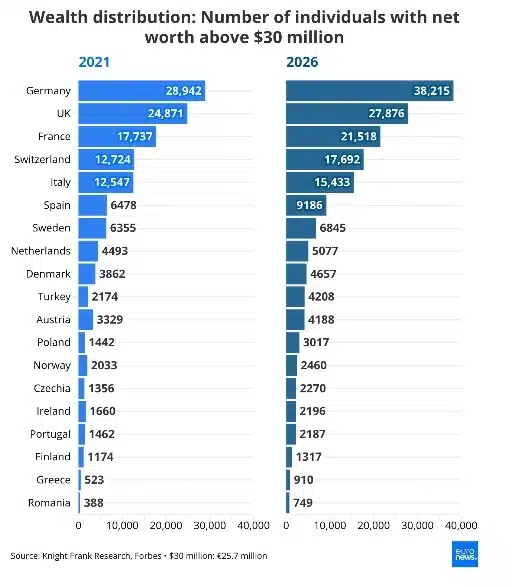
According to the 2026 Knight Frank Wealth Report, the population of Ultra-High Net Worth Individuals (UHNWIs)—defined as those with a net worth of at least $30 million—has surged to 910 in Greece. This represents a massive 74% increase from the 523 individuals recorded just five years ago in 2021.
The Rapid Rise of the Greek Elite
Greece’s 74% growth rate in the ultra-wealthy category places it firmly among the world’s high-growth nations. While established economies like the UK and Sweden saw modest gains of 12% and 8% respectively, Greece is following a trend seen in emerging markets.
For comparison, other high-growth countries include:
* Poland: 109% increase
* Turkey: 94% increase
* Romania: 93% increase
In absolute numbers, Germany remains Europe’s wealth heavyweight with over 38,000 ultra-wealthy residents, but the speed at which Greece’s top tier is expanding is turning heads globally.
The Stark Reality: 1 in 4 Greeks at Risk
The surge in private wealth stands in sharp contrast to the lived reality for millions of Greek citizens. Recent data from Eurostat reveals that more than one in four people in Greece face the risk of poverty or social exclusion.
This ranking places Greece among the worst performers in the European Union, highlighting a widening wealth gap that persists despite the country’s broader economic recovery. While the “Old Continent” as a whole is seeing a rise in wealth—with Europe hosting nearly 26% of the world’s 710,000 ultra-rich—the benefits are clearly not reaching all levels of society equally.
Why is the Wealth Gap Widening?
Experts suggest that global wealth mobility is a primary driver of these shifts. Liam Bailey, Head of Research at Knight Frank, notes that we are seeing a significant shift in how wealth is distributed globally.
As individuals navigate rising tax burdens and regulatory pressures in traditional hubs, they are seeking more favorable financial environments. This mobility, combined with high-growth investment sectors, has allowed a small segment of the population to accumulate wealth at an unprecedented pace.
A Growing Divide
The data paints a picture of a “K-shaped” recovery in Greece: one arm of the economy is reaching new heights of prosperity, while the other remains anchored by the threat of poverty. As the number of millionaires continues to climb, the challenge for Greek policymakers remains the same: ensuring that economic growth translates into a better quality of life for the 25% of the population currently left behind.
What are your thoughts on Greece’s widening wealth gap? Is the surge in ultra-wealthy residents a sign of economic strength, or a symptom of a deeper inequality? Share your perspective in the comments below.
Source: Greek Reporter & Greek Reporter



