

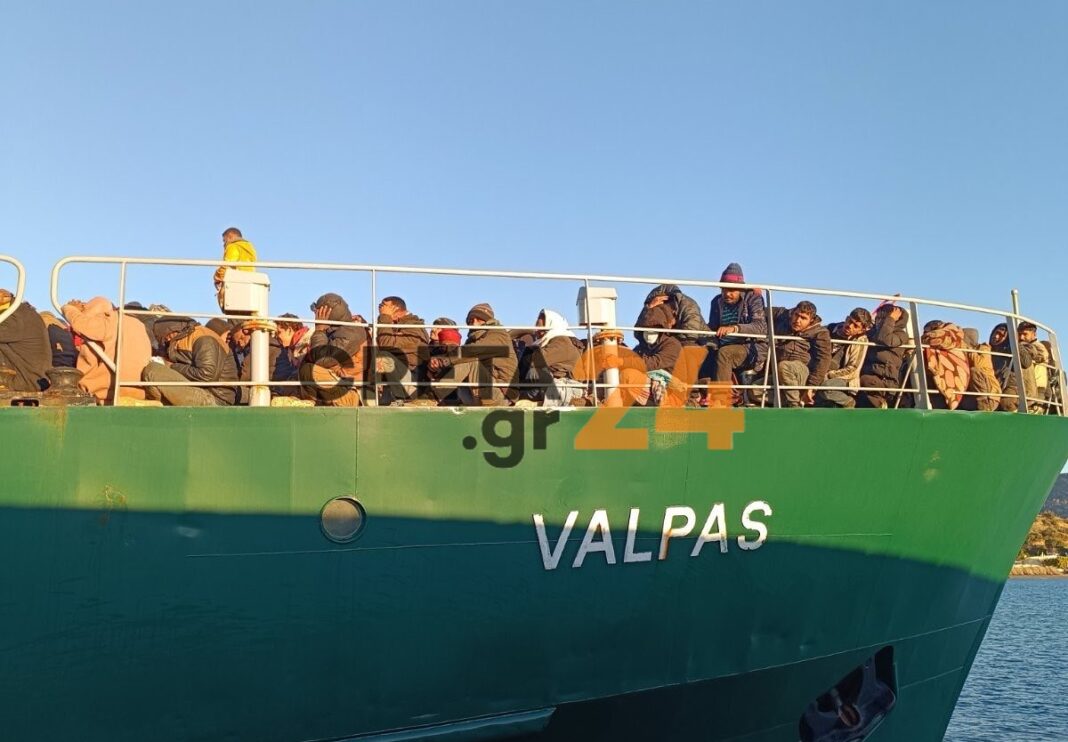
Newsflash from Tuesday, 23 December 2025: Crete Under Pressure – The staggering increase in migrant arrivals in 2025. This morning, another 69 people landed on a beach on Gavdos.

As 2025 draws to a close, Crete is facing an unprecedented rise in migration flows, placing enormous strain on local authorities, the Coast Guard, and island communities. What was once a secondary route has now become one of Greece’s main gateways into Europe, with numbers that have shocked even experienced officials.
Record-Breaking Numbers in Just One Year
According to official figures, nearly 19,000 migrants arrived in Crete in 2025. This represents a dramatic increase of around 370% compared to 2024, when total arrivals stood at approximately 5,000.
In practical terms, local authorities were forced to manage about 14,000 more arrivals than the previous year, stretching infrastructure and emergency response systems to their limits.
On some days, the scale of arrivals was staggering. In one 24-hour period alone, seven separate landings were recorded, from Heraklion to Gavdos. The most significant incident occurred south of Rethymno, where 539 migrants were detected in a single operation.
Three Major Crises Defined 2025
The president of the Union of Coast Guard Personnel of Western Crete identified three critical moments that defined the year:
– July Crisis: Around 2,000 migrants arrived within just 24 hours, overwhelming reception and rescue capabilities.
– September Crisis: Approximately 1,200 people were housed in a temporary facility in Agia, described as a warehouse-like space, where overcrowding led to tensions and clashes.
– Recent Tragedies: Two shipwrecks near Chrysi and Gavdos resulted in dozens of dead and missing, highlighting the most tragic face of the migration phenomenon.
These incidents underscored the growing risks associated with the opening of new sea routes and Crete’s emergence as a primary entry point into Greece.
Exhaustion on the Front Line
Coast Guard personnel have been operating under relentless pressure. Continuous rescue missions, combined with the responsibility of managing large numbers of arrivals, have led to severe exhaustion among crews.
Officials stress that while migration management is critical, public safety for local residents must also be maintained. Despite the sharp rise in arrivals, reinforcements and resources have not increased at the same pace.
In a telling remark, Coast Guard representatives admitted that when weather conditions worsen, arrivals temporarily slow. “We hope for bad weather just to catch our breath,” one official stated — a reflection of the intensity of the situation.
A Challenge with No Easy Answers
The migration surge of 2025 has exposed structural weaknesses in reception facilities, emergency planning, and staffing levels on the island. Crete’s geography, once considered a buffer, is now a frontline.
As winter approaches, questions remain about long-term solutions, stronger support for frontline services, and coordinated national and European responses.
What is clear is that 2025 will be remembered as a turning point — the year Crete found itself at the center of one of the most intense migration challenges in its modern history.
Another 69 migrants landed on the coast of Gavdos this morning. At noon, they are expected to be transported by ferry to Paleochora and then to Agyia.



