

Newsflash from Wednesday, 6 May 2026:

From Obsession to Murder: How a Father’s Grief Became a Killing Spree That No One Could Stop
In the quiet streets of Heraklion, Crete, a tragedy unfolded that authorities saw coming—yet failed to prevent. The case of a 54-year-old man’s obsessive vendetta, culminating in the execution-style murder of a 21-year-old innocent, raises haunting questions about the justice system’s ability to protect victims from predictable violence.
A Father’s Descent Into Darkness
The story begins with loss. In 2024, a 17-year-old boy died in a car accident. His father, a 54-year-old man, couldn’t accept what had happened. He couldn’t move forward. Instead, he fixated on one detail: the driver of that fateful vehicle was his son’s friend, a young man named Nikistrato.
In December 2024, the 54-year-old was released on restrictive terms following accusations of attempted murder against Nikistrato. Court-imposed conditions explicitly forbade him from approaching the young man in any way.
But grief had transformed into something darker—an unshakeable obsession.
A System That Saw the Danger But Did Nothing
Over the months that followed, warning signs multiplied. The victim’s family desperately tried to protect themselves through:
– Formal complaints to authorities
– Multiple lawsuits filed against their aggressor
– Protective measures and restraining orders
– Repeated police reports documenting escalating threats
“The life of the unjustly wronged Nikistrato and his family were lived in an endless nightmare,” explained Alexandra Spanaki, the attorney representing the victim’s family, to Cretalive. “The criminal behavior displayed repeatedly against Nikistrato and his family—who desperately tried to protect this child from the sickness and obsessive behavior of the 54-year-old—provokes shock and intense insecurity.”
Yet despite these documented warnings, the system failed.
The Crime Everyone Feared
On what would become a fateful day in May 2026, the 54-year-old took his wife and got into a car. He was no longer bound by restraint or reason. The obsession had reached its breaking point.
In the Ammoudara area, he intentionally rammed his vehicle into Nikistrato’s car. When the young man tried to escape—trying desperately to run, to save himself—the 54-year-old pulled out a revolver.
Six shots fired.
Four bullets found their mark.
Nikistrato collapsed onto the pavement, bleeding out in the street. Another life destroyed. Another family shattered.

A Wife’s Complicity
The suspect claims he and his wife were returning from a cemetery visit to commemorate another young relative who had died in a traffic accident years prior. However, she is now under arrest as an accomplice for being present in the vehicle during the execution.
The Questions That Haunt Us
This case exposes a critical failure in the justice system:
– How many warnings were ignored? The family had gone to court repeatedly, fearing exactly what happened.
– Why were protective measures not enforced? The 54-year-old allegedly violated his restraining order repeatedly without serious consequences.
– What happens when obsession isn’t treated as a mental health crisis? Loved ones noticed his deterioration—friends and family said he was “unrecognizable,” consumed by his grief-turned-hatred.
– Could this have been prevented? Every indicator suggests it could have been.
A Year of Stalled Justice
Adding insult to tragedy, the case involving the original car accident has been stuck in preliminary investigation for over a year. No progress. No closure. No justice for the family of the deceased teenager.
The victim’s mother captured the despair perfectly when asked about her case at the courthouse: “Nothing. Absolutely nothing.”
The Aftermath
Now, investigators from the Heraklion Security Division are painstakingly reconstructing the bloody scene through:
– Witness testimony
– Video footage
– Documentary evidence from the case file
– Prior complaints and reports
But reconstruction cannot bring back the dead.
What makes this murder particularly chilling is that **it wasn’t random. It wasn’t unexpected. It was warned about, reported, and documented—yet still, it happened.**
As Alexandra Spanaki stated: “This is a murder that appears to have been premeditated and pre-announced. A murder that the victim and his family tried to prevent, but failed. A murder that was not prevented even by the environment of the 54-year-old, as they saw his gaze darkening more each day.”
What Now?
Authorities are now investigating what preceded the execution. The evidence will be weighed against the historical record: the complaints, the lawsuits, the restraining orders, and the desperate pleas for protection that came too late.
For the grieving families on both sides—one robbed of a teenager, the other of an innocent young man—justice feels like a distant promise that the system couldn’t deliver.
This case serves as a sobering reminder that recognizing danger and preventing it are two very different things. The question Crete is asking itself now is: Why couldn’t the system do both?
The answer to this question is quite simple: because in Crete, there is hardly any enforcement against threats or breaches of court orders (such as restraining orders). Shortly afterwards, the perpetrator is back on the streets and the whole cycle starts all over again.
Even after an attempted murder, the perpetrator is not consistently locked up or banished from the island, and the victim remains exposed to the threat. Furthermore, many perpetrators are psychologically disturbed, as there is insufficient medical diagnosis and treatment for mental illness in Crete.
Moreover, the widespread and unrestricted possession of illegal firearms means that murder weapons are readily available – both for acts of impulse and for premeditated crimes.
Shots Fired in Messara: Deputy Mayor Among Arrested After Violent Dispute Over Crop Damage
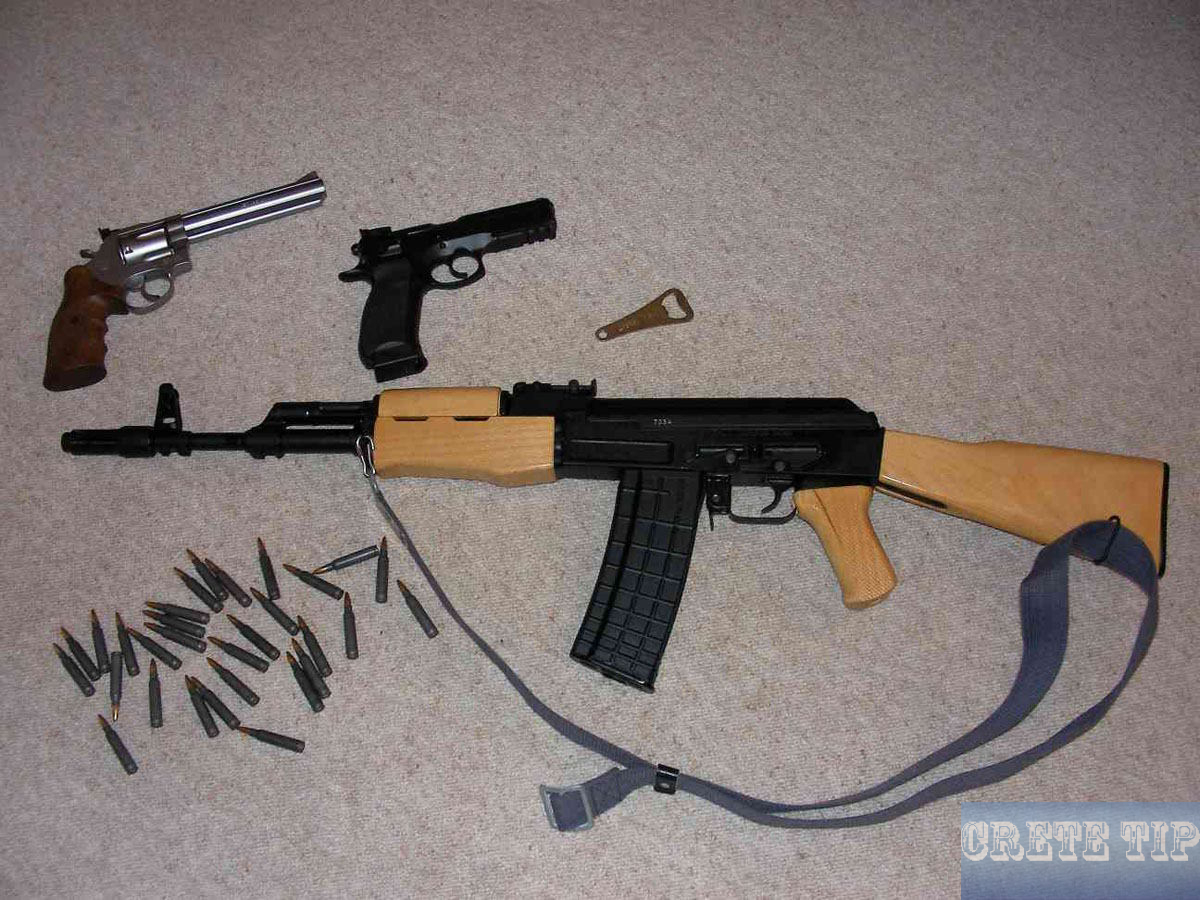
A routine meeting to resolve a local dispute turned into a scene of chaos and violence on Tuesday afternoon in the Messara region of Crete. The incident, which took place in the Kapariana area, involved physical brawling and gunfire, leading to the arrest of four individuals—including a local deputy mayor.
A Meeting Gone Wrong
The confrontation reportedly began as a scheduled “rendezvous” to discuss agricultural damages caused by livestock. In rural Crete, disputes over animals damaging crops are common, but this particular meeting quickly spiraled out of control.
What was intended to be a discussion escalated into a heated argument, followed by a physical altercation. Witnesses describe a “wild episode” where participants traded punches before weapons were drawn.
A Narrow Escape
The situation turned life-threatening when shots were fired. According to reports from the scene, the violence reached a terrifying peak when a bullet passed “grazingly” close to a participant’s boot.
While no one was hit by gunfire, the physical brawl left several people with minor injuries. Sources indicate that at least one individual was struck with a heavy blow to the back of the neck during the hand-to-hand combat.
Arrests and Legal Fallout
Authorities acted quickly following the disturbance. Police have confirmed that four men were arrested in connection with the incident. Among those taken into custody is a deputy mayor of the region, a development that has sent shockwaves through the local community.
The suspects are facing various charges related to the physical assault and the illegal use of firearms.
The Growing Tension in Rural Crete
This incident highlights the volatile nature of “agrozimies” (agricultural damages) in Crete, where long-standing tensions between farmers and livestock herders can occasionally erupt into violence. However, the involvement of a public official and the use of firearms in broad daylight has raised serious concerns about public safety and the rule of law in the region.
Local authorities are continuing their investigation into the exact sequence of events that led to the escalation.



