

Construction of the Northern Road Corridor of Crete (BOAK) between Hersonissos and Neapoli–Agios Nikolaos is making real progress, but it is not without its problems. Long twin-tube tunnels, shorter tunnels, bridges and other large structures are being built in several places.

The twin tunnel at Selinario is quite a special case because the ground is loose and groundwater is constantly pushing in.
Engineers report heavy water ingress in some sections. This forces them to constantly adapt their construction methods and install additional supports.
Nevertheless, work is continuing – and progressing rapidly, according to the experts. Well, at least most of the time, everything seems to be under control.
Visit to the Chersonissos–Neapoli section

Recently, around 40 members of the Technical Chamber visited the section. Another inspection of Chersonissos–Neapoli is scheduled for next Saturday.
The following week, they plan to visit the TERNA construction site, i.e. the new airport in Kastelli. The chairman of the East Crete Chamber of Commerce, Michalis Chorafas, gave a fairly positive assessment of the progress made.
He emphasised the professional approach and said that everyone is complying with the safety regulations. However, during the inspection, the issue of expropriations was also raised, along with questions about how the project will ultimately function.
Progress is also being made on the Neapoli–Agios Nikolaos section. The project involves a large number of technical structures: eight bridges and five overpasses.
However, many of these have not even been started yet. What is worrying is that the four planned junctions in Agios Nikolaos, Neapoli, Lakonia and Limnes are still open.
Will the junctions be completed in time before the new international airport in Kastelli opens? Some are sceptical.
The construction sites for the junctions do not yet exist because the expropriations are simply not progressing. This is blocking everything and disrupting the schedule.
Another contentious issue is the Chersonissos–Neapoli section, which is being run as a public-private partnership. There is no proper side road network here, which is unusual for such an expressway project.
The lack of side roads could really limit local accessibility. In contrast, a larger network of side roads is planned for the Neapoli–Agios Nikolaos section, which is being run as a state project.
These differences are causing discussion among the engineers. Some believe that this will result in unequal access conditions for users and residents.
Here are a few observations from the inspection, summarised in a nutshell:
- Participants: approx. 40 members of the Technical Chamber.
- Next dates: repeat inspection of Chersonissos–Neapoli and Kastelli Airport.
- Safety standards: Construction work is being carried out under strict safety measures.
- Unresolved issues: Expropriations are causing significant delays.
- Technical facilities: Eight bridges and five overpasses in the Neapoli–Agios Nikolaos section, many still pending.
- Junctions: Four important intersections are not yet under construction.
- Network design: No side road network in the PPP section, but more side roads in the state section.
Here is a small table summarising the most important points:
Topic | Hersonissos–Neapoli (PPP) | Neapoli–Agios Nikolaos (state-owned) |
|---|---|---|
Side roads | Not planned | Extensive plans in place |
Bridges/overpasses | Not all started | Eight bridges, five roofing planned |
Crossings | Open, construction sites missing | Open, construction sites missing |
Expropriations | Delays hamper start | Delays also relevant |
Safety standards | Strictly adhered to | Strictly adhered to |
The participants were particularly interested in practical matters such as construction site logistics, traffic management during the construction phases and the protection of local residents.
There was much discussion about technical solutions, deadlines and cooperation between contractors and authorities. Some warned of the risks involved in coordinating the many construction phases simultaneously.
Others emphasised the importance of clear timetables for expropriations so that construction sites can finally get started. The four major intersections are considered key – without them, little will work in terms of traffic later on.
During the inspection, progress was noted in earthworks and construction roads, but there were also areas where nothing was happening. Work on bridge piers and roofing is at different stages – some areas are buzzing, others are at a standstill.
This shows how important coordinated project management is. Some participants found the future use of the adjacent areas exciting and wondered how the new section would fit into the regional transport network.
The safety of motorists and residents during the transition phase was also discussed. The tour was not only for viewing, but also for gathering ideas on how to speed up progress on open construction sites.
Members suggested better communication among project participants and clearer prioritisation of the most important tasks.
- Speed up expropriation procedures so that construction sites can start.
- Complete the four junctions before the airport opens.
- Examine measures to compensate for missing side roads in the PPP section.
- Better coordinate work phases between contractors.
The big cause for concern
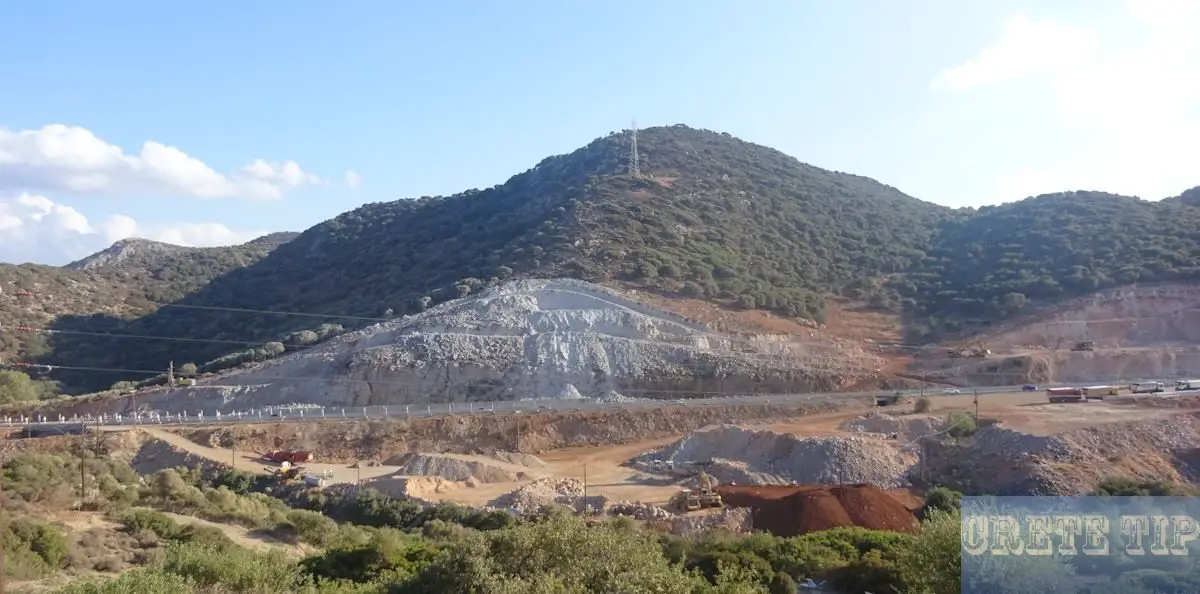
Those involved see several unresolved issues that are slowing down the project. There are still major gaps, particularly with regard to expropriations at the junctions.
Until the ownership issues have been clarified, no one can start construction at the central junctions. This is holding up important sections such as Neapoli, Agios Nikolaos and Limni.
The responsibility for starting work on the junctions lies more with politicians than with engineers. The technical teams are standing by and cannot make any decisions because political approvals are lacking.
This uncertainty makes it difficult to plan the construction process in any meaningful way. No one knows when it will actually start.
Another problem is that the work overlaps with other major projects. Not only is the road scheduled for completion in 2028, but a new international airport is also set to open.
The roads must be open in time to ensure a smooth connection to the airport. Any delay at junctions or side roads will disrupt the entire logistics chain.
There are conflicting concepts for local accessibility in some sections.
No side road network is planned between Hersonissos and Neapoli, while several kilometres of side roads are planned elsewhere.
A closed motorway route without local access roads is a real nuisance for residents. Although the planners say that the terrain sometimes does not allow for connections, the contract does not provide for local access roads, especially for the critical section.
The lack of consistency in the expansion concept raises many practical questions. Where there are no side roads, there are detours, poorer accessibility for emergency services and problems for commuters and farmers.
On the other hand, where a side road network is planned, additional costs and space requirements arise. Those responsible for the project must somehow find a balance here.
There is also disagreement about toll stations. In the public section, it is clear: no toll stations, no driver service stations.
In the privatised section, no one really knows where toll stations could be located. This uncertainty makes traffic planning and cost estimation for users quite difficult.
Possible toll locations are under discussion, but no one has decided yet. Some believe that toll stations in Hersonissos or at the airport entrance would be conceivable.
Such locations would, of course, have consequences: they would influence the traffic load on feeder roads and access roads to tourist destinations and place a financial burden on local residents.
The mix of public and private construction also entails different contractual conditions. Public sections have fixed specifications, while private partners often want more flexibility.
This can result in the route not offering a uniform usage profile. Users then experience changing regulations and standards on the same connection.
At the administrative level, there is growing concern that delays in expropriations and political disagreements are slowing down the pace of the project. What is not done now will be costly and complicated to make up for later.
The communities affected are divided. Some want more side roads to support local traffic and the economy.
Others fear that additional roads will cost agricultural land and drive up construction costs. The debate over local access or fast transit remains open.
There are a number of technical solutions on the table: selective access points, barriers, separate lanes for agriculture and public transport.
However, all of this requires more planning, permits – and, in most cases, more money. Without clear political guidelines, much of this remains theoretical.
Financial issues make the situation even more difficult. Unexpected costs for expropriations or side roads could blow the budget.
Private bidders often respond to new conditions by demanding contract changes. This uncertainty puts a strain on public coffers and the calculations of private investors.
Traffic management during the construction phase is also a problem. As long as central junctions are closed, diversions are needed.
This particularly affects local routes and areas that are important for tourism. Poor traffic management leads to congestion, longer journey times and a higher risk of accidents.
Environmental and climate issues come into play indirectly. Changes to the route or additional infrastructure affect ecosystems, water management and protected areas.
Environmental protection requirements can extend the construction period if they are not taken into account early enough. This often seems to be overlooked.
Communication between the parties involved remains crucial. Clear information on schedules and responsibilities could defuse conflicts.
At the moment, there is a lack of transparency about who is responsible for what and when. This leads to mistrust and sluggish processes.
Experts propose a phased approach: first clarify ownership issues at junctions, quickly establish toll regulations and create uniform guidelines for local accessibility.
Close coordination between the ministry, regional authorities and private construction partners is just as important. Without this, little will run smoothly here.
Practical short-term steps? Accelerated negotiations on expropriations, temporary access solutions during the construction phase and open information on possible toll locations.
Such measures could help to avoid jeopardising airport operations and mobility in the region. But there is still much to be done.
The responsibility does not lie solely with engineers. Politicians must act now to create the legal and financial conditions.
If this does not happen, there is a risk of delays that will have consequences for tourism, the economy and regional development far beyond the construction period.
No toll stations planned from the tunnels to Agios Nikolaos

Those responsible say that there will be no toll stations on the section between the tunnels and Agios Nikolaos. This clearly applies to the section with tunnels, bridges and junctions.
This means that drivers will not have to pay any fees to pass through this section. This announcement applies explicitly to this area.
Planning status and ownership issues play a role here. Many expropriations have already been completed, which clarifies the route and land availability.
There are currently no plans for toll stations, and this is directly related to the status of the project. Authorities and project sponsors seem to have agreed to leave this area toll-free.
The timing also influences the overall situation. The sub-project is part of a series of construction phases, all of which are at different stages of completion.
Some sections are already under construction or have been contracted out, while others are yet to begin. The fact that there are no toll stations here shows how the work is currently being prioritised.
Traffic function and connection quality are the main focus; fees are not a factor at this stage.
Impact on travellers and logistics
- Travellers can drive through without having to stop to pay tolls.
- Commuters and local residents use the section more often and at lower cost.
- Transport and logistics companies know that they do not have to budget for additional fees here.
Technical and operational consequences
Because no toll stations are built, operators save on the infrastructure required for them. This means no toll bridges, booths or machines – making operation easier and cheaper.
There is less monitoring and no control of payment flows on this section. This saves effort and money.
Road safety is also an issue: Without toll stations, no one needs extra stopping areas, and congestion caused by stops is eliminated. This allows traffic to flow more smoothly – at least if the road and junctions allow it.
Financing and budgeting
The entire project is financed from various sources. There is no direct revenue from tolls for the section without tolls.
Instead, they are likely to rely on government funds, subsidies or private investment without any return from tolls. This affects the calculation: the missing revenue must be offset in other ways.
Impact on project management
Project managers are adjusting the budget accordingly. They must evaluate costs and benefits in such a way that the missing toll revenue does not jeopardise the project.
- Coordinate with financing partners to secure other sources of revenue.
- Adjust long-term planning for operation and maintenance without toll revenue.
- Re-examine profitability calculations because the revenue structure is changing.
Public acceptance and political dimension
Without tolls, acceptance among residents and commuters usually increases. Toll-free sections reduce resistance to construction work and expropriations.
Politically, the discussion then tends to shift to other issues: How will the remaining sections be financed? What will the total cost be?
Operational challenges on site
Even without toll stations, there is still plenty to do. Operators continue to take care of maintenance, winter services, signage, traffic monitoring and emergency management.
However, the money for this must come from other budget sources. A few important points:
- Regular maintenance of roads, tunnels and bridges.
- Safety and rescue concepts for the tunnel sections.
- Traffic management at junctions, but without payment controls.
Cooperation with other infrastructures
The section is part of a larger network. A toll-free passage should connect sensibly to other sections, which may be subject to tolls.
Drivers should not suddenly find themselves at a toll booth without a good access option. This applies, for example, to connecting junctions, private sub-projects and connections to airports or cities.
A few examples of important links:
- Connection to airports with high traffic volumes.
- Junctions to routes that have already been allocated and are operated by concessionaires.
- Transitions to sections that have not yet been built or whose completion remains uncertain.
Risks and uncertainties
Planning without tolls also entails risks. Here are a few:
- Financing pressure: Without toll revenues, budget shortfalls may occur if no other funds are available.
- Delays in neighbouring sections: If adjacent construction sections are completed later or are financed differently, the benefits of the toll-free section will suffer.
- Political changes: Future governments could overturn the decision and introduce charges after all if money becomes tight.
Recommendations for further action
- Provide alternative sources of toll revenue at an early stage.
- Discuss the reasons and consequences openly with residents and users.
- Ensure that the toll-free section fits well into the network.
- Regularly review costs and user behaviour in order to be able to react in good time.
Important facts at a glance
- Location: Section between tunnels and Agios Nikolaos.
- Toll situation: No toll stations planned.
- Status: Expropriations mostly completed, construction progress varies.
- Impact: No direct user charges, impact on financing and operation.
- Risks: Financing gaps, delays, possible political changes.
Visual representation (simplified overview)
Area | Status | Toll planned? | Important consequences |
|---|---|---|---|
Tunnels to Agios Nikolaos | Expropriations completed, construction at various stages | No | No user fees; other financing models required |
Adjacent sections | Partially under construction or not yet started | Varies | Requires coordination for connection and financing |
Operation & maintenance | Ongoing requirement | Not toll-financed | Financing from government or project funds required |
The section without tolls directly affects the costs for users and changes the financial planning for the entire project. Operators and planners must therefore seek alternative financing and operating models and coordinate closely with the adjacent construction sections.



