

Newsflash from Monday, 27 April 2026:

Greece is entering a new era of earthquake preparedness. After more than two decades, the country’s seismic risk assessment has been completely overhauled with a new, more detailed earthquake map that reflects the latest scientific understanding of seismic hazards across the nation.
The proposal, developed by leading seismic engineers at Aristotle University of Thessaloniki (AUTh) under the direction of Professor Kyriazis Pitilakis, has been formally submitted to Greece’s Earthquake Planning and Protection Organization (OASP) and the Hellenic Organization for Standardization (ELOT). This marks a significant shift in how Greece approaches building safety and earthquake preparedness.
From Three Zones to Five: A More Precise Map
The most striking change in the new seismic map is the expansion from three seismic zones to five. The previous map, known as EAK2003, has been the standard since 2003 and was based on scientific knowledge from three decades ago. The new framework provides much greater granularity in mapping seismic risk across the country.
This transition allows for a more nuanced understanding of where earthquakes pose the greatest threat and ensures that building codes can be tailored more precisely to local conditions. Importantly, the new zones were determined not only by geological factors but also by **population density**, giving special attention to densely populated areas like Attica (Athens) and Thessaloniki, where reducing uncertainty in seismic design parameters is critical.
Understanding the Five New Zones
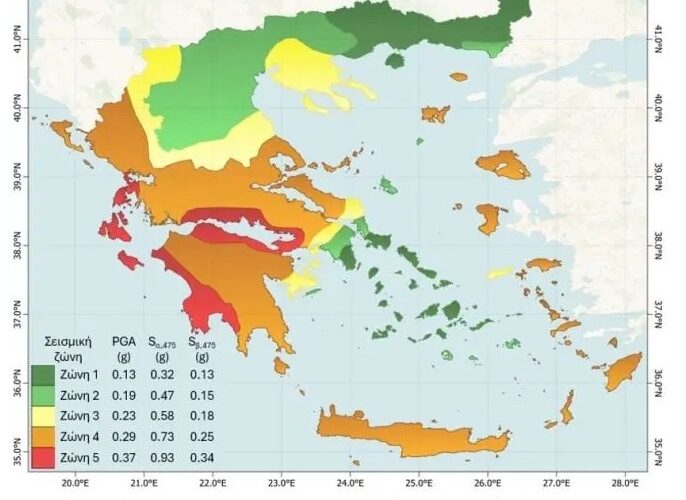
The new seismic map divides Greece as follows:
Zone 1 (Green) – Lowest Risk: Located primarily in Thrace, this zone has the lowest seismic hazard with a peak ground acceleration (PGA) of 0.13g.
Zone 2: Low to moderate seismic risk with corresponding design parameters.
Zone 3: Moderate seismic risk, representing the middle tier of the classification system.
Zone 4: High seismic risk with elevated design requirements for buildings.
Zone 5 (Red) – Highest Risk: This zone encompasses areas with the highest seismic hazard, with a peak ground acceleration of 0.37g. Buildings in this zone must be designed to withstand the most severe anticipated earthquakes.
What is Peak Ground Acceleration (PGA)?
Peak Ground Acceleration, or PGA, is the maximum rate of change of acceleration during an earthquake. It’s measured in units of gravitational acceleration (g). For context:
– 0.13g (Zone 1) represents relatively gentle shaking.
– 0.37g (Zone 5) represents intense shaking that requires robust structural design.
Buildings must be engineered to safely withstand the PGA anticipated for their specific zone.
Beyond PGA: A More Sophisticated Approach
One of the most important innovations in the new map is that it moves away from relying solely on PGA as the design parameter. The revised framework, aligned with the updated Eurocode 8 (EC8) standards, incorporates **two spectral acceleration values** that much better describe how buildings actually respond to earthquake shaking.
Additionally, the new standards introduce soil amplification factors that account for how different soil types amplify or dampen earthquake waves as they travel from bedrock to the surface. These factors vary depending on both the soil type and the intensity of the expected earthquake.
The Design Philosophy: Protecting Lives, Not Eliminating Damage
An important clarification from Professor Pitilakis emphasizes that the goal of modern earthquake design is **not to prevent all damage** in the event of a major earthquake. Instead, the objective is to ensure that buildings remain safe for human occupancy and do not collapse, thereby protecting lives.
The design standards use a probabilistic approach: buildings are designed to safely withstand an earthquake with a 10% probability of being exceeded within 50 years. Statistically, this is equivalent to a 475-year recurrence interval earthquake.
For critical buildings like hospitals and schools, the safety margins are even stricter, reflecting their essential role during disaster response.
Geographic Boundaries Designed Thoughtfully
The boundaries of the five new zones were carefully selected to:
– Avoid dividing major urban centers like Athens and Thessaloniki, ensuring consistency in building codes within a single city.
– Align with administrative divisions of the country where practical.
– Minimize uncertainty in seismic design parameters within each zone, particularly in densely populated regions.
What This Means for Greece
The adoption of the new seismic map represents a significant step forward in:
1. Building Safety: Stricter design standards will result in more resilient structures across the nation.
2. Public Protection: Enhanced earthquake preparedness for the millions of Greeks living in seismically active regions.
3. European Alignment: Full compliance with the latest Eurocode 8 standards, ensuring Greek buildings meet the highest European safety benchmarks.
4. Reduced Uncertainty: More precise zoning and parameters reduce guesswork in structural design.
When Will the New Map Take Effect?
The formal adoption process is underway. Once approved by OASP and ELOT, the new seismic map will become the official standard for all new construction and structural assessments in Greece. The transition will likely occur over the coming months, with implications for architects, engineers, and builders nationwide.
What Should Homeowners and Builders Know?
If you own property or are planning construction in Greece:
– New construction will be required to meet the new, stricter standards.
– Existing buildings may need structural assessment and reinforcement, particularly in high-risk zones.
– Consultation with engineers is recommended to understand how the new zones affect your specific location.
– Insurance considerations may change as risk assessments are updated.
Are you affected by the new seismic zones? Do you live or own property in one of Greece’s high-risk earthquake areas? Share your thoughts and concerns in the comments below. For professional advice on earthquake safety and structural reinforcement, consult with a qualified structural engineer in your region.



