

Newsflash from Saturday, 13 June 2026:
Weapons Found in Heraklion Operation
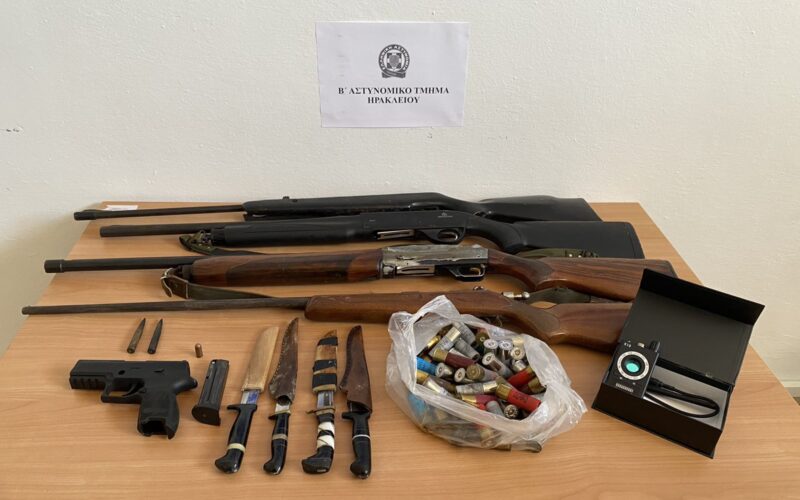
In Malevizi, police arrested two men aged 27 and 63 following searches of their home, storage facilities, and sheepfold. Officers discovered and confiscated:
- 1 pistol
- 3 hunting rifles
- 1 air rifle
- 1 pistol magazine
- 64 rounds of ammunition of various types
- 4 knives
- 1 camera/GPS detection device
In addition to weapons charges, the suspects face accusations related to livestock violations, including failure to properly declare and account for their herd.
Major Discrepancy in Declared Sheep
In a separate but related operation in Amari, Rethymno, police arrested three individuals (aged 52, 23, and 41) and filed charges against two more.
During inspections of their sheepfold, authorities uncovered a significant discrepancy: only 123 sheep were found, despite 1,840 having been officially declared.
Some of the animals also lacked the required identification tags, raising further legal concerns.
Additional Weapons Seized
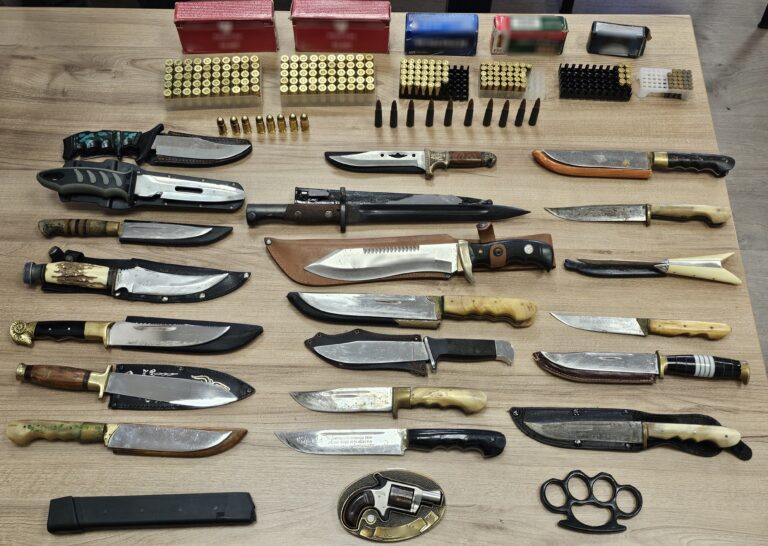
The Rethymno operation also led to the seizure of:
- 1 revolver
- 1 pistol magazine
- 220 rounds of ammunition
- 1 bayonet and 1 metal knuckle weapon
- 19 knives of various types
Ongoing Investigation
Both cases are being handled by local police departments, with investigations focusing on illegal weapons possession and violations of livestock regulations, including suspected animal theft and failure to submit required declarations.
A Broader Crackdown
The operations are part of a wider effort by authorities in Crete to combat illegal firearms and address irregularities in agricultural declarations, particularly in rural areas.
The findings highlight how routine inspections can uncover far more serious offenses—turning what seemed like a livestock check into a major law enforcement case.
Alarm Bells in Crete: New Data Reveals Scale of Illegal Gun Ownership

Recent figures from police authorities paint a troubling picture of gun ownership in Crete, highlighting a deeply rooted issue that continues to challenge public safety across the island.
According to data released by the General Regional Police Directorate of Crete, dozens of illegal weapons have already been confiscated and hundreds of arrests made in just the first eight months of 2025.
By the Numbers
The statistics reveal the extent of the problem across Crete’s four regional units:
- Chania: 93 weapons seized, 150 arrests
- Rethymno: 31 weapons seized, 105 arrests
- Heraklion: 64 weapons seized, 271 arrests
- Lasithi: 8 weapons seized, 55 arrests
While Lasithi records comparatively lower numbers, the overall picture suggests that illegal gun possession remains widespread throughout the island.
Only the Tip of the Iceberg
Authorities caution that these figures likely represent only a fraction of the true scale of gun ownership in Crete. Many weapons remain unregistered and hidden, making enforcement particularly difficult.
Experts warn that the real concern is not just the number of weapons, but their accessibility. In many cases, firearms are kept within easy reach—whether in homes, vehicles, or on personal carry.
A Cultural Challenge
In some areas, gun ownership is still associated with tradition, masculinity, or social status, complicating efforts to reduce illegal possession.
This cultural dimension makes the issue more than just a policing matter. Changing perceptions and attitudes is seen as a key step toward long-term solutions.
From Disputes to Tragedy
Authorities stress that the presence of a firearm can quickly escalate everyday conflicts. A disagreement over land, livestock, or even a minor misunderstanding at a social gathering can turn deadly when weapons are readily available.
The gap between anger and fatal violence becomes dangerously small when a gun is within reach.
Beyond Enforcement
While police operations and arrests are essential, officials emphasize that enforcement alone is not enough. Addressing illegal gun ownership in Crete will require a broader approach, including education, prevention, and a shift in social attitudes.
The challenge now is clear: reducing access to illegal weapons and redefining cultural norms before more lives are lost.
Crete at a Crossroads: Modern Infrastructure Clashes With Ancient Codes of Vengeance

As Crete emerges as a European hub of progress and tourism, a darker reality persists beneath the surface—one where the ancient “law of blood” continues to claim lives and define justice outside courtrooms.
The blood of a 21-year-old has not yet dried in Heraklion. While analysts debate “Cretan bravery” and “anachronistic customs,” the real conversation must move beyond romanticism to confront a systemic failure that leaves citizens—victim and perpetrator alike—prey to their own instincts.
Two Sides of the Same Island
Crete in 2026 stands at a critical juncture. On one side, ambitious infrastructure projects, emblematic developments, energy interconnections transforming the island into a European hub, and record tourism arrivals paint a picture of progress.
On the other side, a dark, muted reality emerges from remote interior valleys and city neighborhoods—a reminder that beneath the polished veneer of advancement, the “law of blood” remains operative.
The murder of a young man in Heraklion epitomizes this contradiction: a tragedy that exposes the island’s failure to bridge modernity with accountability.
A Massive Institutional Void
For decades, the State has functioned in Crete as a dry, bureaucratic “punisher after the fact”—a mere “traffic cop state” that records bodies but stubbornly refuses to invest in prevention.
The victim’s family had appealed to the justice system since February. There were charges filed. There were documented threats. What did the state do? Nothing.
Justice in Greece has become a slow-moving ship that arrives at the harbor when the city has already burned. When citizens feel unprotected, when complaints disappear into drawers for years, the fertile ground for the “law of blood” is created.
The Moral Complicity of Delay
Delayed justice is not merely inefficient—it is morally complicit in vigilantism. When the formal system fails to deliver timely protection and accountability, it inadvertently encourages citizens to take matters into their own hands.
The court system’s paralysis becomes the midwife of vengeance.
The Perpetrator’s Chilling Confession
The 54-year-old perpetrator’s statement—”I did what I had to do”—is the most disturbing aspect of this tragedy. This is not the utterance of someone who lost control. This is the voice of a man who sees himself as legislator, judge, and executioner.
In a properly functioning state, “what one must do” is defined by the Penal Code. In Crete’s shadows, it is defined by “honor”—distorted through the lens of pathological egotism.
The arrest of the perpetrator’s wife for complicity in the premeditated ambush reveals that the crime bore a family seal. When homes become command centers for murder, society’s foundation has rotted from within.
The Vendetta Nightmare
Let us be clear: the climate in Heraklion and surrounding areas is volatile. Legal experts on the island warn that the risk of vendetta is real and present.
Revenge and vigilantism do not dissipate with a single arrest. Often, they are fueled by it. How many times have we witnessed in Crete the cycle of blood open and fail to close for generations?
How many homes must be shuttered before we understand that vendetta is not “tradition”—it is a barbaric relic that keeps us imprisoned in the past?
The Matriarchal Undercurrent
It is widely known that matriarchy has ancient roots in Crete. The fierce independence of the mountain Cretan yields only to the authority of his wife, who after marriage assumes the role in the family and occupies the position of the most sacred person: the mother.
Yet this cultural structure, when intertwined with violence and honor codes, can become complicit in tragedy.
What Must Change
Three critical reforms are necessary:
- Justice System Acceleration: Cases involving threats and escalating violence must be prioritized and resolved within months, not years.
- Preventive Policing: Authorities must shift from reactive enforcement to proactive intervention when threats are documented.
- Cultural Reckoning: Society must openly reject the notion that honor and family loyalty justify violence or obstruct justice.
Progress Without Justice Is Hollow
Infrastructure projects and tourism records mean little if citizens cannot move safely through their communities. Energy interconnections and European integration ring hollow when young people are executed in ambushes.
True progress means transforming not just the skyline, but the soul—rejecting the “law of blood” and embracing the rule of law.
Crete stands at a crossroads. The island’s future depends on choosing which path to follow: the light of modern justice and human dignity, or the darkness of ancient revenge and institutional neglect.
The blood that has been spilled demands that we choose wisely.



