

Newsflash from Saturday, 19 September 2026:

Drivers in eastern Crete face yet another extension of the ongoing road closure on the BOAK (Voreios Odikos Axonas Kritis — the Northern Road Axis of Crete, the island’s main coastal highway).
The complete traffic shutdown between Agios Nikolaos and Neapoli (two towns in the Lasithi region of eastern Crete) has now been extended once again.
According to an official announcement, the closure will run from Monday, September 21 at 6:00 AM (i.e. immediately after the current full lockdown) until Thursday, September 24 at 5:00 PM.
Between 25 and 29 September 2026, there will be no road closures and traffic will flow as normal.
Why the Extension?
Authorities say the extra time is needed to complete round-the-clock work replacing the Xiropotamos bridge (a river crossing along the BOAK route).
Officials stated that once these works are finished, no further closures on the existing BOAK are expected in the near future.
Alternative Routes During the Closure
Traffic will be redirected as follows:
- Cars, buses, and vehicles under 12 tons: Traffic heading from Agios Nikolaos to Heraklion will use the Old National Road. Traffic heading from Neapoli to Agios Nikolaos will use the Old National Road via Lakonia and the Kritsa junction.
- Vehicles over 12 tons: These will be diverted via the ring road connecting Heraklion, Arkalochori, Viannos, Ierapetra, and Pachia Ammos before reaching Agios Nikolaos — a significantly longer detour.
Signage will be placed at key points along the road network to guide drivers through the temporary rerouting.
No Additional Measures to Speed Up Construction
Separately, Infrastructure and Transport Minister Christos Dimas rejected calls in parliament for additional measures to accelerate BOAK construction work.
He explained that adding more shifts is not currently considered necessary, citing concerns over increased traffic disruption and road safety risks.
The minister was responding to a parliamentary question from MP Lefteris Avgenakis, who had proposed more work crews, extended hours, and additional shifts where technically feasible.
On a more positive note, Dimas confirmed progress on the Kako Oros tunnel (a twin tunnel roughly 500 meters long, part of the BOAK project). He also said the first approximately 10 kilometers of the Neapoli–Agios Nikolaos section should open to traffic soon.
The minister added that the Chersonissos–Neapoli section of the project has surpassed 40% completion, with a target availability date of July 11, 2028, and a contractual completion deadline of July 11, 2029.
Meanwhile, 27 tourism, business, and labor organizations from Crete have submitted a joint statement supporting the BOAK project, while requesting better coordination and communication regarding traffic disruptions. They have also asked for a joint meeting with the ministry, though no firm commitment has been made yet.
What does this mean for visitors?
- Plan extra travel time: If you need to travel between Agios Nikolaos and Neapoli between September 21–24, expect significant delays due to detours.
- Use the Old National Road: Regular cars and buses can still travel via the Old National Road, but expect heavier traffic than usual.
- Avoid large vehicles on this route: If you’re driving anything over 12 tons (unlikely for most tourists, but relevant for those with campers or towing equipment), you’ll need to take the long way via Arkalochori, Viannos, and Ierapetra.
- Expect continued disruptions: With BOAK construction ongoing through at least 2028–2029, periodic closures and delays may continue to affect travel in this part of Crete.
- Check local news before traveling: Closures and detour plans can change, so it’s worth checking local outlets or official Coast Guard/traffic police announcements before setting out.
Traffic Jams on the New BOAK Are Already Being Predicted — Even Before It’s Finished
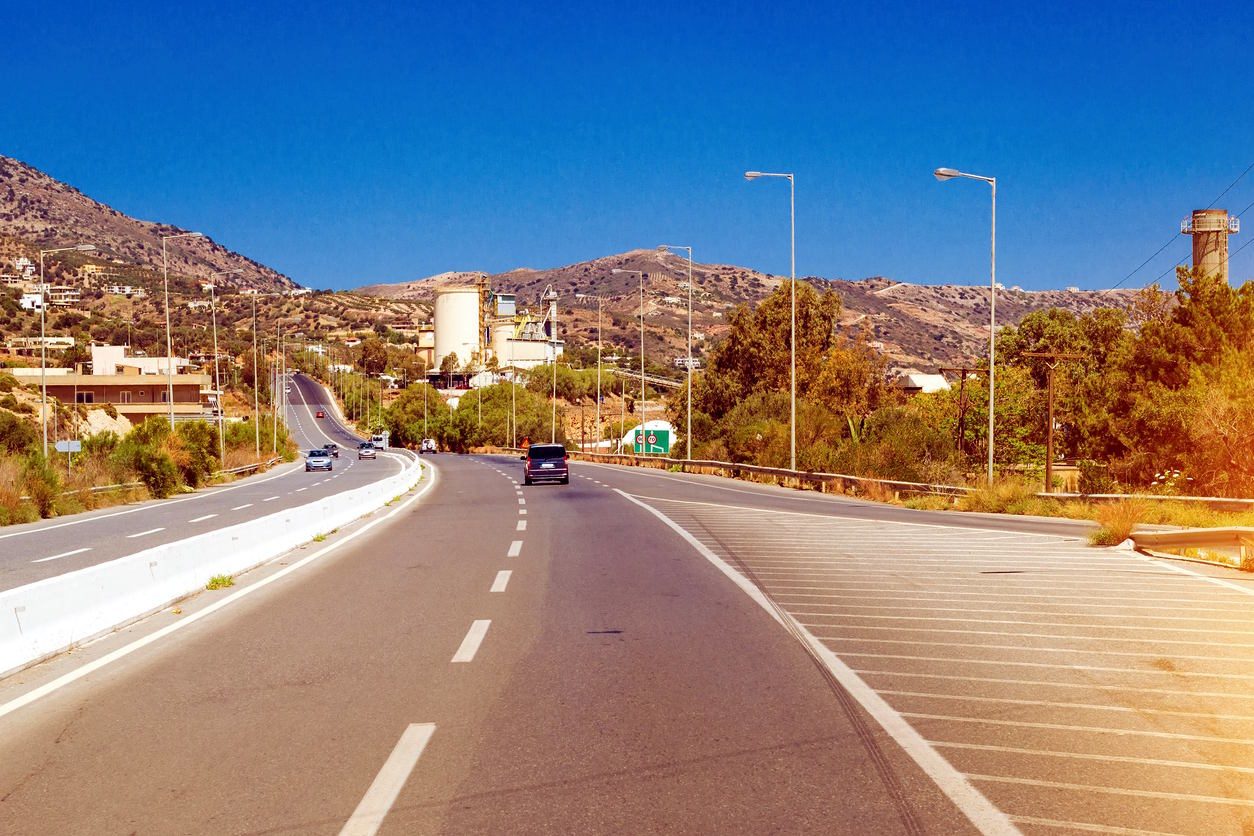
A new traffic study has raised serious concerns about future congestion on the urban section of the BOAK (Voreios Odikos Axonas Kritis — the Northern Road Axis of Crete, the island’s main highway) as it passes through Heraklion.
The study, conducted by Professor Vasilis Psarianos of the National Technical University of Athens on behalf of the project contractor, was completed in May 2026 and submitted to all relevant authorities.
It comes as the municipalities of Heraklion and Malevizi (an area just west of Heraklion) have filed appeals with the Council of State, Greece’s highest administrative court, seeking improvements to the urban BOAK section. The case will be heard on December 9.
The Numbers Behind the Concern
The research examined five urban sections of the BOAK across Crete: Vamvakopoulo–Souda (Chania), Atsipopoulo–Amari (Rethymno), Linoperamata–Papanastasiou, Papanastasiou–Karteros (both in Heraklion/Malevizi), and Gournes–Chersonissos.
Traffic projections were calculated for 2025, 2035, 2045, and 2055, each with separate summer and winter scenarios.
The findings show that the Papanastasiou–Karteros section in Heraklion carries roughly four times more traffic than the Souda section in Chania.
In 2025, this stretch saw an estimated 32,656 vehicles per day in the winter mid-range scenario, rising to 41,448 vehicles in the peak summer scenario.
Notably, traffic volumes stay high year-round — winter figures are nearly as intense as summer ones, meaning this isn’t just tourist-driven seasonal traffic.
When combined with the neighboring Linoperamata–Papanastasiou section (in Malevizi), peak summer traffic across both stretches reaches an estimated 71,876 vehicles per day — more than the combined BOAK traffic in Chania, Rethymno, and Chersonissos put together.
Projections Keep Climbing
The study forecasts continued growth over the coming decades on the Papanastasiou–Karteros section:
- 2035: up to 47,352 vehicles/day (summer peak)
- 2045: up to 53,529 vehicles/day (summer peak)
- 2055: a slight projected decrease to 50,506 vehicles/day (summer peak), for reasons not fully explained in the study
Winter traffic on the same stretch is expected to rise steadily too, from 34,830 vehicles/day in 2025 to an estimated 50,845 vehicles/day by 2055.
A Bottleneck That Can’t Be Widened
One particular concern raised is the Bentevi bridge, which carries BOAK traffic over Knossou Avenue in Heraklion.
The bridge already handles an estimated 55,000 vehicles per day without major congestion — but experts question how it will cope with future volumes.
Crucially, the bridge cannot be widened. Adding an extra lane would require support structures to be built on land currently occupied by homes along Knossou Avenue.
Tolls on the Way
Adding to the pressure, the concessionaire operating the BOAK will collect tolls on these urban sections for three decades, as the project has been designed with a 30-year operational horizon.
This means significant planning is required now, not just for construction, but for the road’s next phase, given the scale of traffic it will need to support long-term.
What does this mean for visitors?
- Expect heavy traffic year-round: If you’re driving through Heraklion or Malevizi via the BOAK, congestion isn’t just a summer tourist-season issue — winter traffic is nearly as intense.
- Budget for tolls: Once complete, this section of the BOAK will include tolls, so factor this into your travel costs if you frequently use this route.
- Consider alternate routes near Knossou Avenue: The Bentevi bridge area is likely to remain a chronic bottleneck since widening isn’t physically possible — allow extra time if traveling through this specific stretch.
- Long-term residents should stay informed: If you live in Heraklion or Malevizi, watch for updates from the Council of State case in December, as it may affect final road design and traffic management measures.
- Plan ahead for peak summer travel: With projected volumes approaching 72,000 vehicles/day across the Linoperamata–Karteros stretch in summer, expect this to be one of the busiest roads on the island during high season.
Sources:



