

Newsflash from Tuesday, 6 October 2026:

Meteorologists and hydrologists are now calling it the most significant weather event on Crete in at least 25 years.
Comparing 2026 to the Historic Storms of 2019

The comparison comes from the National Observatory of Athens (Greece’s leading meteorological research institute) and its meteo.gr monitoring network.
Researchers Kostas Lagouvardos, Giorgos Kyros, and Stavros Ntafis analyzed data from 39 weather stations that were already operational back in 2019, ensuring a fair comparison despite meteo.gr’s network growing to more than 70 stations today.
They compared this year’s storm to the two major 2019 weather systems known as “Chioni” (meaning “Snow” in Greek, active February 13–17, 2019) and “Okeanida” (meaning “Oceanid,” active February 24–26, 2019).
In 2019, the heaviest rainfall had concentrated in semi-mountainous areas of the Chania region (western Crete), with significant rain also recorded along the northern coast, particularly near Chania city and Heraklion.
This year’s storm showed a different pattern.
With the exception of the Chania region — where 2019 rainfall averages were actually higher — every other regional unit on the island saw greater rainfall in 2026 than during the 2019 storms, especially in semi-mountainous and mountainous areas.
Notably, coastal areas along the northern shore received far less rain this time compared to 2019.

Staggering Rainfall Totals
The numbers from this year’s storm are striking.
- Over 840mm of rain fell at Xyloskalo, the entrance to the Samaria Gorge (a famous gorge in Chania region)
- Over 640mm fell in Anogeia, a mountain village in the Rethymno region
- 448mm fell at Tzermiado, in the Lasithi Plateau (an upland agricultural area in eastern Crete)
Expert Analysis: A Once-in-a-Century Event
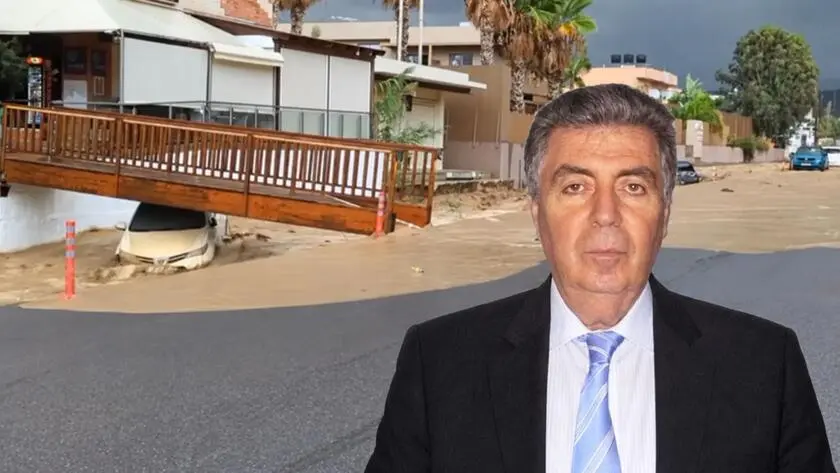
Giorgos Tsakiris, Emeritus Professor of Hydraulic and Land Reclamation Works at the National Technical University of Athens, and former Greek Minister of Rural Development, offered his perspective on the disaster.
He noted that hydrologists consider the 2019 storms a “500-year event,” though he personally estimates their return period at over 100 years.
Professor Tsakiris believes this year’s storm fits a similar extreme category, both in total water volume and rainfall intensity.
He pointed out that infrastructure projects are typically designed with a 50-year lifespan in mind — meaning no existing infrastructure could realistically withstand rainfall of this magnitude.
Two major infrastructure projects that had not yet been completed might have helped reduce the impact in Lasithi: regulation works on the Chavgas stream on the Lasithi Plateau, and small retention dams to manage water and debris near Ierapetra.
Despite the destruction, Tsakiris highlighted one positive point: major urban centers along Crete’s northern coast were largely spared from serious damage.
He also praised the emergency response, noting that Greece’s Ministry of Climate Crisis and Civil Protection, the Region of Crete, and local authorities handled the crisis satisfactorily.
According to him, risk assessments were reasonably accurate, the 112 emergency alert system issued warnings quickly, and a “red code” alert was declared in time between the storm’s two waves.
Looking Ahead: Adapting to a Changing Climate
Professor Tsakiris connected the recent extreme weather to broader climate change patterns affecting Crete.
He warned that the island should expect a future of both prolonged droughts — similar to recent years — and sudden, intense rainfall events like this one.
According to him, the key issue is the rate at which rain falls: when large amounts fall within just one or two days, the water cannot be properly absorbed by underground aquifers.
He stressed that rainfall needs to be distributed more evenly across time and location to be effectively utilized.
Tsakiris also called for swift compensation payments to affected residents, without the usual bureaucratic delays, and emphasized the need to adapt infrastructure and practices to these new climate realities.
His closing message was direct: societies must learn to live with such extreme weather events going forward.
Sources: Neakriti.gr and Cretalive.gr



