

Newsflash from Saturday, 10 October 2026:

Residents and farmers of the Lasithi Plateau (Oropedio Lasithiou), a highland agricultural basin in eastern Crete, are organizing a sit-in protest following severe flooding that has devastated local crops and threatened the region’s economy.
The demonstration is scheduled for Sunday, October 11, at 5:00 PM, outside the Lasithi Plateau Town Hall, with organizers inviting the entire local community to take part.
Widespread Crop Destruction
Recent storms left farmland across the plateau flooded, with mud covering fields that just days earlier had been ready for harvest.
Early estimates from producers suggest that potato crops — one of the plateau’s signature products — have suffered losses reaching or even exceeding 80%.
Vegetable crops haven’t fared much better, with damage estimated at around 50%.
For many farmers, the financial blow goes beyond losing this year’s harvest. Significant sums had already been spent preparing fields, carrying out cultivation work, and managing production — expenses that now can’t be recovered.

Farmers’ Demands
Protesters are calling for immediate, unhurried damage assessments and swift financial support for those affected.
Key demands include:
- Full compensation for crop losses
- Activation of state relief mechanisms, including ELGA (the Greek Agricultural Insurance Organization) and “de minimis” aid programs
- Tax relief measures for affected farmers
- Repair of damaged agricultural roads and infrastructure
- Investment in flood-prevention projects to reduce the risk of future disasters
Residents emphasize that temporary fixes won’t be enough — they’re calling for long-term infrastructure projects that can help prevent similar catastrophes going forward.
Sunday’s gathering marks the first organized response from the local community since the floods, aimed at drawing attention to the scale of the damage and pushing for a swift government response.
A Single Photograph That Captured the Depth of Crete’s Agricultural Crisis
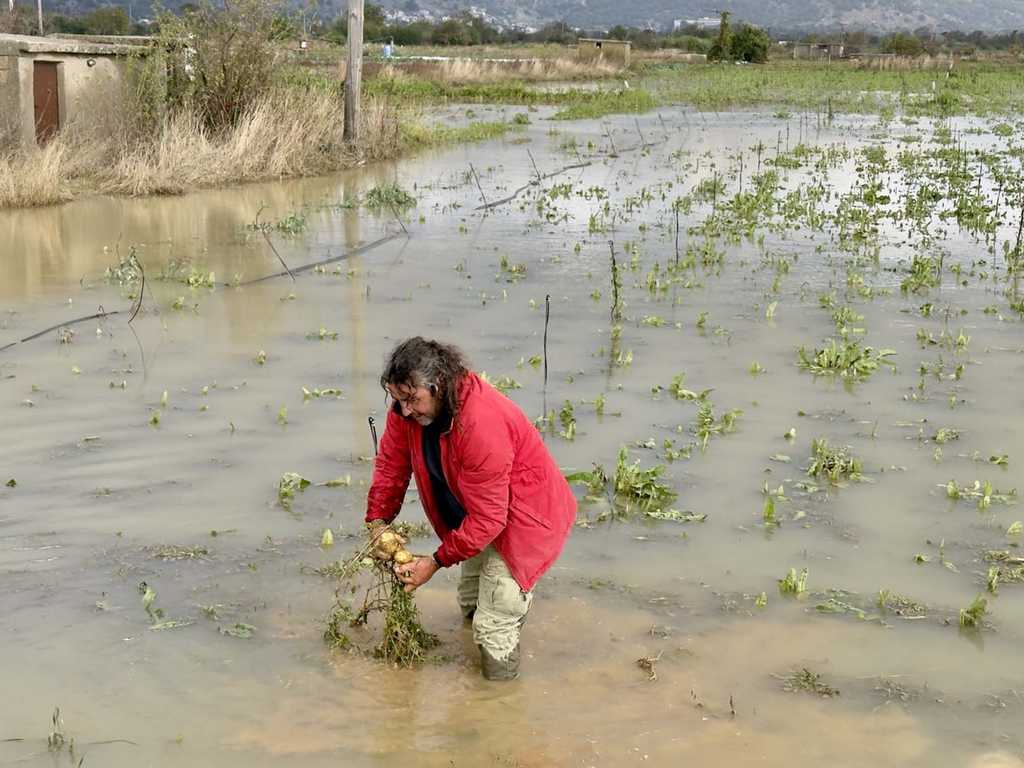
Sometimes one image says more than any press release ever could. A recent photograph from the Lasithi Plateau (Oropedio Lasithiou) — a highland farming basin in eastern Crete — has become exactly that kind of document.
It shows Manolis Paterakis, president of the provisional committee of the Lasithi Agricultural Association, standing knee-deep in a flooded field, holding up a handful of ruined potatoes for a visiting government delegation to see.
Wading Into the Truth
Paterakis didn’t wait for officials to come to him. Instead, he walked straight into the flooded field himself, without a moment’s hesitation.
Dressed in a red jacket that stood out sharply against the muddy, waterlogged landscape, he waded through thick mud that pulled at every step, reached down into the submerged soil, and pulled out the spoiled potatoes with his bare hands.
He held them up directly in front of government representatives who had come to assess the damage in person.
It was a silent but powerful statement — no shouting, no dramatic slogans, just the raw evidence of what the storm had done.
A Landscape Transformed
Behind him, the mountains stood as silent witnesses, while heavy, dark skies hung over the scene, hinting at the possibility of more difficult weather ahead.
The entire cultivated expanse of the plateau had become an immense lake, with only the tips of plants poking above the surface — crops that represented months of labor now drowned beneath the water.
Potatoes that should have fed a farming family, paid off debts, and sustained the local economy are instead left to rot beneath the floodwaters.
More Than Just a Photo
This image isn’t simply a dramatic snapshot of a natural disaster — it reflects the harsh reality facing Crete’s primary sector, and particularly the farmers of Lasithi.
It captures the deep vulnerability of agricultural workers in the face of extreme weather events, which are increasingly becoming the norm rather than the exception as the effects of climate change intensify.
As local reporting put it, the plateau’s floodwaters now act as a kind of unflinching mirror — reflecting every detail of the damage without softening or hiding any of it.
A Delegation That Saw It for Themselves
When the government delegation traveled up into the mountains of Lasithi for the official on-site inspection, they weren’t arriving blind to the situation — images of the flooding had already been circulating widely.
Still, they may have expected complaints or exaggerated claims. Instead, they found farmers who were composed, well-informed about the scale of the problem, and completely clear in their message: “Just our damage. Nothing else.”
By witnessing the destruction firsthand — not through reports or secondhand accounts, but with their own eyes — officials came face to face with what locals describe as the lifeblood of Lasithi’s agricultural economy, held up in the hands of a man who had just lost everything.
What does this mean for visitors?
- Expect to see storm recovery efforts: If you’re traveling through the Lasithi Plateau in the coming weeks, you may notice flooded fields, mud-covered farmland, and ongoing cleanup work.
- Road conditions may be affected: The storm also damaged parts of the local agricultural road network, so those driving through rural areas of the plateau should exercise caution and check road conditions beforehand.
- Protest activity planned for Sunday: If you’re in the area on October 11, you may encounter a peaceful sit-in demonstration outside the Town Hall starting at 5:00 PM — be mindful of local traffic and gatherings.
- Support local producers: Given the scale of crop losses, buying local produce (where available) can be a meaningful way to support farmers recovering from this disaster.
- A region worth understanding: The Lasithi Plateau remains one of Crete’s most distinctive agricultural areas — worth visiting respectfully, especially as the community works through a difficult recovery period.
Sources: Creta Times and Anatoli



