

Newsflash from Monday, 8 June 2026:

8-Hour Road Closures Between Neapoli and Agios Nikolaos This Week
Drivers in eastern Crete should prepare for significant traffic disruptions this week, as temporary closures will affect the Northern Road Axis of Crete (BOAK) between Neapoli and Agios Nikolaos.
According to the construction company AKTOR, the closures are necessary due to urgent geotechnical conditions in the excavation area near the Xeropotamos bridge (at chainage 8+300). The works involve the removal of unstable rock formations to ensure long-term road safety.
Closure Schedule
The traffic interruption will take place on the following dates:
- Wednesday, June 10, 2026: 09:00 – 17:00
- Thursday, June 11, 2026: 09:00 – 17:00
Traffic Diversions
During the closure hours, traffic will be redirected as follows:
From Neapoli to Agios Nikolaos:
Small vehicles and buses will be diverted via the Old National Road, passing through Lakonia and the Kritsa junction before reaching Agios Nikolaos.
From Agios Nikolaos to Neapoli:
All small vehicles and buses will travel exclusively via the Old National Road.
What About Heavy Vehicles?
Heavy vehicles will continue to use the existing BOAK route. However, traffic will be managed with temporary stoppages, as work crews periodically halt operations to allow vehicles to pass safely.
Driver Advisory
Motorists are advised to plan ahead, allow extra travel time, and follow all posted signage and instructions from traffic authorities. Delays are expected, particularly during peak hours.
These temporary measures are part of ongoing infrastructure improvements aimed at enhancing safety along one of Crete’s most important road corridors.
Traffic Chaos on BOAK Sparks Tourism Crisis in Lasithi
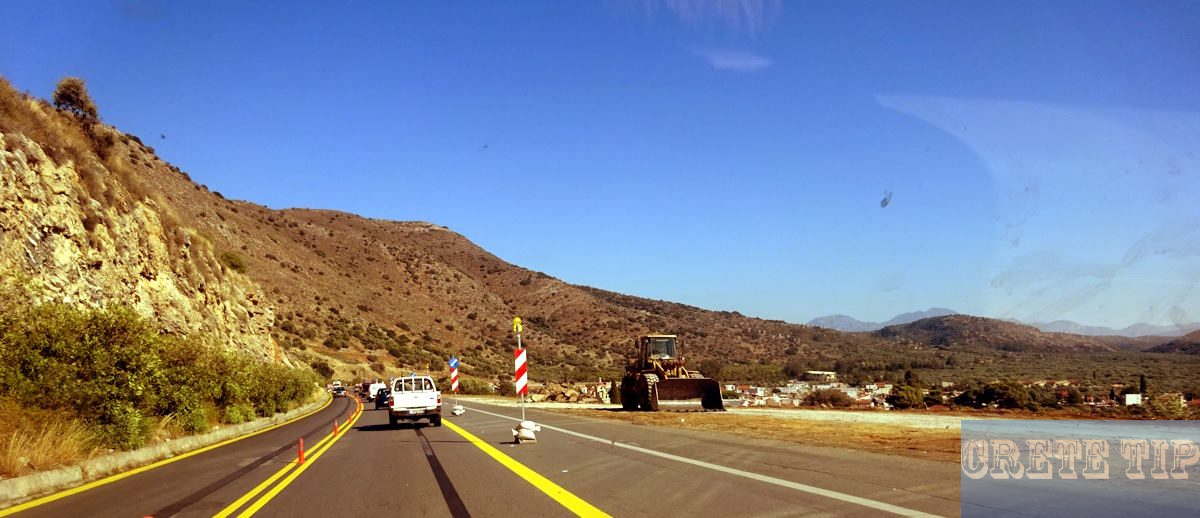
The ongoing construction works along Crete’s Northern Road Axis (BOAK) are causing severe disruption in eastern Crete, with industry professionals warning that the situation is beginning to threaten tourism in Lassithi.
What should be a vital transport link between Heraklion and Agios Nikolaos has turned into a daily ordeal. Travel times have doubled, traffic bottlenecks are constant, and the lack of coordination and timely updates about roadworks is creating widespread frustration across the tourism sector.
Travel Times Double Amid Gridlock
According to local transport operators, a journey that typically takes under an hour now requires at least two. The most problematic sections are near Gouves, Neapoli, and the wider Agios Nikolaos area, where ongoing construction has narrowed lanes and reduced speeds.
Further delays occur when vehicles are diverted onto outdated provincial roads in the Mirabello region—routes that were never designed to handle such heavy traffic volumes.
Tourism Industry Under Pressure
The impact on tourism is becoming increasingly serious. Tour bus operators report major scheduling disruptions, missed transfers, and mounting operational costs. When buses are delayed, entire itineraries collapse, forcing agencies to find last-minute replacements or cancel excursions altogether.
Visitors heading to popular destinations such as Spinalonga risk missing boat departures, while others face delays reaching the airport, sometimes even missing flights. In such cases, travel agencies are often required to cover additional accommodation and rebooking expenses.
Frustration and Reputational Damage
The situation is also damaging Crete’s image abroad. Tourists caught in long traffic queues have reportedly expressed disbelief, noting that similar large-scale works in other countries are typically carried out overnight to minimize disruption.
Incidents of buses being stuck for hours—such as a recent two-and-a-half-hour delay near Neapoli—have further fueled frustration, with visitors documenting their experiences and sharing them online.
Drivers Face Legal and Safety Challenges
Beyond delays, professional drivers are facing serious compliance issues. EU regulations require strict driving and rest periods, but the unpredictable delays make it nearly impossible to adhere to these rules.
As a result, drivers risk fines ranging from €500 to €1,000 for violations caused entirely by traffic conditions beyond their control. Industry representatives are calling for flexibility from authorities under these exceptional circumstances.
Calls for Immediate Action
Tourism stakeholders have already submitted formal complaints to government officials and construction companies, urging better planning, coordination, and advance notice of road closures.
Without immediate improvements, transport operators warn they may be forced to reconsider serving key routes, including transfers to and from Heraklion Airport—an outcome that could significantly impact the region’s tourism flow.
As the summer season intensifies, the need for practical solutions becomes urgent. For Lassithi, a region heavily dependent on smooth transport connections, the current situation on BOAK is no longer just an inconvenience—it is a growing crisis.
First 10 km of New BOAK Section Near Completion This Summer in Eastern Crete

A major milestone is approaching for one of Crete’s most important infrastructure projects, as the first 10 kilometers of the upgraded Northern Road Axis (BOAK) between Neapoli and Agios Nikolaos are expected to be delivered this summer.
The announcement follows a recent site visit by Deputy Minister of Infrastructure and Transport Nikos Tachiaos, who confirmed that construction is progressing at a steady pace and remains in full development.
A Key Project for Crete
The Neapoli–Agios Nikolaos section is part of the broader BOAK upgrade, a flagship project funded through the Recovery and Resilience Facility. The initiative aims to modernize Crete’s main road corridor, significantly improving safety, connectivity, and travel efficiency across the island.
What the New Section Includes
The new road segment is designed to meet modern highway standards, featuring:
- Two traffic lanes per direction
- A dedicated Emergency Lane (hard shoulder) on each side
- A separated carriageway with a total width of 22.25 meters
In addition, the project includes a full network of parallel and vertical road connections to ensure smooth local access and reduce congestion.
Major Engineering Works
The scale of the project is reflected in the extensive technical works underway. These include:
- Three grade-separated interchanges at Neapoli, Limnes, and Agios Nikolaos
- Four twin-branch bridges and one single-branch bridge
- Eight underpasses
- Five partial and full roadway covering structures
Supporting infrastructure also involves hydraulic works and flood management systems aimed at improving resilience against extreme weather events.
Boosting Safety and Connectivity
Once completed, this upgraded section is expected to significantly enhance road safety and reduce travel times in eastern Crete, an area that has long faced challenges due to outdated road infrastructure.
The project also plays a crucial role in strengthening tourism and local economic activity by providing faster and more reliable connections between key destinations.
As construction continues at a fast pace, the delivery of the first 10 kilometers this summer marks an important step toward the full transformation of the BOAK corridor.



