

A showdown is looming in the dispute over the migrant centre near Heraklion; Crete is the main problem, with 12,000 arrivals, whilst figures across Greece have fallen by 35 per cent.

Gavdos is a small, remote island located south of Crete, officially recognized as the southernmost point of Europe. Despite its tiny size and population, it has become a frequent landing point for boats crossing from North Africa.
Trypiti is a beach on Gavdos that has repeatedly served as an arrival site for migrant boats in recent weeks.
Almost Daily Arrivals Strain Local Resources
According to initial reports, among the 113 people who arrived were at least four women and three children.
This latest incident is far from isolated. Gavdos has been receiving new arrivals on an almost daily basis, keeping the island’s port authorities in a constant state of high alert.
Local Coast Guard personnel have once again been called upon to manage a large-scale arrival, at a time when migration flows to the island remain especially intense.
Staff from the relevant services are reportedly working around the clock, as incidents continue to follow one after another, with new boats arriving from the sea area south of Crete.
A Pattern of Increasing Arrivals
This latest arrival adds to a string of recent incidents that have placed significant strain on Gavdos and the wider Chania region (the northwestern prefecture of Crete that administratively includes Gavdos).
The small island, with extremely limited infrastructure, continues to serve as a frontline entry point, with authorities repeatedly stretched thin trying to manage successive waves of arrivals.
Migration Surge Continues: Yesterday 39 More Arrivals Near Lentas as Southern Crete Faces Relentless Pressure
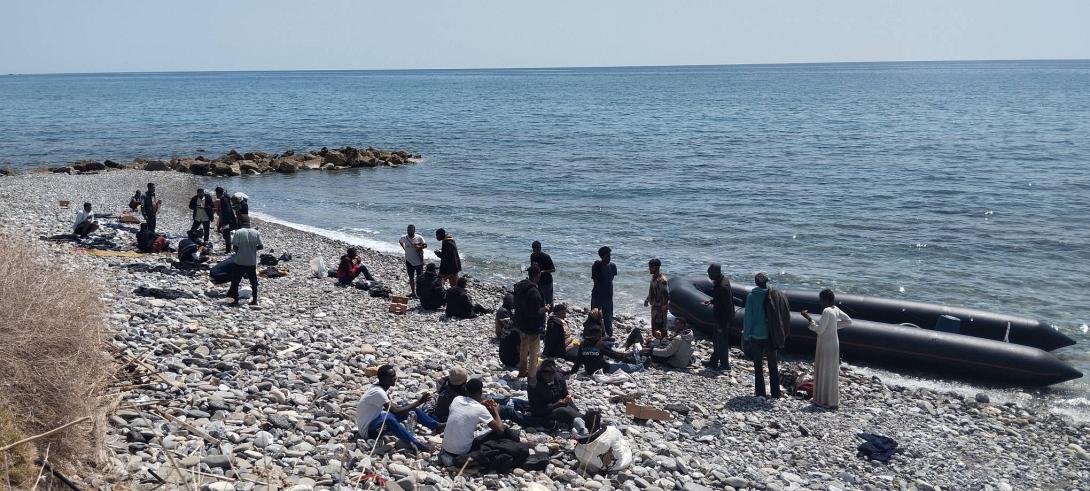
Migration flows to the southern coast of Crete show no sign of easing. In the latest incident, 39 migrants safely landed at the fishing shelter of Loutra, near Lentas, on the afternoon of Monday, August 31, 2026.
Lentas is a small coastal village on the southern shore of Crete, part of the Heraklion region, known for its remote location and rocky coastline.
This arrival comes just as authorities continue to grapple with an even larger incident on Gavdos — Greece’s southernmost island — where 113 migrants arrived overnight at the beach of Trypiti, including at least four women and three children.
Details of the Lentas Arrival
According to local authorities, the group that landed near Lentas consisted overwhelmingly of men — 38 men and 1 woman.
Coast Guard officers, police (ΕΛ.ΑΣ.), and volunteer first-response teams rushed to the scene immediately following the boat’s arrival.
Authorities began registering the migrants’ details on-site, while also providing first aid, water, and other essential supplies.
The group is expected to be temporarily transferred to designated holding facilities to complete required administrative procedures and medical checks.
A Persistent Pattern Along Southern Crete
These back-to-back incidents confirm that the sea route from North Africa remains active — and dangerous — for migrants seeking passage to Europe.
Southern Crete, including both Gavdos and mainland coastal areas like Lentas, continues to bear the brunt of these crossings, with local authorities repeatedly called into action.
What Does This Mean for Visitors?
If you’re traveling to or currently staying in Gavdos or the surrounding Chania region, here’s what to keep in mind:
- Expect a visible Coast Guard and authority presence on Gavdos, particularly near beaches like Trypiti, as officials respond to ongoing arrivals.
- Boat and ferry schedules could be affected during periods of intense migration activity, so it’s wise to check for any service disruptions before traveling.
- Local infrastructure is limited — Gavdos is a small island with minimal facilities, and frequent large-scale arrivals can add pressure to local services.
- Stay informed via local news sources if you’re planning a visit to Gavdos in the coming days, as the situation is evolving rapidly and almost daily.
- Tourists are not typically directly affected by these operations, but should be aware of increased official activity on the island.
Authorities continue to monitor the situation closely as Gavdos remains a key point of entry amid ongoing migration flows from North Africa toward southern Crete.
Sources: Neakriti.gr and Ekriti.gr
Showdown Looms: Minister to Meet Heraklion Residents as Migrant Facility Dispute Reaches Critical Point

The battle over a planned migrant accommodation facility near Heraklion is heading toward a decisive moment, with a high-level meeting now scheduled between the government and local residents.
Heraklion is the largest city on Crete and the island’s regional capital, located on the north coast.
Key Meeting Set for September 8
Migration Minister Thanos Plevris will meet with Heraklion Mayor Alexis Kalokairinos and a five-member committee representing local residents on Tuesday, September 8, at 1:00 PM, at the Ministry.
The meeting was announced by Mayor Kalokairinos during a recent municipal council session, attended by a large crowd of residents from areas around Athanatoi and Moires — communities on the outskirts of Heraklion that have spent the last two months voicing strong opposition to the facility.
Minister’s Position: “Only With a Counter-Proposal”
In a letter delivered to the Mayor, Minister Plevris stated that the Ministry has been requesting alternative proposals from local authorities since October 2025 for the operation of migrant facilities in Crete.
He explained that the Ministry has settled on the Skouloudis building as the planned site, citing that recommendations from relevant services have been taken into account.
Crucially, Plevris stated he remains open to any alternative location — even for temporary use — until a permanent site is found within the prefecture.
According to the letter: “The plan can only be halted, and another location chosen, if during our meeting you propose an alternative site outside of the ‘Psygeio’ (the site’s local nickname) where the plan could be implemented.”
Legal and Administrative Hurdles
Mayor Kalokairinos presented official findings from the Municipality’s Legal Service, Urban Planning Department, and DEYAH (Heraklion’s Water and Sewerage Company), all of which highlighted significant problems with the proposed site.
However, the Legal Service noted that, under current circumstances, there is no enforceable administrative act that could currently be legally challenged by the Municipality — though this could change once final decisions are formally issued.

Local Opposition Remains Firm
Zacharias Chiotakis, president of the Stavrakia community, apologized for extreme reactions voiced during the council session but stressed the scale of local opposition.
He noted that 10,000 signatures have been collected from residents across Heraklion’s municipal communities opposing any such facility in the area.
“This message cannot be ignored. We ask the Municipality to convey the will of the local community to the responsible ministry,” Chiotakis said.
He also called for a formal commitment from the Municipality to pursue legal action once the facility’s establishment is officially published in the Government Gazette (ΦΕΚ), and requested a joint meeting between the Municipality and the Region of Crete to explore alternative locations, including in eastern Crete.
Mayor: Legal Action Premature
Mayor Kalokairinos pushed back on calls for immediate legal action, stating that filing a legal challenge now would be “only for appearances — and we are not here for appearances.”
He clarified that legal action can only proceed once the facility is officially operational, adding that the necessary legal arguments have already been documented and prepared.
He reaffirmed the municipal council’s opposition to the chosen location, but acknowledged that no viable alternative site has been proposed so far — noting that every alternative location floated to date has met with local resistance as well.
Regarding renewed talks with the Region of Crete on alternative sites, he confirmed that previous contact had proven unsuccessful, though he expressed willingness to resume dialogue.
Opposition Leader Weighs In
Michalis Karamalakis, head of the main opposition bloc on the council, pointed to previous cases where sites were rejected on infrastructure grounds — specifically citing how a former KTEO facility (vehicle inspection center) and a site in Malades were both turned down due to lack of sewage connections and traffic access issues, arguing similar standards should apply here.
What Does This Mean for Visitors?
If you live in or are visiting the Heraklion area, here’s what to keep in mind:
- Expect ongoing public demonstrations in areas near Athanatoi and Moires, particularly around the Heraklion-Moires road, as this dispute continues to unfold.
- Traffic disruptions are possible near the proposed facility site and during any organized protests in the coming weeks.
- The situation remains unresolved — no final decision has been made, and the outcome of the September 8 ministerial meeting could significantly shape next steps.
- This is a local political and administrative dispute and does not pose any direct safety concern to tourists or residents in daily life.
- Stay informed via local news if you’re in the area, as public sentiment remains highly charged and further developments are expected soon.
All eyes will now turn to the September 8 meeting, which could prove decisive in determining whether the Skouloudis site proceeds as planned or whether an alternative location is found.
Source: Neakriti.gr
“Crete Is Now the Main Problem”: Migration Minister Reveals 12,000 Arrivals as Government Defends Island-to-Island Transfers

Greece’s Migration and Asylum Minister, Thanos Plevris, has confirmed that Crete has become the central front of migration pressure currently facing the country, citing approximately 12,000 arrivals on the island.
Speaking on Monday morning (August 24) on the Greek television channel OPEN, Plevris outlined the government’s strategy for managing flows from Libya, as well as the controversial transfers of migrants from Crete to the islands of Samos and Lesvos in the northeastern Aegean.
Greece-Turkey Relations: “Calm Waters” Doesn’t Mean Backing Down
Addressing relations with Turkey, Plevris was clear that Greece’s policy of de-escalation does not represent a retreat from its established national positions.
“‘Calm waters’ doesn’t mean giving up any national position. It means that when a country believes it has an issue with another, it chooses dialogue over escalation,” he said, adding that this approach has proven effective — citing an example of Greece’s coast guard being able to directly call their Turkish counterparts to flag activity at sea.
However, he warned that Greece would respond firmly if its sovereign rights were ever challenged: “If our sovereign rights are questioned, we will respond. Whenever it was necessary, we have been present.”
Transfers to Samos and Lesvos: “No Overloading of Facilities”
Plevris also addressed the transfer of migrants from Crete to Samos and Lesvos, a move that has sparked backlash on the North Aegean islands.
He insisted the policy is not designed to increase the overall number of people housed at these islands’ facilities, but rather to temporarily make use of existing infrastructure and the operational experience these islands have built up in managing asylum procedures.
According to Plevris, a key government condition is that facilities must first be decongested before any new transfers take place. “I am consistent on this — there will be no transfer of people there unless decongestion has already occurred,” he stated.
Samos: The Numbers Behind the Policy
Plevris gave specific figures regarding Samos, revealing that 205 people were transferred there from Crete, while 229 people were scheduled to leave the island’s facility that same Thursday.
Before the latest transfer, roughly 850 people were housed at the Samos facility, which has a total capacity of approximately 2,500 places.
“We don’t want to overload the facility,” Plevris emphasized, adding that since January 1, 2026, a total of 2,350 people have departed from Samos.
Notably, the figure of 205 transferred to Samos differs slightly from data reported the previous day (Sunday, August 23), which indicated that a total of 417 people had been transferred from Crete — approximately 200 to Samos and 217 to Lesvos.
A Nationwide Network of 33 Facilities
Plevris outlined the ministry’s broader strategy for managing migration flows, noting that Greece currently operates 33 facilities, both open and closed.
He explained that new arrivals are not required to remain on the island where they first land. Instead, a process of screening and relocation takes place based on each case’s profile and the progress of their asylum application.
Specifically referencing Lesvos, Chios, Samos, Leros, and Kos — all islands in the eastern Aegean that serve as primary entry points — Plevris noted that if every new arrival remained on these islands, local communities would face far greater pressure.
According to the minister, those with higher chances of receiving asylum can be transferred to open facilities on the Greek mainland, while a separate process applies to those facing deportation procedures.
Government Insists Decongestion Comes First
Plevris maintained that, prior to the recent transfers from Crete, space had already been freed up at the island facilities, as other residents had been relocated to open or closed facilities elsewhere in the country.
“We are not going to transfer people in a way that burdens those facilities,” he said, explaining that the temporary use of island facilities is specifically due to their proven experience in efficiently completing asylum procedures.
Source: Cretalive.gr
Greece Sees 35% Plunge in Migrant Arrivals — But Unrest Erupts at Northern Detention Facility
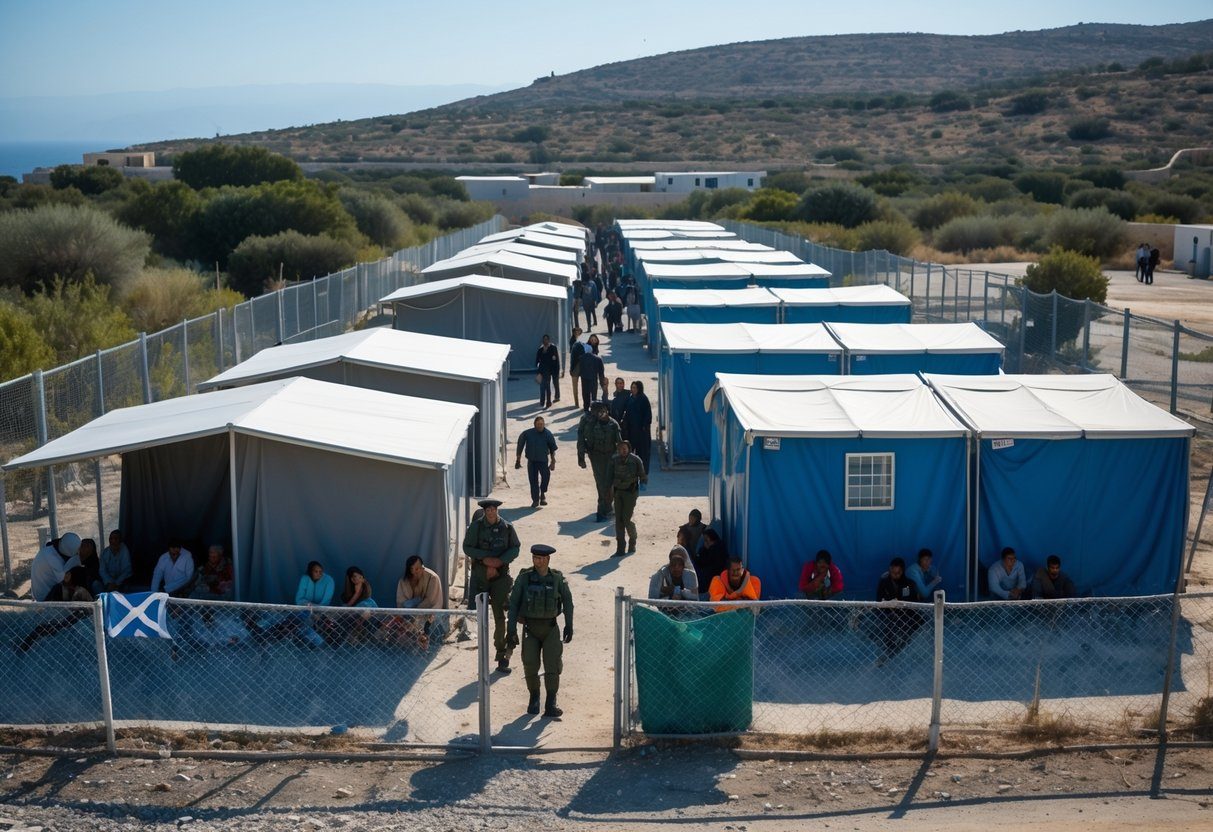
New data from Greece’s Ministry of Migration and Asylum reveals a significant shift in the country’s migration landscape: arrivals are down sharply, while returns are climbing.
The Numbers: A Clear Downward Trend
Between August 1, 2024 and August 1, 2025, Greece recorded 61,112 migrant arrivals. In the following twelve-month period, from August 1, 2025 to July 31, 2026, that number dropped to 41,998.
That’s a difference of almost 20,000 fewer arrivals — a decline of roughly 35 percent.
The downward trend has continued into 2026, with migration flows during the first seven months of the year down 25 percent compared to the same period in 2025.
Returns on the Rise
As arrivals fall, returns are climbing. During the first seven months of 2026, total returns increased by 20 percent compared to the same period a year earlier.
Forced returns rose even more sharply, up 35 percent year-on-year.
Meanwhile, the asylum recognition rate — the percentage of applicants granted protection status — fell to 37 percent during the same seven-month period.
Unrest at Northern Detention Facility in Sintiki
While the overall trend points to tighter migration management, a serious incident at a closed accommodation facility in northern Greece has raised fresh concerns.
Sintiki is a municipality near the city of Serres, in the Central Macedonia region of northern Greece. The area is home to a closed facility for asylum seekers in the village of Kleidi.
On Saturday night, shortly after 9pm, a group of detainees at the facility attacked police with stones and other objects, damaging facility infrastructure and cutting through the perimeter fence.
A total of 25 people were arrested in connection with the unrest — 23 of them Bangladeshi and Egyptian nationals — and remanded in custody pending trial on charges including attempted escape, escape, mutiny by detainees, and property damage.
15 detainees managed to escape and remained at large as searches continued. Five people were injured during the incident; three were treated at Serres Hospital and returned to the facility, while two remained hospitalized.
Local Community Demands Facility Closure
The unrest has intensified long-standing local opposition to the Kleidi facility. During an extraordinary meeting on Monday, the Sintiki Municipal Council overwhelmingly voted to call for the facility’s closure.
The council urged the Greek state and the Ministry of Migration and Asylum to take all necessary steps to shut down the site, citing the community’s ongoing concerns and the latest security incident.
Source: GreekReporter.com



