Newsflash from Sunday, 19 April 2026:
Residents and visitors in southern Crete were woken by a significant tremor today as a moderate earthquake struck off the coast of Ierapetra.
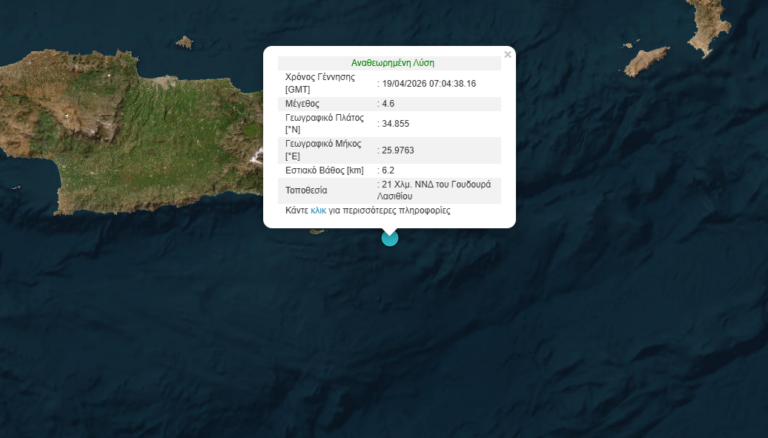
The earthquake, which measured 4.8 on the Richter scale, occurred in the sea area south of the island, according to the Geodynamic Institute of the National Observatory of Athens.
Key Details of the Tremor
* Magnitude: 4.8 Richter
* Location: Sea area south/southeast of Ierapetra, Crete
* Depth: Estimated at a shallow focal depth, which contributed to the tremor being felt across the Lasithi prefecture and parts of central Crete.
Impact and Reports
While a 4.8 magnitude quake is classified as “moderate,” its proximity to the coast meant that the shaking was clearly felt by locals in Ierapetra and surrounding villages. Early reports suggest that the vibration lasted for several seconds.
As of now, there have been no immediate reports of significant damage to infrastructure or injuries. Local authorities are currently monitoring the situation, and seismologists are observing the post-seismic activity to determine if this was the main earthquake.
A Seismically Active Region
Crete is located in a seismically active zone along the Hellenic Arc, where the African plate subducts under the Eurasian plate. Tremors of this magnitude are relatively common in the region and are usually handled well by the island’s modern, earthquake-resistant buildings.
Safety Reminders
While the situation appears calm, residents are reminded to follow standard safety protocols:
* Stay away from old buildings or structures that may have suffered minor cracks.
* Secure heavy furniture or items on high shelves.
* Stay tuned to local news and official announcements from the Civil Protection services.
Did you feel the earthquake? Let us know in the comments below or share your report with the Euro-Mediterranean Seismological Centre (EMSC).
Local time at the epicentre: Sunday, 19 April 2026, at 07:04 (GMT +0)
Magnitude: 4.8
Depth: 10.0 km
Epicentre: 34.861°N / 25.8633°E (latitude / longitude)
Intensity: V (Moderately strong near the epicentre)
Nearby locations | Distance | Intensity |
|---|---|---|
Ferma | 18 km (11 mi) | IV |
Ierapetra | 20 km (12 mi) | IV |
39 km (24 mi) | IV | |
44 km (28 mi) | IV | |
50 km (31 mi) | IV | |
52 km (32 mi) | IV | |
60 km (37 mi) | III |
General information: CreteTip only reports earthquakes with a magnitude of 4.0 or higher, or earthquake swarms close to this threshold!
The reason for this is that earthquakes of lower intensity pose no danger whatsoever and are hardly noticeable after a longer stay in Crete.
Understanding Intensity and the Modified Mercalli Intensity Scale
Ever wonder what exactly people mean when they talk about the “strength” of an earthquake? That’s called its intensity—basically, how much shaking folks actually feel where they are.
Intensity isn’t the same thing as magnitude, which is all about the energy released at the quake’s source. Intensity is more personal; it’s about how strongly the quake hit a specific spot.
The Modified Mercalli Intensity (MMI) scale is the usual go-to for describing this. It ranks shaking from I (not felt) to X (extreme shaking). The scale uses Roman numerals and sometimes colors to help visualize it, which is kind of handy:
- I to II: Not felt or barely felt
- III to IV: Weak to light shaking
- V and above: Moderate to strong shaking
How intense the shaking feels depends on a mix of things—how powerful the quake was, how deep underground it started, and how far away you are from the epicentre.
If you’re close to the epicentre, chances are you’ll feel it more. Not exactly a surprise, right?
Recent earthquakes near Crete:

Earthquake simulator at the Natural History Museum:
More about Earthquakes on Crete and Crete is a risk area for strong earthquakes and tsunamis.
How do you protect yourself during earthquakes?
Protection from earthquakes involves preparation before an earthquake and acting safely during an earthquake. Here’s what you should do:
Before an earthquake
1) Prepare an emergency kit: Include water, food, a torch, batteries, first aid supplies, important documents and medications.
2) Secure the room:
– Fasten shelves securely to the walls.
– Place heavy objects on the lower shelves.
– Secure televisions, computers and other heavy items.
– Know how to switch off gas, water and electricity.
3) Create a family emergency plan:
– Know safe places in each room (under sturdy tables, on interior walls).
– Plan and practise evacuation routes.
During an earthquake
If you are in the house:
DROP, COVER, and HOLD ON:
– Drop to your hands and knees (before you’re knocked down).
– Cover your head and neck under a sturdy table or desk. If there’s nothing to hide under, cover your head and neck with your arms and crouch in an inside corner of the building.
– Hold On to your shelter until the shaking stops.
– Keep away from windows, glass and heavy objects that could fall.
– Do not run outside during the quake.
If you are outdoors:
– Move to an open area away from buildings, trees, streetlights and power lines.
– Stay there until the quake stops.
If you are in a vehicle:
– Stop as quickly and safely as possible.
– Stay inside the vehicle.
– Avoid stopping on bridges, in tunnels or under overpasses.
After an earthquake
– Check yourself and others for injuries.
– Be prepared for aftershocks.
– Inspect the house for damage and hazards (gas leaks, fire, etc.).
– Listen to emergency announcements for information and instructions.
– Use the telephone only in emergencies.
Important notes:
Most earthquake injuries are caused by falling objects and debris, not building collapses. Protect your head and neck and stay calm.
 Information from the Greek Civil Protection for earthquakes (in English)