

Newsflash from Tuesday, 15 September 2026:
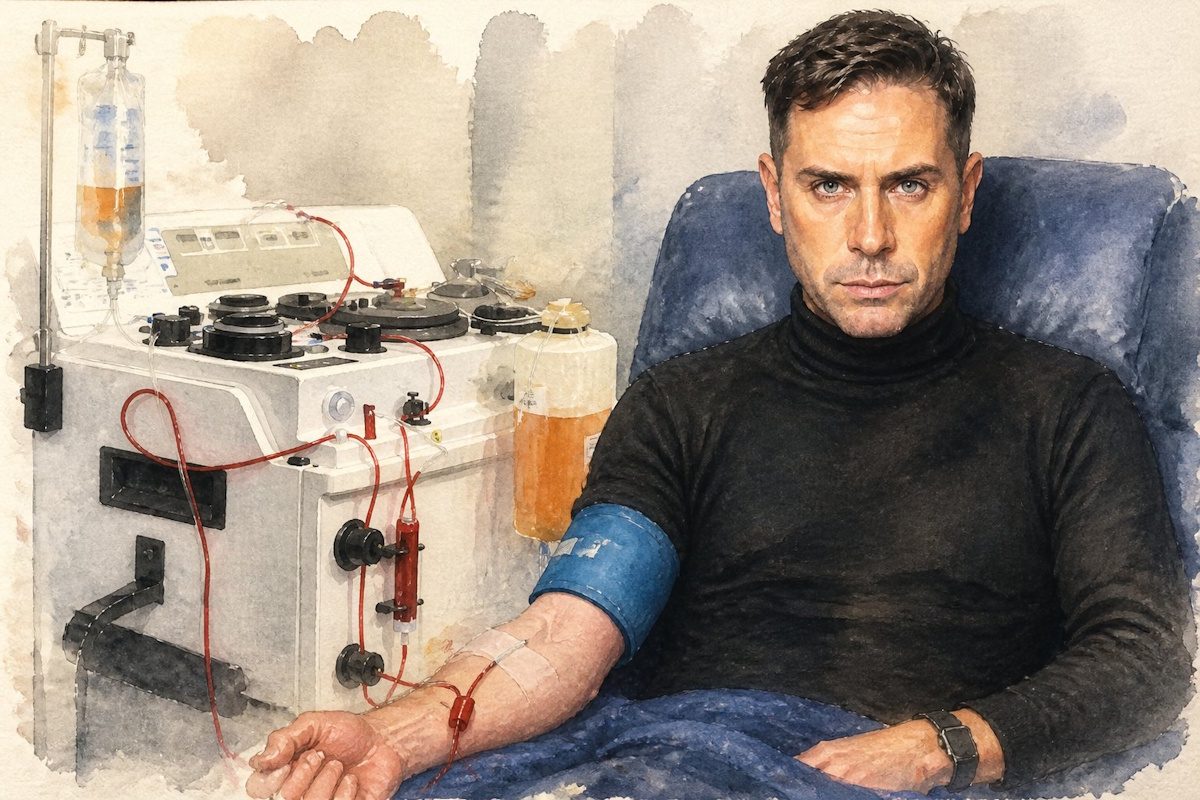
The investigation into the death of popular Greek singer Giorgos Mazonakis has taken a dramatic turn. The two doctors involved in his care now face the far more serious charge of homicide with possible intent (ανθρωποκτονία από πρόθεση με ενδεχόμενο δόλο).
The Athens Public Prosecutor’s Office filed the new criminal charges after fresh digital evidence gathered by the Hellenic Police (ΕΛ.ΑΣ.) was submitted to the 32nd investigating magistrate handling the case.
What triggered the upgrade
The new evidence centres mainly on digital data recovered during police examinations, with a report on the plasmapheresis machine — which recorded the singer’s vital signs — considered especially significant.
Notably, the request to upgrade the charge to homicide with possible intent had originally been made by lawyer Charalambos Lykoudis, who has represented Mazonakis for years and now represents his family in the case. Lykoudis cited case evidence and the defendants’ conduct before and after the singer’s death.
A felony charge of this kind carries a potential sentence of life imprisonment and opens up the possibility of pre-trial detention for the two doctors following their testimony.
Doctors granted extra time to respond

The couple, who run a private clinic in Kolonaki — an upscale central Athens neighbourhood — where Mazonakis suffered cardiac arrest, appeared before the investigating magistrate around midday.
Given the new evidence and the upgraded charge, they requested and were granted an extension, with their formal testimony now scheduled for Tuesday. Their lawyer, Nikos Agapinos, confirmed to reporters outside the Evelpidon courts that his clients would proceed with their statements as planned.
Police point to inconsistencies
Konstantia Dimoglidou, spokesperson for the Hellenic Police, addressed the case on ERT’s “Proines Diadromes” programme.
She said several digital evidence matters remain pending, with investigators still working to recover data and assess whether the defendants — or anyone else potentially involved — attempted to conceal important information.
According to Dimoglidou, the digital evidence recovered so far, including material retrieved from the female doctor’s mobile phone, contradicts the defendants’ original statements. Analysis of the plasmapheresis machine and computer data from the clinic reportedly shows that different actions were taken than what was initially reported.
She added that the timing of the patient’s arrival and the length of time he spent at the clinic also differ from what the two doctors originally told investigators. Evidence reportedly confirms he underwent a specific treatment.
Authorities are also awaiting results from phone record disclosures, which are expected to reveal communications between the defendants and other clinic staff from the moment Mazonakis arrived until paramedics took over his care.
What happens next
With the upgraded charge now formally in place, the two doctors are due to give their testimony to the investigating magistrate on Tuesday, as the case continues to develop based on ongoing forensic and digital analysis.
Doctor’s Testimony: Mazonakis Was “Restless,” Coughing, With Worsening Joint Pain

New details have emerged from testimony given by one of the doctors under investigation in the death of Greek singer Giorgos Mazonakis. According to her statement, the singer appeared restless, had a cough, and was suffering from worsening joint pain in the period before his fatal cardiac arrest.
The testimony forms part of the wider case file being examined by Greek authorities as they investigate the circumstances surrounding the singer’s death at a private clinic in Kolonaki, an upscale neighbourhood in central Athens.
What the doctor described
According to the doctor’s account, Mazonakis showed signs of restlessness in the hours leading up to his collapse.
She also stated that he had a cough and that his joint condition had deteriorated compared to previous visits.
According to her statement, Giorgos Mazonakis turned up alone at her surgery at around 7 pm on Tuesday, 8 September. There, she carried out an electrophysiological examination using the equipment available in her office and found that he was in a state of severe stress.
She explained that Mazonakis had confirmed her assessments on each occasion. When she asked him about possible substance use, he replied: “You can’t even imagine.” He also told her that he was taking diuretics to treat fluid retention.
According to her account, the singer was suffering from an unusual cough, hyperstimulation and difficulty standing for long periods.
As he had a performance coming up, Mazonakis had pressed for immediate treatment. He had asked her what could be done that very same day to resolve the situation.
The doctor then explained to him that she could quickly remove chemical or toxic substances from his body. She was referring to treatment using a special blood-purification machine. According to her statement, this method had no side effects or contraindications and was particularly suitable in such cases.
The treatment normally took two to three hours. She stated that she had not obtained written consent, as she had assumed that Mazonakis wanted the treatment because he had come to the surgery in the first place.
These details are now being weighed alongside other evidence in the case, including digital records and testimony already gathered by investigators, as authorities work to establish a clear timeline of the singer’s final hours.
Part of a wider investigation
This testimony comes as part of a broader and ongoing judicial process, in which the two doctors who ran the clinic face serious charges related to Mazonakis’s death.
Investigators continue to piece together statements from clinic staff, alongside technical and forensic evidence, to determine exactly what happened before paramedics found the singer in cardiac arrest.
Sources:



