

Newsflash from Tuesday, 24 February 2026:
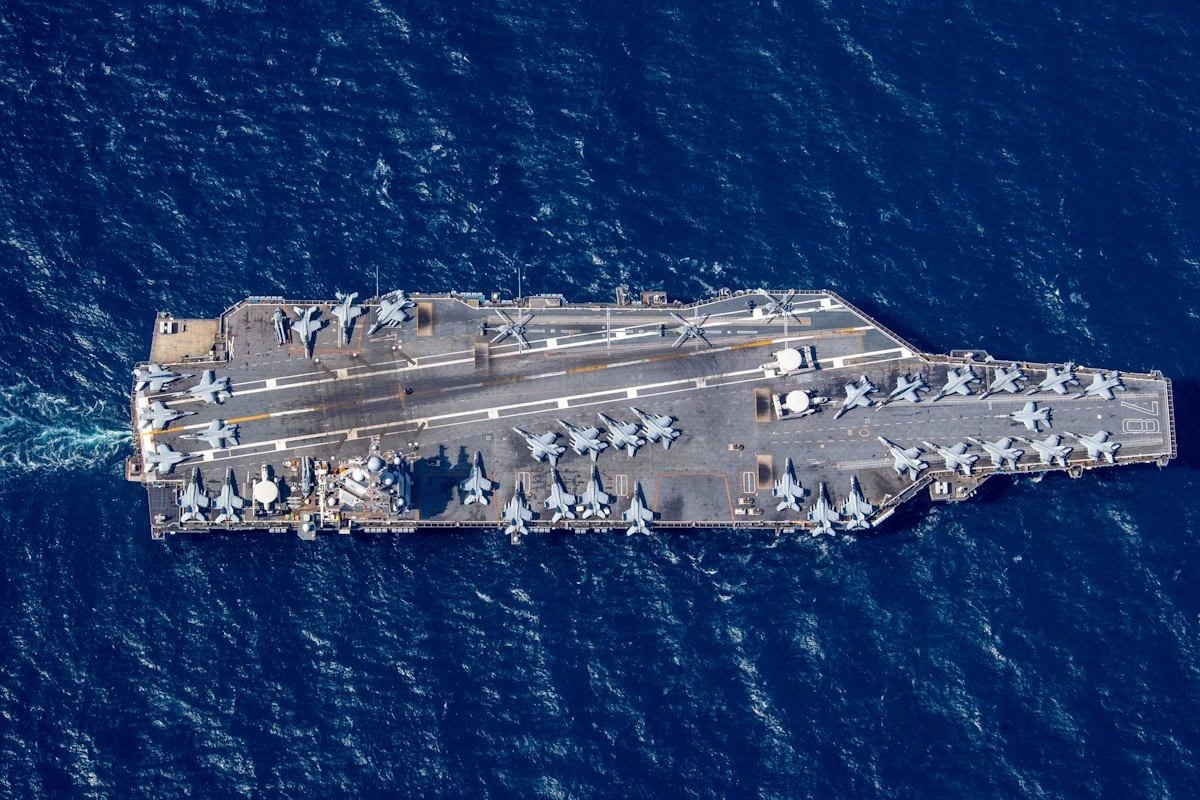
The horizon of Chania, Crete, looked significantly different this week as the world’s largest and most advanced aircraft carrier, the USS Gerald R. Ford (CVN 78), made a powerful entrance into Souda Bay.
The arrival of the U.S. Navy’s flagship at the Marathi NATO pier has drawn international attention, marking a significant moment in regional maritime operations.
A Show of Force in the Mediterranean
According to reports and visual data released by Reuters, the massive carrier was seen approaching the Souda Bay Naval Support Activity base. The stop is primarily intended for refueling, resupplying, and providing the crew with a brief period of rest.
However, the timing of this visit is far from routine. The deployment comes during a period of heightened geopolitical friction. President Donald Trump has recently directed the carrier’s strike group to head toward the Middle East as the administration evaluates potential military scenarios concerning Iran.
The USS Gerald R. Ford: A Marvel of Modern Engineering
As the lead ship of her class, the USS Gerald R. Ford represents the pinnacle of naval technology. Key features of this “floating city” include:
* Size: Measuring approximately 1,100 feet in length.
* Technology: Equipped with the Electromagnetic Aircraft Launch System (EMALS) and Advanced Arresting Gear.
* Capacity: Capable of carrying more than 75 aircraft and thousands of personnel.
USS Gerald R. Ford aircraft carrier arrives at Souda Bay on the island of Crete, Greece, February 23, 2026. REUTERS/Stelios Misinas pic.twitter.com/1wVMm4lwKg
— Idrees Ali (@idreesali114) February 23, 2026
Why Souda Bay?
Souda Bay remains one of the most strategic naval outposts in the Eastern Mediterranean. Its deep-water harbor is one of the few locations in the region capable of accommodating a carrier of the Ford’s magnitude.
The presence of the carrier in Crete serves as a reminder of the strong defense cooperation between the United States and Greece, while also acting as a logistical hub for U.S. operations moving toward the Persian Gulf and the broader Middle East.
Looking Ahead
As the USS Gerald R. Ford prepares to depart Cretan waters, all eyes remain on its trajectory toward the Middle East. With tensions surrounding Iran remaining a top priority for U.S. foreign policy, the movement of this carrier strike group is a clear signal of American presence and readiness in the region.
Massive US Air Power Buildup in Crete: F-22s and F-35s Swarm Souda Bay Amid Iran Tensions

The strategic landscape of the Eastern Mediterranean has shifted dramatically this week as Souda Bay, Crete, becomes the staging ground for one of the most significant concentrations of American air power in decades.
In a move described by analysts as the largest gathering of U.S. fighter jets in the region since the Iraq War, the Souda Air Base is currently buzzing with advanced 5th-generation stealth fighters and a massive support fleet.
The Stealth Duo: F-22 Raptors and F-35 Lightnings

The buildup is headlined by the arrival of at least a dozen F-22 Raptors, which touched down in Crete after a journey from the United Kingdom. These elite air-superiority fighters are joined by a significant number of F-35 Lightning II jets already stationed at the base.
* The F-35 Lightning II: Known as a “multirole” powerhouse, these jets use stealth technology to bypass enemy radars while providing pilots with an unparalleled 360-degree view of the battlefield.
* The F-22 Raptor: Widely considered the most capable air-to-air fighter in existence, the Raptor’s role is to ensure total air dominance, clearing the way for other operations by neutralizing any aerial threats.
The “Invisible” Support Network
While the fighter jets grab the headlines, the mobilization includes a massive logistical tail that makes long-range strikes possible. Spotted alongside the fighters are:
* Aerial Refuelers: Boeing KC-135 Stratotankers and KC-46 Pegasus aircraft are on-site, acting as “flying gas stations” that allow the F-22s and F-35s to reach deep into the Middle East without landing.
* Heavy Transports: C-17 Globemaster III aircraft have been delivering the necessary personnel, weaponry, and technical equipment to sustain a high-tempo operation.
* Special Ops Support: Lockheed MC-130 aircraft, designed for low-level infiltration and special operations, have also been integrated into the deployment.
Why Souda Bay?
The choice of Crete is no coincidence. Souda Bay is one of NATO’s most vital hubs, offering a unique combination of deep-water naval facilities and a high-capacity air base. Its location provides a “bridge” between Europe and the Middle East, allowing Washington to project power toward Tehran while maintaining a secure distance.
Around a dozen F-22 jets have transited through the UK en route to the Middle East, while large numbers of F-35s, A-10s, tankers, transports, and special operations aircraft have been spotted at Souda Bay in Greece. pic.twitter.com/IKwbxWjPlB
— Clash Report (@clashreport) February 21, 2026
A Clear Signal to Tehran
This massive deployment comes at a delicate time. As negotiations regarding Iran’s nuclear program remain at a standstill, the presence of these advanced warplanes sends a clear message of military readiness.
Whether this is a deterrent or a preparation for a potential strike remains to be seen, but one thing is certain: the eyes of the world—and the radars of the region—are firmly fixed on the activity in Chania.



