

Newsflash from Thursday, 12 March 2026:

Winter 2025–2026 will go down in the history books as one of the wettest Greece has seen in decades. From the peaks of the Pindos Mountains to the valleys of Epirus, the heavens opened, shattering records and filling reservoirs.
However, a closer look at the data from meteo.gr and the National Observatory of Athens reveals a fascinating climate divide: while the mainland was soaking, parts of southern Greece—and specifically Eastern Crete—told a very different story.
A Record-Breaking Season for the Mainland
For much of the country, the three-month period from December 2025 to February 2026 was defined by relentless rain. According to the network of automatic meteorological stations, several regions saw rainfall totals that were double their usual averages.
The “Wet” Highlights:
* Theodoriana, Arta: The undisputed “rain capital” of the winter, recording a staggering 1,580 mm of rain.
* Western Greece & Pindos: These regions bore the brunt of the storms, with stations in Megalohari and Zotiko also surpassing the 1,300 mm mark.
* Massive Deviations: In parts of Northern and Central Greece, rainfall was 100% to 130% higher than the 2010–2019 average.

The Crete Contrast: A Tale of Two Sides
While the mainland was dealing with historic deluges, Crete experienced a significant internal split.
In the West, the mountains acted as a rain trap. The Samaria – Xyloskalo station in Chania recorded a massive 1,269 mm, proving that the White Mountains can compete with the rainiest peaks of Epirus.
However, move toward the East and South, and the picture changes completely. The data shows that while the rest of Greece was drowning in record-breaking totals, rainfall in these areas remained close to or even below the climatic averages.
Why the Difference?
This “rain shadow” effect is common in Crete, but it was particularly pronounced during the 2025–2026 winter. While the atmospheric circulation brought moisture-heavy systems to the western and northern parts of the country, the southeastern corner of the Aegean remained relatively shielded. For residents and farmers in Eastern Crete, the “historic winter” felt much like any other—and in some cases, even drier than usual.
What This Means for 2026
This disparity highlights the complex microclimates of Greece. For the mainland, the surplus of water is a boon for hydroelectricity and groundwater levels. For Crete, the situation serves as a reminder of the island’s ongoing need for careful water management, especially in the eastern prefectures where the “rainy” winter didn’t quite deliver on its promise.
As we move into the spring and summer tourism season, one thing is certain: the Greek landscape has never been greener, but if you’re looking for that famous Mediterranean sun, the East of Crete remains your best bet!
Crete’s Water “Crash”: Aposelemi Dam Faces Critical Shortage After Four Years of Drought
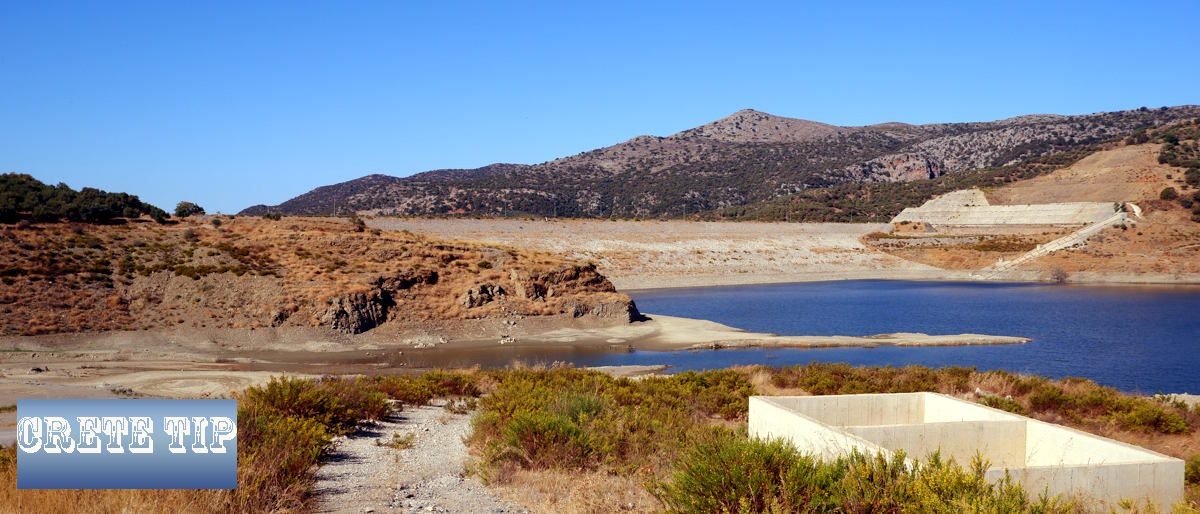
The region of Eastern Crete is staring down the barrel of a major water crisis. After four consecutive years of low rainfall, the Aposelemi Dam—the lifeblood for the island’s largest urban centers—has reached a breaking point.
Without significant rainfall this spring, local authorities warn of an impending “crash” in the water supply system, forcing emergency measures just as the high-demand summer season approaches.
The Numbers: A Dam on the Brink
The statistics provided by water management authorities are sobering. For the Aposelemi Dam to provide a smooth, “normal” supply to the municipalities of Heraklion, Hersonissos, and Agios Nikolaos, water levels should ideally sit at a safety limit of 5 million cubic meters.
Today, the reserves have plummeted to just 1.8 million cubic meters.
This massive deficit has forced the dam into a state of “under-operation.” To stretch the remaining resources through the summer, supply rates have been slashed. Until May, the dam will only provide:
* 60 cubic meters per hour to Heraklion.
* 20 cubic meters per hour to Hersonissos.
* 20 cubic meters per hour to Agios Nikolaos.
A “New Reality” or a Failure of Planning?
The current situation has sparked a heated debate across Crete. While the weather is undoubtedly a factor, many are asking why “emergency plans” are only being discussed now, four years into a documented drought cycle.
Critics argue that the lack of long-term infrastructure and serious water management has left the region vulnerable. With climate change making drought a “new reality” rather than an occasional emergency, the pressure is on for local DEYA (Water Utilities) to find alternative sources and for the government to invest in more resilient infrastructure.
Is There Any Hope?
While the situation is dire, there is one small silver lining. The underground aquifers in the Lassithi Plateau and the Katharo Plateau—which serve as the primary feeders for the Aposelemi reservoir—did see some replenishment during the rains in February.
While these rains weren’t enough to “save” the dam immediately, they have saturated the ground. This means that any additional spring rainfall will flow more directly into the reservoir rather than being absorbed by dry earth. However, without heavy, consistent downpours in the coming weeks, these gains will be negligible.
What This Means for Residents and Visitors
As the Region of Crete prepares for a record-breaking tourism season, the water shortage presents a significant challenge. Residents are being urged to practice extreme water conservation, and restrictive measures are already being pulled “out of the drawer” for implementation.
The goal is simple but difficult: keep the dam active through the scorching summer months when demand peaks. If the spring rains don’t arrive, the City of Heraklion will have to rely almost entirely on its own wells and alternative sources to keep the taps running.
Are you living in Eastern Crete? How are you preparing for potential water restrictions this summer? Share your thoughts and tips for water conservation in the comments below.



