

The situation on the mainland: Forest fires in West Attica have now been raging for five days; animal rescue volunteers are battling the flames; Griechische Welle Austria is supporting the victims of the forest fires in Greece.

Crete’s Wildfires Raise a Difficult Question: Is Overtourism Straining Greece’s Islands?
The devastating fires that swept across Crete and other Greek islands have renewed concerns about whether tourism growth is outpacing essential infrastructure. While extreme heat, dry vegetation and strong winds remain major wildfire drivers, the destruction has highlighted deeper pressures linked to waste management, water supplies and rapid construction.
Wildfires expose growing vulnerabilities
Recent fires affected parts of Crete, as well as Paros, Andros, Lesvos and the Peloponnese. Thousands of people were reportedly evacuated from areas of Crete, while large areas of vegetation, forest and natural habitat were damaged.
Strong, shifting winds helped the flames spread quickly, making firefighting particularly difficult. However, the scale of the emergency also drew attention to the challenges faced by islands that experience a dramatic seasonal increase in population.
Tourism growth and limited infrastructure
According to reporting by the Financial Times, the fires have exposed the risks created by rapid tourism development across Greece’s islands. Many island communities have limited water resources and waste-management systems that struggle to cope during the peak season.
The situation on Paros illustrates the problem. The island has approximately 15,000 permanent residents but receives around one million passenger arrivals each year through its port and airport. Its landfill had reportedly reached capacity by 2022, while the closure of a private recycling-sorting facility led to recyclable materials accumulating near the waste-disposal site.
Investigators examined whether piles of recyclable material, branches and household waste may have contributed to the fire that began inside the landfill area. The incident resulted in the arrest of four people, including the mayor of Paros and the deputy mayor responsible for sanitation. All four were later released after appearing before a prosecutor, while the investigation continued.
More than a firefighting issue
Experts and local residents argue that the risk is not limited to the immediate causes of individual fires. Rapid construction, short-term rentals and the growth of gardens and holiday properties have increased the volume of construction debris, old appliances and green waste.
When waste facilities lack capacity or proper fire-protection measures, combustible materials can accumulate and turn an already dangerous situation into a major environmental emergency.
Tourism itself does not cause wildfires. Fires are influenced by weather conditions, vegetation, human activity and land-management practices. Yet overtourism can intensify the consequences by placing additional pressure on infrastructure that was designed for a much smaller permanent population.
Can better planning reduce future risks?
The Greek Environment Ministry has announced plans for a new waste-recovery and recycling facility on Paros through a public-private partnership. Similar projects are also planned or being developed in other popular island destinations, including Mykonos and Syros.
Long-term resilience will require more than new facilities. Authorities will also need effective recycling systems, stricter control of illegal dumping, improved fire prevention, adequate water planning and building policies that reflect each island’s real capacity.
A warning for Greece’s tourism model
The fires in Crete and elsewhere do not have a single cause. Nevertheless, they offer a clear warning: tourism growth without matching investment in infrastructure and environmental protection can leave island communities increasingly exposed.
As Greece prepares for future tourism seasons, the central question is not whether visitors should come, but whether destinations can welcome them safely and sustainably.
The Situation on the Mainland: Wildfires in Western Attica Enter a Fifth Day as Crews Battle New Flare-Ups
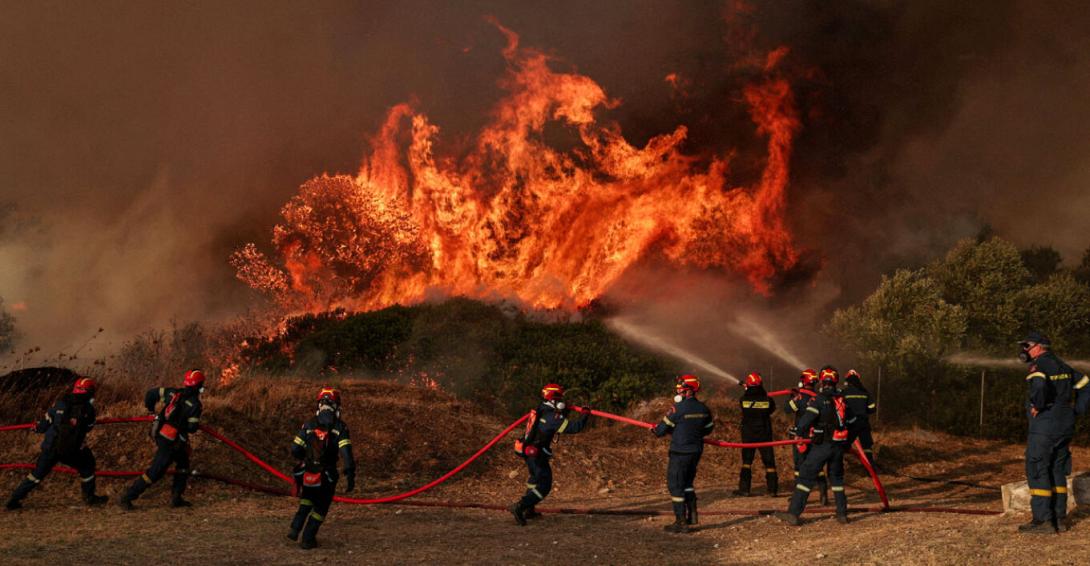
A major firefighting operation in western Attica has entered its fifth consecutive 24-hour period, with crews continuing to tackle scattered hotspots and renewed flames across a vast, difficult perimeter.
The fires began on Friday, 31 July, after starting in Boeotia and spreading toward western Attica. Firefighters, volunteers and support teams worked through the night to contain active pockets and prevent further spread.
Three key operational sectors
Under the coordination of the “Olympus” Mobile Operations Centre, the affected area has been divided into three main sectors:
- North and northeast of Psatha: including Kryo Pigadi, Agios Nektarios, Agia Paraskevi and the Kithairon mountain ridge, toward Vilia.
- South and southwest: covering Psatha, Loumba, Veniza and Zachouli.
- Southeast: extending from Kandili and the Moni Kamara area toward Megara.
Authorities reported a general improvement in the situation, particularly around Loumba, Zachouli and Kandili. However, the extensive fire perimeter and numerous isolated hotspots continued to pose a serious risk.
Renewed activity near Psatha and Loumba
The most challenging area remained between Psatha and Loumba. A new flare-up was reported early in the morning approximately two kilometres north of Loumba, in a pine-forest area between the two locations.
The difficult terrain made ground operations especially demanding. Strong forces, including specialist forest-fire crews, were deployed to contain the flames. Another dangerous area was reported southeast of Alepochori, near Agnanti beach.
Firefighters also remained alert to “small glowing spots” that can retain heat and reignite on the slopes above Psatha, where olive groves and woodland are located.
Hundreds of firefighters remain deployed
Approximately 450 firefighters were operating in the area with 126 vehicles and 22 foot teams, supported by volunteers and numerous water tankers.
Firefighters from France and Romania were also assisting the Greek response. A total of 46 international firefighters—23 from each country—were deployed with eight vehicles.
During Monday’s operations, 34 aerial assets were made available, including 23 aircraft and 11 helicopters. Three helicopters served in coordination roles, while the Armed Forces’ “Deucalion” team also participated in the emergency response.
Firebreaks and damage assessment
Heavy machinery from the Regions of Attica and Central Greece, together with equipment from the Directorate for Construction and Natural Disaster Response, was used to open and strengthen firebreaks in cooperation with the Forestry Service.
Although the situation showed signs of improvement in several sectors, authorities warned that the large perimeter and continuing flare-ups made it too early for complacency. The fires have damaged properties and agricultural land, while the full extent of damage to homes was not yet clear at the time of reporting.
Animal Rescuers Race Against the Flames in Western Attica

With residents evacuating and smoke covering large areas, many animals were unable to escape on their own. Rescue teams entered affected communities whenever conditions allowed, searching homes, yards, farms and roadside areas for animals in distress.
Pets and livestock left behind
Dogs and cats were among the animals rescued from fire-affected locations. Some were found trapped inside properties, while others had been abandoned or became separated from their families during the evacuation.
Rescuers also searched for livestock and other domestic animals in fields and rural facilities. In several cases, teams had to work in intense heat and heavy smoke while trying to move frightened animals to safety.
The rescue effort included animal welfare organisations, volunteers, veterinary teams and municipal services. Temporary collection points were established to provide rescued animals with water, food, medical attention and shelter.
Wildlife also caught in the disaster
The emergency extended beyond domestic animals. Wildlife affected by the fires was collected and transported for assessment and treatment. Injured or dehydrated animals require specialised care before they can be returned to suitable habitats.
Rescuers have repeatedly stressed that people should not attempt to approach dangerous fire zones without coordination with emergency services. Smoke, falling branches, unstable structures and rapidly changing winds can put both animals and rescuers at risk.
How the public can help
People who find an animal in an affected area should provide its exact location, a photograph if possible and details about its condition. Residents should avoid entering evacuated zones unless authorities have declared them safe.
Donations of food, crates, blankets, veterinary supplies and financial assistance can also support the organisations working around the clock. Anyone searching for a missing pet should contact local municipalities, shelters and recognised rescue groups, while checking temporary animal collection points.
A race against time
The rescue operation in Attica highlights the importance of including animals in emergency planning. Identification tags, microchips, transport crates and evacuation plans can save valuable time when wildfires threaten homes and rural areas.
As firefighting crews continue to battle the blaze, animal rescuers remain on the ground—searching, treating and relocating animals that would otherwise have little chance of survival.
Griechische Welle Austria Extends Support to Greece’s Fire Victims
When wildfires devastate communities across Greece, help is needed long after the flames are gone. The Austrian humanitarian organisation Griechische Welle Austria supports people affected by fires and other natural disasters, while also assisting vulnerable families and children throughout Greece.
Direct assistance for affected communities
Formerly known as Griechische Welle Wien, Griechische Welle Austria describes itself as a humanitarian aid association dedicated to supporting socially disadvantaged people in Greece. Its work includes assistance for families who have lost their homes or livelihoods in devastating fires.
The organisation also supports people affected by earthquakes and severe weather, as well as orphans, children and young people with disabilities, and children who have experienced abuse or neglect.
Working with local partners
Griechische Welle Austria says it works with recognised Greek social organisations so that donations can be passed directly to people in need. This local-partner approach helps identify urgent needs and deliver practical support where it matters most.
In addition to emergency aid, the association has supported school-start initiatives, provided heating stoves for families in need and assisted voluntary fire brigades with equipment and vehicles.
Volunteers keep the organisation running
The association’s members work voluntarily and without payment in their free time. According to the organisation, members of its leadership cover travel and many administrative expenses privately, helping to ensure that donations can focus on assistance projects.
Unavoidable expenses, such as bank and administrative charges or the transport of donated goods, may be charged to the association’s account.
How to support fire victims in Greece
People who would like to help can learn more about current appeals, projects and donation options on the official Griechische Welle Austria website. The organisation’s work demonstrates how international solidarity and local cooperation can provide meaningful support to communities rebuilding after disaster.
Important: Please check the organisation’s official website for the latest project details and verified donation information before contributing.
Sources
Cretalive: Financial Times report on wildfires, overtourism and infrastructure pressures on Greek islands
eKriti: Wildfire emergency in western Attica enters its fifth day
Zoosos: Rescue efforts continue for animals trapped by the fires in western Attica
Griechische Welle Austria – Official website



