

In Greece, outdated technology in the transport sector repeatedly causes problems. The latest failure in Athens airspace showed that old communication systems, ignored warnings and employees working overtime are a dangerous combination.
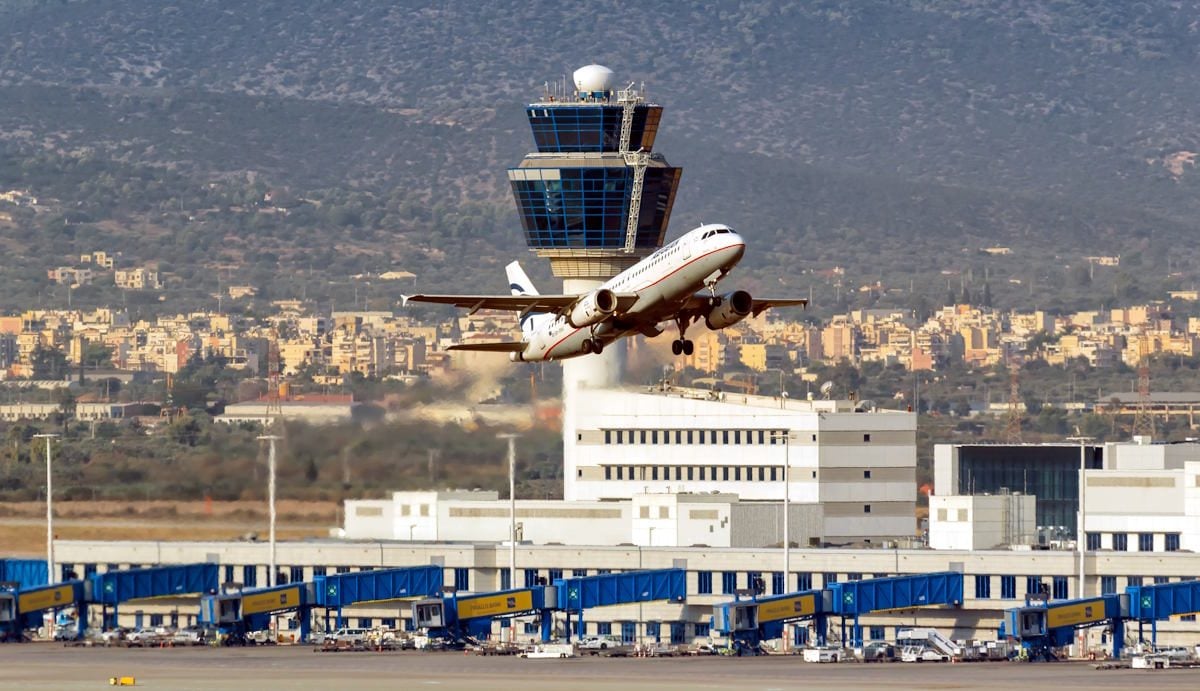
Investigations and experts say that without rapid modernisation, similar incidents could occur again and again. The necessary upgrades often remain piecemeal, meaning that the country regularly narrowly avoids major failures.
Impossible to determine the exact cause of the failure – OTE had been warning since 2019
The investigation report states that it is no longer possible to determine the exact cause of the failure at the Athens Air Traffic Control Centre. Missing or incomplete logs make it virtually impossible to clearly identify the cause.
Without these records, many sources of error remain mere speculation. Technical components get out of sync – sometimes due to material problems, sometimes due to timers, heat or power fluctuations.
Such factors can occur individually or in combination. This makes tracking even more difficult.
The interfaces and systems used are outdated. Old transmission architectures provide hardly any useful diagnostic data and do not guarantee stable operation.
As a result, it is not possible to derive clear error chains from old logs. OTE, the network operator, has been calling for modernisation since 2019.
At that time, OTE recommended switching from the old synchronous structures to an IP-based, broadband architecture. This would have improved reliability and diagnostic capabilities.
Briefly on the infrastructure problems:
- The voice communication system uses technology that manufacturers hardly support anymore.
- Outdated networks provide little monitoring data.
- Without support, the risk of malfunctions and long downtimes increases.
Consequences of this situation:
- Less transparency in the event of malfunctions – without logs, much remains unclear.
- Longer recovery times – spare parts and expertise for old systems are often lacking.
- Risk of recurrence – without modernisation, the vulnerabilities remain.
Typical scenarios that illustrate this:
- A timing failure paralyses several parts of the system. With incomplete logs, no one knows where the problem originated.
- A problem with the power supply causes voltage drops. The traces in the records are so faint that they are easy to overlook.
A modern, IP-based solution not only provides faster data transmission. It also offers better diagnostic tools and more support from the manufacturer.
What experts are calling for:
- Introduce comprehensive system and error logging.
- Switch to IP-based networks with redundancy.
- Regular testing of time base and power supply.
- Contracts with manufacturers for long-term support or replacement.
Warnings such as those from OTE should not be ignored. Those who postpone modernisation miss the opportunity to truly eliminate sources of error.
Ageing technology and incomplete documentation make it impossible to perform a clean analysis later on. The report does not directly blame OTE, but it shows that outdated technology and poor record-keeping make it impossible to determine the causes of errors with certainty.
Without complete logs and modern monitoring, the analysis of incidents remains a guessing game. The recommendations are clear: out with old technology, in with robust logging and monitoring.
It cannot be ruled out that something like this could happen again

The Secretary General of Air Traffic Control warns that such an incident could well happen again. He calls for a rapid safety assessment and questions whether control centres should really be operating at full capacity on a permanent basis.
Until the matter is clarified, he recommends reducing the workload in order to minimise risks. He also says that air traffic control will only continue to operate safely as long as the technology works.
If failures occur again, the situation will become serious – many systems are old and urgently need to be replaced. Old equipment makes the system vulnerable and makes it difficult to monitor flights safely.
The demand is clearly directed at the state. Modernisation must not wait until the next incident highlights the danger again.
New systems could improve stability and make the job of air traffic controllers easier. With the latest technology, errors can be found and corrected more quickly.
Important points:
- Check safety: Safety assessments must show whether full capacity is okay.
- Temporarily reduce capacity utilisation.
- Replace old technology.
- Government responsibility – investment must finally be a priority.
- Strengthen public confidence: it is not a question of fuelling fear of flying.
What will happen if the renewal continues to stall?
- The risk of failures will increase.
- Flight delays or groundings become more likely.
- More stress for staff in the event of disruptions.
- Safety gaps when errors snowball.
He says that he and his family will continue to fly. It is not about demonising, but about safety for passengers and staff with better technology.
His specific proposals:
- Start a safety assessment immediately.
- If necessary, temporarily reduce traffic load.
- Plan and finance a replacement programme for old systems.
- Short-term measures for more redundancy in critical parts.
The equipment should have been replaced in 2010

The air traffic control equipment dates back to the late 1990s. It is long outdated.
Technical devices that have been in operation since 1999 hardly meet modern standards anymore. This significantly increases the risk of malfunctions.
He repeatedly states that replacement would have been necessary by 2010 at the latest. The delay has led to a shortage of spare parts, and the manufacturer no longer offers support.
This makes repairs more expensive and time-consuming. Sometimes improvisation is necessary because original parts are unavailable.
The airlines finance most of the system themselves. They pay fees for en route and terminal services, which are used to pay for maintenance and modernisation.
Private operators therefore bear the costs of wages, spare parts and technology. State funds play hardly any role.
The state contributes almost nothing from the budget. However, the responsible authority decides how the fees are used.
This leads to dependencies. In the end, a lot depends on administrative decisions, not on local needs.
Critics say that the funds are not being reinvested entirely in the infrastructure. Some of the revenue ends up elsewhere.
It is often unclear to outsiders how much is actually being spent on modernisation. There is a lack of transparency.
Outdated systems entail technical risks:
- Fault diagnosis takes longer because spare parts are unavailable.
- No more support for old hardware.
- Modern software is difficult to integrate.
- Operating costs rise because everything runs less efficiently.
Staff also notice the consequences. They work with old interfaces and often have to improvise.
This reduces efficiency. In critical situations, the pressure on people increases.
Typical consequences of outdated equipment:
- Failures and malfunctions become more frequent.
- Repairs take longer.
- Emergency solutions cost more.
- New systems often do not fit together properly.
- Training is made more difficult by old technology.
The airlines pay, but the administration decides how the money is spent. This creates a conflict of interest.
The companies invest, but have little influence on priorities. This often feels unfair.
In practice, spare parts for 1990s equipment are almost impossible to obtain. Technicians have to resort to used parts or order custom-made parts.
This means that repairs take longer and become more expensive. It is not uncommon for everything to come to a standstill.
Experts are discussing various recommendations:
- Funds should be set aside specifically for air navigation equipment.
- External audits could check how the funds are being used.
- A clear investment plan with fixed deadlines would be helpful.
- Contracts with manufacturers should guarantee longer support.
In the short term, preventive maintenance, spare parts stocks and loan systems can help. But to be honest, without complete modernisation, all this is just a patchwork solution.
The debate revolves around transparency and accountability. As long as no one discloses how the fees are distributed, doubts remain.
This undermines confidence in the administration. Operators feel they are not being taken seriously.
‘We have been warning about this for years – and yet much has remained undone.’
He sums it up: authorities and those responsible had enough time to identify problems. Nevertheless, most of the time, only announcements and contracts followed, which changed little.
This pattern has been going on for years. Words are simply not enough.
Promises and symbolic signatures do not bring about any visible improvements. Many critical facilities are still running on technology that is no longer up to the task.
There were enough warnings. Since 2023, the professional association has repeatedly reported the urgency of the situation in writing and publicly.
These warnings were sent to ministries and management levels. Nevertheless, most of them remained mere lip service.
The devices are from a different era. They were never intended for today’s continuous operation and increasing utilisation.
Now they run around the clock and wear out faster. As a result, errors occur more frequently.
Compatibility between old and new systems remains an ongoing problem. It has been known for years that older components no longer interact smoothly with new devices.
The risk of malfunctions increases, and updates become a test of patience. Without coordinated renewal plans, every transition remains risky.
The consequences are immediately apparent in everyday life. If a central component fails, it has a ripple effect throughout the entire system.
Individual malfunctions can spread and bring everything to a standstill. This increases the number and severity of incidents.
Staff are then under enormous pressure. They have to fix failures under the most difficult conditions.
The pace of modernisation simply remains too slow. Projects are delayed by bureaucracy, coordination problems and sluggish budget approvals.
Experts are calling for clearer priorities and faster procedures. Investments must finally reach where they are needed.
He calls for concrete steps:
- Immediate inventory of all critical systems.
- Priority lists for replacement and repair based on risk.
- Short-term measures against failures.
- Faster procurement channels with fixed schedules.
- Better coordination between ministries, authorities and operators.
Modernisation is not just about replacing old hardware. It also requires support concepts, training and regular maintenance.
Without long-term operational reliability, any new purchase is a drop in the ocean.
Money plays a major role, of course. Investments are expensive, but failures usually cost more in the end.
Delayed modernisation drives up costs – emergency repairs and breakdowns are a significant expense.
Preventive financing would be cheaper in the long run. But who wants to hear that?
Transparency is often lacking. Reports on the state of the infrastructure and progress in modernisation build trust.
Public timetables and evaluation reports help to make responsibilities visible.
We mustn’t forget the staff. Technicians and operators work under pressure, especially when old systems are constantly causing problems.
More training and support could help here. Stable operation requires not only technology, but also motivated specialists.
Crises should actually be a wake-up call. A major failure could provide an opportunity to finally pick up the pace.
Decision-makers would then have to move from announcements to real action. This is the only way to prevent further disruptions.
EEEKE: ‘Traffic cannot be managed in summer’

The air traffic controllers’ union warns that the system will not be able to cope with the increase in flight movements in the summer.
It believes that the existing technology and procedures will not be sufficient when the season reaches its peak and there are significantly more flights.
The current conditions are such that increased demand in air traffic simply cannot be handled reliably.
This will lead to more delays, possible airspace closures and even more pressure on staff and infrastructure.
The union holds the management of the national air traffic control authority responsible for capacity management.
It is calling for capacity to be restored to 100 per cent immediately.
It rejects a gradual return or permanently reduced capacity as long as the cause of the failure is unclear and measures to prevent a recurrence are lacking.
There is also criticism of internal communication and decision-making processes.
The investigation revealed problems in the diagnosis and a lack of coordination between management levels.
According to the union, this chaos caused unnecessary delays in responding to the incident.
The air traffic controllers emphasise that their efforts and correct procedures ensured that all aircraft landed safely during the incident.
They say that the professional efforts of the controllers stabilised the situation and prevented worse from happening.
According to the union, the decision to temporarily close the airspace and implement the zero-rate procedure was crucial.
The investigation did not find a clear cause for the failure. It could be that several factors came together.
For the union, this shows how vulnerable the technology currently is.
They are particularly concerned about the voice communication system because it does not allow for reliable operational commitments.
Without stable voice connections, control and coordination in airspace is hardly possible in a safe manner.
The organisation is calling for an immediate review of the technology and rapid investment.
It wants to replace old systems and introduce modern redundancies.
This includes backup systems to compensate for failures and tested emergency plans that really work in a crisis.
The union also demands clear responsibilities within the authority.
Especially in times of crisis, decisions must be made quickly and uniformly.
It sees the delays to date and the lack of a coordinated management structure as major weaknesses.
The demands can be roughly divided into three areas:
- Technical renewal: replacement and modernisation of communication and surveillance technology.
- Capacity management: immediate restoration of full operating capacity without phased restrictions.
- Management and organisational structure: clear lines of responsibility, rapid decision-making and better internal cooperation.
The union also questions what the long-term plan is.
What measures are already in place to prevent similar incidents in the future?
In its view, there are currently no real guarantees that the systems will remain stable under high load.
Personnel issues also play a role.
During the incident, the air traffic controllers felt overworked and under pressure.
The organisation is therefore calling for not only technical but also organisational measures to relieve the burden on staff.
These include better shift schedules, more staff during peak times and regular emergency drills so that the team can act more confidently in stressful situations.
In its statement, the union recalls earlier warnings.
It says that it has repeatedly pointed out outdated equipment and identified risks.
It sees the current investigation results as confirmation of these warnings.
For the union, the whole thing highlights a long-simmering problem that has now finally come to light.
The union is also calling for transparency towards the public and airlines.
Travellers and airlines should be informed about possible restrictions and planned improvements.
This is the only way to restore confidence and enable meaningful planning for the season.
Financial aspects also come into play.
The organisation emphasises that investments in technology and personnel are necessary to ensure safe operations.
Cost-cutting measures at the expense of operational safety are not an option for them.
It is calling for clear budget allocations for modernisation and emergency preparedness.
The EEEKE makes it clear that reduced capacity during the peak season is not an option.
This would damage the tourism sector and air traffic economically.
It believes that short-term and decisive measures are necessary to keep operations stable.
In detail, the union lists the following technical measures as urgent:
- Inspection and replacement of outdated voice communication systems.
- Establishment of redundant communication channels.
- Introduction of modern monitoring and control systems.
- Regular tests and stress tests of the entire infrastructure.
In terms of organisation, it calls for:
- Immediate restoration of full capacity without gradual restrictions.
- Clear contingency plans with defined responsibilities.
- Faster internal information flows and decision-making processes.
- More staff and better working conditions for air traffic controllers.
The union is using the investigation results to exert public pressure.
It wants air traffic control management to take concrete steps and present timetables for implementation.
Without such commitments, it sees the risk of further disruptions in the next season.
It is also calling for regular reports on progress with modernisation.
These reports should be independently verifiable and visible to authorities, airlines and the public.
This will at least make it possible to verify whether the promised measures are actually being implemented.
In the short term, the union advises a more conservative approach to flight planning.
This could mean capacity limits in case of further disruptions.
However, it emphasises that this is only a stopgap solution.
Such restrictions cannot remain in place permanently because they would restrict the air traffic system too much.
The union’s position has met with widespread approval in the industry.
Airlines and tour operators are following the debate closely.
Many are also calling for quick solutions to prevent air traffic from collapsing in the summer.
The union has announced that it will continue to publicly highlight problems and take further action if necessary.
It sees it as its duty to ensure safety in the airspace and to draw attention to potential hazards.



