

Greece’s tourism balance sheet: record visitor numbers, plummeting spending – is this the moment of reckoning, and what will happen after the era of mass tourism?

Crete’s Tourism Boom Masks Serious Infrastructure Cracks and Safety Concerns
Crete’s tourism sector is firing on all cylinders in August 2026, with record passenger numbers streaming through airports and ports. But beneath the success story lies a troubling reality: the island’s ageing infrastructure and services are struggling to keep pace with the flood of visitors.
Record numbers, stretched resources
Heraklion airport alone processed 181,145 passengers in just three days (7-9 August), with over 360 flights operating daily. July figures showed 1.75 million passengers passing through Heraklion airport, up 3.3% on the previous year.
Chania airport is experiencing even more explosive growth, with a 15.1% year-on-year increase in available seats — far above the national average of 7.6%. The two airports combined now handle nearly 5.8 million inbound international seats annually, accounting for almost 20% of all Greek air traffic.
Maritime arrivals add another layer to the pressure: 32,630 ferry passengers arrived at Chania’s Souda port in the first two weeks of August alone, with peak days seeing over 3,500 arrivals.
When the system breaks down
But the welcome mat is wearing thin in places. On Saturday morning at Heraklion airport, incoming passengers faced shocking scenes as they queued for passport control.
One traveller reported that crowds were so backed up that people were forced to wait on the airport’s taxiway — the actual runway used by aircraft — while processing was completed. The delays occurred just after 1 a.m., suggesting serious understaffing of border control staff during night shifts.
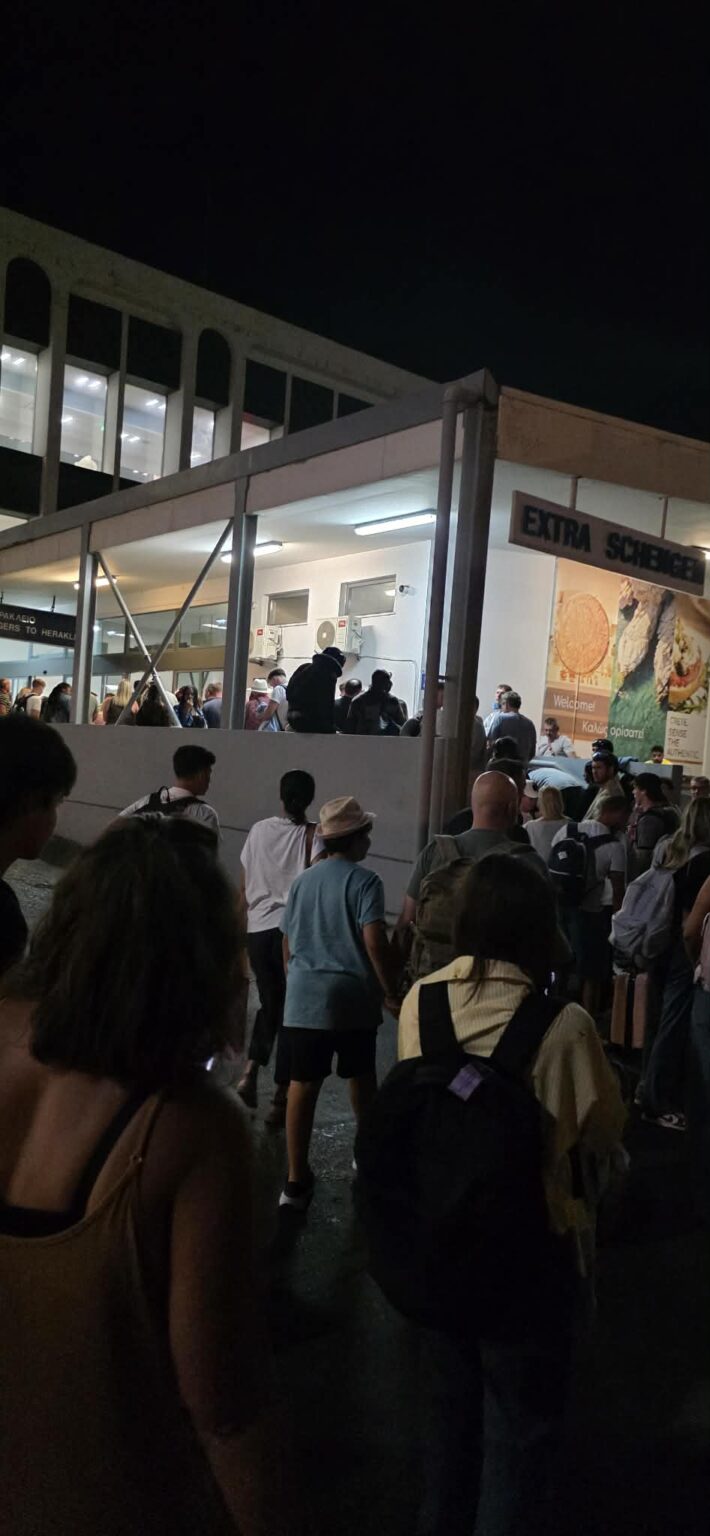
This is not a minor inconvenience: passengers standing on an active taxiway poses both a safety and security risk that should never occur at a major international airport.
Infrastructure buckling under pressure
The real problem extends far beyond passport queues. Crete’s physical infrastructure — roads, energy grids, water systems and waste management — is visibly straining under the summer load.
The aging Northern Road Axis (BOAK) connecting Heraklion to other parts of the island is becoming increasingly congested, with ongoing roadworks making conditions worse. The power grid is being tested daily as hotels, restaurants and tourist facilities pump electricity demand to peak levels during heatwaves.
Water supply is another critical concern, particularly as the summer progresses and municipal reserves dwindle. The pressure on waste disposal systems is equally acute.
A divided island
Heraklion and eastern Crete continue to dominate the tourism picture, with 4.25 million available seats and a 7.6% year-on-year increase. German tourists remain the lifeblood of this region, accounting for over 1.27 million bookings, followed by the UK (775,000), France (470,000) and the Netherlands (223,000).
However, western Crete (Chania) is experiencing a tourism renaissance that may offer a counterbalance. With 15.1% growth compared to the national average of 7.6%, Chania is emerging as a serious alternative to the saturated east.
This geographic diversification could relieve pressure on Heraklion’s creaking systems — but only if the western infrastructure is upgraded in parallel.
Market fatigue and the slowdown in bookings
Despite the undisputed dominance of traditional markets (Germany, the UK, France, Italy), the data from the INSETE booking system reveal a detail that should prompt the local government and local authorities to take action. At the end of July, in the middle of the summer peak season, a sharp decline in new bookings was recorded compared with the previous year.
The figures are telling: a fall of -33.4 per cent from Germany, -28.0 per cent from the United Kingdom, -34.6 per cent from Italy and -21.5 per cent from the USA.
The frequently cited narrative – namely that tourists have been flocking to ‘early bookings’ in recent months – offers a partially convincing explanation.
However, as observers of international trends, we cannot ignore the facts. The significant delay in last-minute bookings indicates clear market fatigue.
The European middle class, under pressure from inflation, is reacting to the sharp rise in prices for Greek tourism products, and particularly those in Crete. If the island is considered overpriced by the average European visitor, the vast supply of airline seats risks remaining an empty, unused farce in the future.
The September test
The real challenge for Crete will come after 15 August, when the peak summer holidays end. September and October will determine whether the island’s 2026 tourism boom can sustain itself into the autumn shoulder season.
If demand remains strong, the extended season could spread visitor numbers more evenly across the year, easing pressure on summer infrastructure. But if numbers collapse after mid-August, the island will face a very different problem: a shortened season that demands maximum extraction during just a few weeks.
Looking ahead: the Kastelli factor
One major wildcard is the planned new international airport at Kastelli in the Heraklion region. When operational, this facility could transform tourism patterns by allowing long-haul flights and attracting a higher-spending, less mass-market clientele.
However, the airport’s opening date remains uncertain, leaving the island dependent on its current, overstretched facilities for the foreseeable future.
The verdict
Crete is undoubtedly a tourism success story in 2026, with international demand remaining resilient despite broader European economic caution. But the island’s leaders must urgently address infrastructure deficits and service capacity gaps, or risk turning visitors away through poor experiences.
The queues on the taxiway are a warning sign that cannot be ignored.
Greece’s Tourism Reckoning: Record Visitors, Plummeting Spending – The Dangerous Math Behind the Headlines

Greece is celebrating record tourism numbers in 2026, but behind the triumphant announcements lies a troubling reality that tourism experts have been warning about for years. The numbers tell a story that official statistics often obscure: more tourists are arriving, but they’re spending significantly less.
The contradiction at the heart of Greek tourism
In the first half of 2026, Greece welcomed 13.49 million international visitors, a 15.4% increase on the same period in 2025. Yet tourism revenues rose just 14.8% to €8.796 billion — and this masks a far more concerning trend hidden in the fine print.
Average spending per tourist fell by 0.6% in the first half of the year, dropping to €621.60 per trip. This might sound marginal, but June’s figures revealed the true crisis: while arrivals jumped 6.9%, tourism revenues grew by just 1.2%.
June’s average spend plummeted 6.2% year-on-year, from €712.50 in June 2025 to €668.50 in June 2026. In real terms, accounting for inflation, Greece’s tourism sector actually contracted.
The visitor paradox
Greece faces a paradox that threatens its economic model: the country is increasingly expensive as a destination, yet hotels remain underpriced relative to what visitors experience overall. A tourist might find a bargain room rate, only to face shocking prices for transport, dining, entertainment and activities once outside the hotel door.
This creates a dangerous disconnect. Visitors feel trapped between their expectations and the reality of Crete and Greek island costs. They cut back on meals, shopping, activities and experiences — exactly the high-margin spending that generates profits for restaurants, tavernas, shops and local businesses.
As one hospitality sector source put it: “The tourists are here, the streets are full, the flights arrive, but the cash registers aren’t following with the same intensity.”
Which markets are pulling back?
June data exposed dangerous weakness in key source markets. Receipts from Germany fell 14.5%, from the United Kingdom dropped 26.1%, and from the United States declined 3.7%.
These are not marginal declines — they represent the core, high-spending clientele of Greek tourism actively reducing their expenditure or choosing alternative destinations. While some markets (notably Italy) performed well, the overall picture is unmistakably deteriorating.
Tour operators from Berlin’s ITB tourism fair in March had warned of this exact trend months ago, telling Greek representatives to “watch the prices.” They were hearing from their clients that value-for-money was increasingly being questioned.
The infrastructure trap
Greece’s tourism sector faces a cruel bind: infrastructure improvements require investment, but low spending per visitor makes capital investment difficult to justify. Yet without better roads, ports, water systems and waste management, the quality of the visitor experience continues to decline.
Crete exemplifies this perfectly. The island is simultaneously expensive for tourists and burdened by infrastructure that can’t handle peak-season volumes — overcrowded airports, gridlocked roads, water shortages, and waste management crises.
When tourists experience hours-long queues on airport taxiways, heatstroke dangers on poorly-maintained hiking trails, and overpriced, mediocre services, they vote with their wallets by spending less.
The warning signs were ignored
Tourism analyst Konstantinos St. Deriziotis has been sounding alarms for years about this exact scenario. In recent months, he noted that celebrating record passenger numbers while ignoring declining per-capita spending is dangerously myopic.
“No tourist destination has eternal immunity from the laws of market competition,” Deriziotis warned. Turkey, Egypt, Tunisia, Spain and other Mediterranean competitors are not sitting idle — they are actively improving value propositions.
Yet Greek tourism leadership has increasingly assumed that Greece will sell regardless of conditions because of its powerful brand, natural beauty and cultural heritage. This assumption is proving catastrophically wrong.
July signals deepening trouble
While official July statistics haven’t yet been released, industry sources report alarming signals from on-the-ground hospitality operators. Hoteliers, restaurateurs and business owners across multiple destinations describe tourists as more cautious, more selective, and more budget-conscious than ever before.
Visitors are skipping restaurant meals, reducing shopping, avoiding paid activities and entertainment, and economizing wherever possible. This behavior pattern intensified significantly in July compared to June.
The real metric that matters
Tourism officials must shift their focus from the vanity metric of “record visitor numbers” to the only metric that truly matters: the total value generated per visitor for the Greek economy.
More tourists spending less adds up to less total revenue than fewer tourists spending more. And when spending drops below inflation rates, real economic output actually falls despite headline growth.
A reckoning deferred is a reckoning magnified
The tourism sector cannot be sustained indefinitely on volume alone without addressing the core value proposition. Either Greece must improve infrastructure, service quality and overall experience to justify premium pricing, or it will continue its inevitable slide toward mass-market, low-margin tourism.
The choice is not whether a reckoning will come, but whether Greece will face it proactively through strategic investment and pricing realignment, or reactively through declining revenues and investor retreat.
The numbers suggest the moment of reckoning may already be upon us.
After Mass Tourism: Can Crete and Greece Survive the Post-Volume Economy?
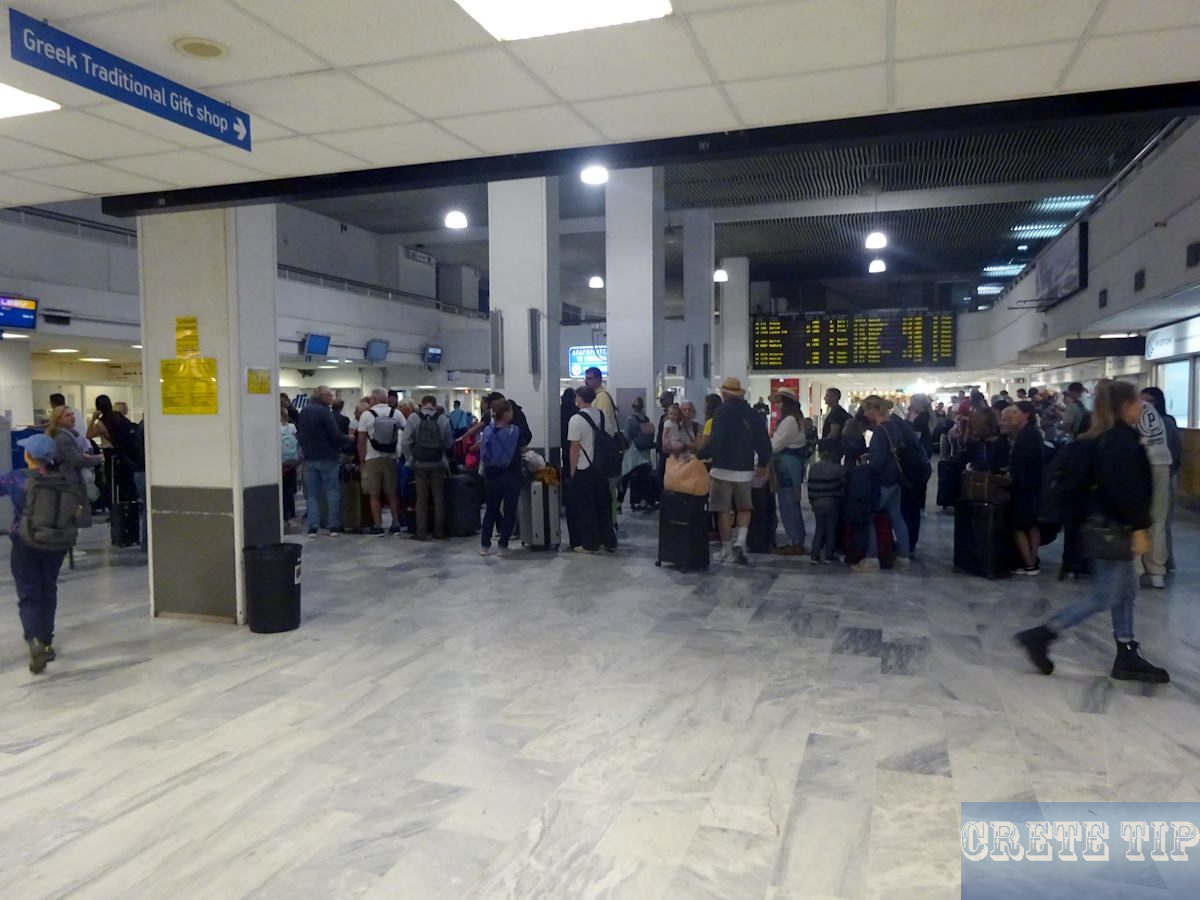
For decades, Greece’s tourism strategy has been straightforward: maximize visitor numbers, extract maximum revenue per room night, and assume the money will trickle down through the economy. But as mass tourism faces structural collapse across Europe, a more unsettling question looms: what comes next?
The monoculture problem
Crete has built its entire economy on a single crop: mass tourism. Hotels, restaurants, bars, shops, transport services, construction and real estate — nearly every economic sector is entirely dependent on the summer flood of visitors.
This “monoculture” approach has generated wealth, but it has also created profound fragility. When tourism fluctuates — whether due to economic crises, pandemics, geopolitical instability or simple market saturation — the entire island economy shudders.
The wealth generated by tourism, moreover, has never been equitably distributed. A tiny elite of hoteliers and tour operators capture roughly 80% of tourism revenues, while the workers who deliver the actual service languish in poverty.
Who captures the money?
The tourism pyramid in Crete is steeply hierarchical. At the apex sit the major hoteliers and international tour operators, who control the distribution channels, set pricing, and extract the lion’s share of profit.
Below them sit smaller accommodation providers, restaurant owners and shop operators — the traditional middle class of tourism — who capture perhaps 15% of tourist spending. These are the people who own tavernas, rent rooms, operate small hotels and run family businesses.
At the base sit the workers themselves: hotel staff, kitchen workers, cleaners, bartenders, waiters and service providers. Despite being the actual force that delivers tourism experiences, they capture the smallest slice of the pie.
The hollowing of the middle class
Over the past 15 years, the share of tourism revenues flowing to small and medium entrepreneurs has declined significantly. This is partly due to the rise of international booking platforms, which favor large chains, and partly due to the shift toward all-inclusive resort packages.
When tourists stay in all-inclusive hotels, they spend almost nothing outside the hotel gates. This means restaurants, cafes, bars, shops and attractions that once thrived on tourist spending now struggle to survive.
Fifteen years ago, the percentage of tourist spending that went to businesses outside the hotel sector was roughly double what it is today. This represents a massive wealth transfer away from small entrepreneurs toward large hotel operators.
The wages trap
Tourism workers in Crete have seen their real wages collapse since the 2012 financial crisis. A worker who could once earn enough in two months of summer work to live for six months now works the entire summer season (May-October) and barely scrapes by.
Official collective labor agreements set minimum wages, but the vast majority of employers simply ignore them. Investigations reveal that many tourism businesses operate as “modern galleys,” extracting maximum work while paying subsistence wages.
The lack of career progression is equally damaging. Tourism offers no skill-building, no advancement pathway, and no dignity. A 25-year-old waiter has little hope of becoming a manager or entrepreneur — the industry simply doesn’t work that way.
The diversification fantasy
Greek policymakers often speak of “diversifying” the economy beyond tourism, but this is largely fantasy. No alternative has emerged to replace tourism’s revenue-generating capacity.
Agriculture has been hollowed out by EU policies and international competition. Manufacturing remains minimal. Services are largely tourism-dependent. Without significant capital investment in education, technology and new industries, diversification remains a pipe dream.
Yet investment in non-tourism sectors remains minimal because the easy money is in tourism. This creates a vicious cycle: tourism crowds out capital from other sectors, which ensures that when tourism falters, no alternatives exist.
What happens when tourists stop coming?
The 2020 pandemic provided a terrifying preview. When tourism collapsed overnight, Crete’s economy essentially froze. Workers lost income, small businesses closed, and the social safety net proved inadequate.
Recovery was swift because tourism demand rebounded quickly, but the experience revealed how fragile the system truly is. The next crisis — whether economic, pandemic-related, or caused by climate change and extreme heat — could prove far more destructive.
And it’s not clear that another rebound will materialize as readily. Climate change is making Mediterranean summers increasingly uninhabitable for outdoor activities. Economic stagnation in key source markets could permanently reduce demand.
The structural crisis
Greece now faces a structural problem that no amount of marketing can solve. The country has become expensive as a destination, yet lacks the infrastructure, service quality and value proposition to justify premium pricing.
Meanwhile, competitors like Turkey, Egypt and North Africa are offering better value at similar or lower prices. As European tourists’ purchasing power stagnates, they’re increasingly choosing alternatives.
The June 2026 data revealed this shift: while visitor numbers rose, spending per visitor fell. This is not a temporary fluctuation — it’s the beginning of a structural reorientation.
What comes after mass tourism?
The honest answer is: nobody knows. Crete and Greece have invested so entirely in the mass tourism model that alternative futures are genuinely difficult to imagine.
A genuine diversification strategy would require: massive public investment in education, technology and infrastructure; support for entrepreneurs in non-tourism sectors; retraining programs for tourism workers; and a deliberate policy of de-emphasizing tourism as the primary development driver.
But such a strategy would require political courage and a willingness to accept lower economic growth in the short term. It would also require challenging the oligarchs who have enriched themselves through tourism monopolies.
The window is closing
The hard truth is that Crete and Greece have a narrowing window to make this transition while tourism revenues are still substantial enough to fund alternatives. If they wait until tourism collapses before diversifying, they will be forced to do so in crisis conditions with far fewer resources.
Every year that mass tourism remains the default economic strategy is a year not invested in sustainable alternatives. Every season of record visitor numbers that masks declining per-capita spending is a year of strategic complacency.
The question “What comes after mass tourism?” will eventually have to be answered. The only remaining question is whether it will be answered through deliberate planning or through chaotic collapse.
Sources:



