

Newsflash from Thursday, 25 June 2026:

A dramatic rescue unfolded on one of Crete’s most famous beaches, Falassarna, where a woman was pulled unconscious from the sea and brought back to life thanks to the swift actions of a lifeguard and the use of a defibrillator.
The incident occurred around midday on Wednesday, June 24, according to local reports. Beachgoers quickly realized that something was wrong when the woman, described as a foreign visitor, was found unresponsive in the water.
The on-duty lifeguard reacted immediately, retrieving the woman from the sea and initiating emergency procedures. Crucially, a defibrillator was used during the rescue — a decision that proved lifesaving. Thanks to this rapid intervention, the woman regained consciousness at the scene.
Emergency medical services were called without delay. An ambulance transported her to the Kissamos Health Center, where she received further medical care and monitoring.
The incident highlights the vital importance of trained lifeguards and the availability of life-saving equipment such as automated external defibrillators (AEDs) on popular beaches. Quick response times and proper equipment can make the difference between life and death in critical situations like this.
Falassarna Beach, known for its strong currents at times, attracts large numbers of visitors, especially during the summer season. Authorities continue to remind swimmers to remain cautious, follow safety instructions, and pay attention to local conditions.
Sources:
CretaOne – Dramatic rescue of a woman in Falassarna
kriti360.gr
High numbers of drownings and advice

Drowning is still a serious problem in Crete and Greece, and it affects both locals and visitors. Many accidents happen just because swimmers skip basic safety advice.
People lose their lives in both the sea and swimming pools, so everyone really needs to stay alert, no matter their age. Some recent tragedies follow after these important instructions.
In June 2025 alone, many drowning deaths happened at Greek beaches. Most victims were over 60, making older adults especially vulnerable, but young kids are also at high risk.
Key Risk Factors
- Age: Older adults and young children face the highest danger.
- Swimming skill: People who can’t swim well or can only float are more likely to get into trouble.
- Health and behaviour: Swimming when tired, after a meal, or after drinking alcohol makes things riskier.
- Environment: Calm waters might look safe, but drownings happen there too—rougher spots are obviously dangerous.
- Ignoring safety: Too many people ignore warnings about currents or dive into unsafe places.
Role and Coverage of Lifeguards
Lifeguards play a huge role in keeping swimmers safe. This season, about 86% of Greek beaches have lifeguard coverage, which is a big step forward.
Still, drownings remain stubbornly high, so there’s clearly more work to do. Lifeguards jump in to rescue swimmers, enforce rules, and educate beachgoers about the risks.
- Rescue swimmers in trouble.
- Enforce safety rules on the beach.
- Teach people about water safety and risks.
- Report on rescue operations to help track safety.
Recommendations for Swimmers
If you want to stay safe, here’s what you should keep in mind:
- Don’t swim alone, especially if you’re not a strong swimmer.
- Skip swimming after eating, when you’re tired, or if you’ve had alcohol.
- Stick close to shore and stay inside marked safe zones.
- Watch out for strong sea currents; they can sneak up on you.
- Never dive into water when you can’t see the bottom or don’t know how deep it is.
Parents, don’t count on floaties or inflatable gear to keep your kids safe. Honestly, the best thing you can do is make sure your child learns to swim and float properly.
Swimming Pools and Lifeguard Presence
New rules now require lifeguards at swimming pools, especially in hotels and resorts. If a pool is deeper than 1.5 metres and the place has more than 50 rooms, a lifeguard must be there.
Pool lifeguards don’t have to stay in one spot—they might walk around the pool’s edge, keeping an eye on everything. Their presence definitely boosts safety and, frankly, makes guests feel better about the place.
Safety Tips in Table Format
Do’s | Don’ts |
|---|---|
Swim with a companion | Swim alone if you are a weak swimmer |
Stay near the shore within safety zones | Swim far from shore without reason |
Learn to swim and float correctly | Rely only on inflatable armbands for children |
Pay attention to weather and sea conditions | Swim while tired or after drinking alcohol |
Follow lifeguard instructions | Dive into unknown or murky waters |
Staying alert and actually listening to safety advice can really help cut down on drownings. Lifeguards do their part, but honestly, you can’t just leave it all up to them.
Kids and older folks need extra watching—it’s no secret they’re at higher risk around water. Sometimes it feels like people forget how quickly things can go wrong.
Swimmer safety depends on everyone doing their bit. Authorities make the rules, lifeguards keep an eye out, but in the end, swimmers have to follow the basics.
Drowning is still a major cause of accidental deaths across Europe. It’s especially a problem in countries with long coastlines and busy tourist spots.

Even though there’s been a small drop in drowning cases in recent years, some countries still see a worrying number of fatalities each year.
One country really stands out for having a high share of these deaths compared to other EU members. It’s among the top countries for annual drowning deaths, which says a lot about the ongoing risks for both locals and tourists.
Key Takeaways
- Drowning makes up a big chunk of accidental deaths in Europe.
- One country ranks high in drowning deaths compared to the rest.
- There’s been a slight drop in yearly drownings, but the numbers are still troubling.
Locations with the Highest Number of Drownings
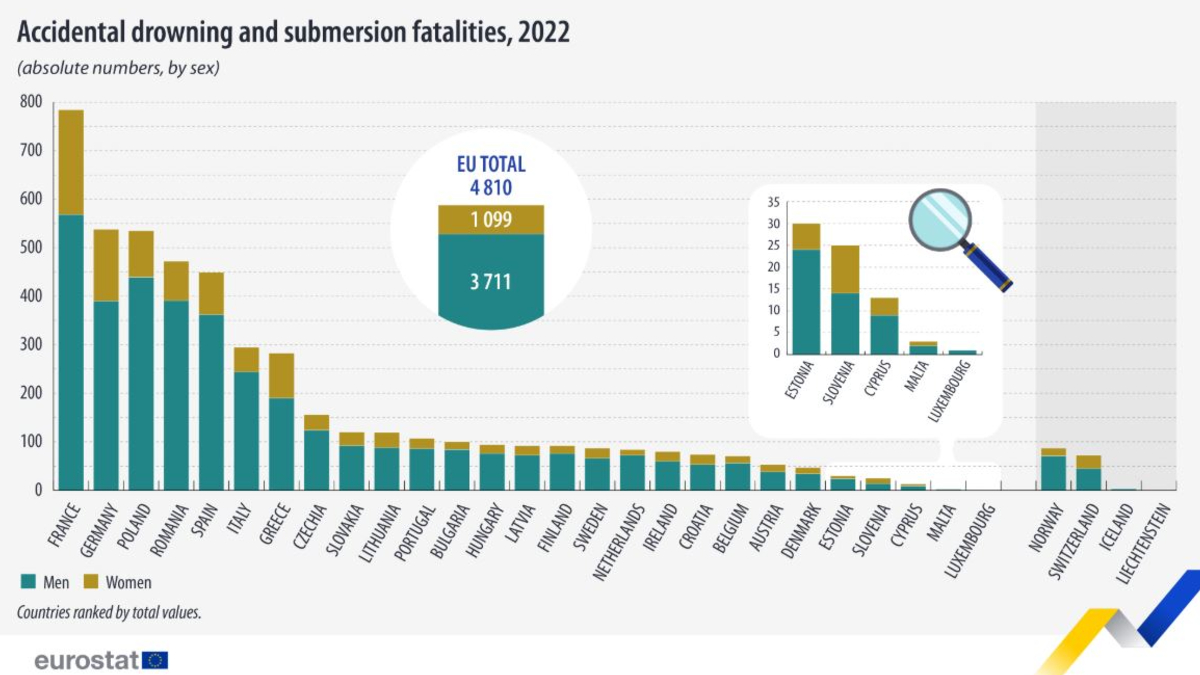
Most drownings happen in natural water—think lakes, rivers, and the coast, including islands. Swimming pools also see their share of incidents.
Here are the countries with the highest number of drownings:
- France: 784 cases
- Germany: 542 cases
- Poland: 535 cases
- Romania: 472 cases
- Spain: 449 cases
- Italy: 295 cases
- Greece: 283 cases
So, it’s clear that drownings tend to happen more in places with lots of natural water or popular swimming spots.
Fewer Drownings Recorded
Countries with fewer drownings usually have strong lifeguard coverage and solid safety rules for water sports.
For example:
- Luxembourg: 1 drowning
- Malta: 3 cases
- Cyprus: 13 incidents
- Slovenia: 25 drownings
Having trained lifeguards really does seem to make a difference near the water.
Gender and Drowning Incidents
Drowning deaths are more common among men than women in Europe. This trend shows up year after year.
The gap between male and female victims shifts from country to country but it’s always there. In Slovenia, for instance, recent numbers show 14 male drownings compared to 11 female. Meanwhile, in Luxembourg, every drowning victim was male—kind of stark, isn’t it?
What’s behind these differences? Men often take more risks or jump into water sports and activities more often. They might also work jobs near water, which ups their exposure.
There’s another angle, too—older adults. Folks in the “third age” group face extra challenges, like health issues or less mobility, making them more vulnerable to drowning whether it’s during a swim or just a bad fall near water.
Group | Risk Factors |
|---|---|
Men | Higher exposure, risk-taking |
Women | Lower rates, possibly less exposure |
Older Adults (third age) | Reduced physical ability, health issues |
If we really want to make swimming and water fun safer for everyone, it makes sense to keep these gender and age differences in mind when we talk about awareness and prevention. More on this in the detailed report if you’re curious.
Drowning Incidents in Greece in 2022
In 2022, Greece saw 283 drowning deaths. Men made up 190 of those, women 93.
That’s actually higher than in 2021, when there were 258 fatalities. The problem’s big enough that the Ministry of Shipping and Ministry of Health are pushing for more safe water sports and better public awareness.
Here’s what they’re focusing on:
- Better training for lifeguard teams
- Campaigns from health authorities like EODY and EKAN
- More education to cut down on fatal accidents and injuries
Let’s hope these efforts actually move the needle on water safety in Greece.
The most critical years recorded in Greece
Two years really stand out for the sheer number of drowning deaths here. In 2013, Greece saw 308 recorded drowning cases.
Three years later, in 2016, the number dipped a bit but still felt way too high—293 incidents got reported. These numbers just keep reminding us how tough it is to get water safety right in this country.
Europe keeps pushing for fewer drowning incidents, but Greece still struggles with stubbornly high rates, especially among men. It’s clear we need more focused prevention strategies, and maybe a bit of a rethink.
The Hellenic Coast Guard (Λιμενικό Σώμα) and the Hellenic Police (Ελληνική Αστυνομία) jump into action during emergencies and run awareness campaigns too. They respond fast, but they also work to educate people about water safety rules and risks.
Still, the number of drownings hasn’t really budged, so it seems like prevention efforts could use a boost—and maybe better coordination. Something’s missing in the current approach.
Experts like Nikos Giovanidis keep pushing for a smarter national strategy based on real data. If we target the highest risk groups and locations, maybe we’ll finally see those numbers drop.
Training matters—not just for the pros, but for everyone who spends time near the water. It’s a bit surprising we haven’t made this a bigger priority already.
Key factors in addressing the problem include:
- Systematic prevention programmes: We need these in schools, communities, and especially among tourists in seaside spots.
- Public education: Let’s get the word out about water dangers and teach people how to react in emergencies.
- Improved rescue services: Quick, effective action from the Coast Guard and Police can save lives.
- Data-driven policy: Reliable stats should guide our next moves—otherwise, we’re just guessing.
Since most drowning victims are men, focusing on this group could help bring fatality rates down. Greece’s long coastline and the steady stream of tourists make these efforts even more urgent—not just for locals, but for visitors too.
Year | Recorded Drownings |
|---|---|
2013 | 308 |
2016 | 293 |
Honestly, we need a strong national strategy that blends prevention, education, and quick emergency response. Authorities like the Coast Guard and Police, with input from experts like Nikos Giovanidis, could really make a difference—if everyone actually works together.



