

Newsflash from Thursday, 27 August 2026:

Crete’s long-awaited new international airport has taken another major step toward completion: the electrification works for the new Heraklion Airport at Kastelli (Καστέλι, a village and construction site located southeast of Heraklion, in central Crete) have officially begun.
Power Connection Gets the Green Light
Greek construction group GEK TERNA (ΓΕΚ ΤΕΡΝΑ) has received approval from the Ministry of Infrastructure to start connecting the new airport to the national power grid. GEK TERNA is carrying out the work on behalf of the concession company “Heraklion International Airport of Crete S.A.” (Διεθνής Αερολιμένας Ηρακλείου Κρήτης, or ΔΑΗΚ), which holds the contract to build and operate the new airport.
The Greek state has approved a payment of €33,115,984.86 to cover the utility-network costs (referred to in Greek as ΟΚΩ, or “Organizations of Public Utility”). After accounting for contract-related price revisions, contingencies, and VAT, the total public cost rises to €46,867,196.85.
Why the State Is Footing the Bill
According to the report, ADMIE (ΑΔΜΗΕ), Greece’s Independent Power Transmission Operator, had previously stated it was unable to undertake construction of the connection works linking the new airport to the national high-voltage transmission system (ΕΣΜΗΕ). As a result, it fell to the airport project itself to carry out the required studies and construction — with the Greek state covering the associated utility costs, since this work falls outside the scope of GEK TERNA’s construction contract and outside ΔΑΗΚ’s contractual obligations.
Officials stressed that the schedule is tight due to long lead times for procuring critical high-voltage materials and equipment. To keep things on track, an advance payment of 25% of the total cost will be made upon signing, with further payments released in line with construction progress, verified and certified by ADMIE according to the approved timeline and project milestones.
Land Transfers and Oversight
Once the relevant land parcels are transferred into state ownership, the Greek government will hand over the necessary property rights to ADMIE, allowing construction, installation, and operation of the connection infrastructure. ADMIE will also be responsible for reviewing engineering studies, supervising construction, conducting technical inspections, and formally accepting the completed high-voltage connection works, ensuring compliance with national transmission network technical standards.
Separately, the state approved a payment of €1,796,726.12 (an indicative cost) to ΔΑΗΚ, which will in turn pay ADMIE for study reviews and construction supervision, as outlined in their contract.
What’s Included in the Electrification Works
The project covers several stages, including:
- An underground 150kV power transmission network, consisting of two lines
- Connection to the national high-voltage transmission system (ΕΣΜΗΕ)
What does this mean for visitors?
For holidaymakers and residents in Crete, this development is a solid sign that the new Heraklion Airport at Kastelli — intended to replace the current, aging Nikos Kazantzakis Airport — is progressing according to plan on the infrastructure side. While no exact opening date is confirmed in this report, the electrification milestone suggests the project remains on track toward completion. Travelers planning trips to Crete over the next couple of years should:
- Continue to check for updates on flight arrivals, as the current Heraklion airport remains operational for now
- Expect ongoing construction activity in the Kastelli area, which may affect nearby roads or traffic in the medium term
- Watch for future announcements regarding the transition of flights from the old to the new airport, as this will directly affect travel logistics to and from Crete
The toll-free road from the new airport through the villages to Heraklion
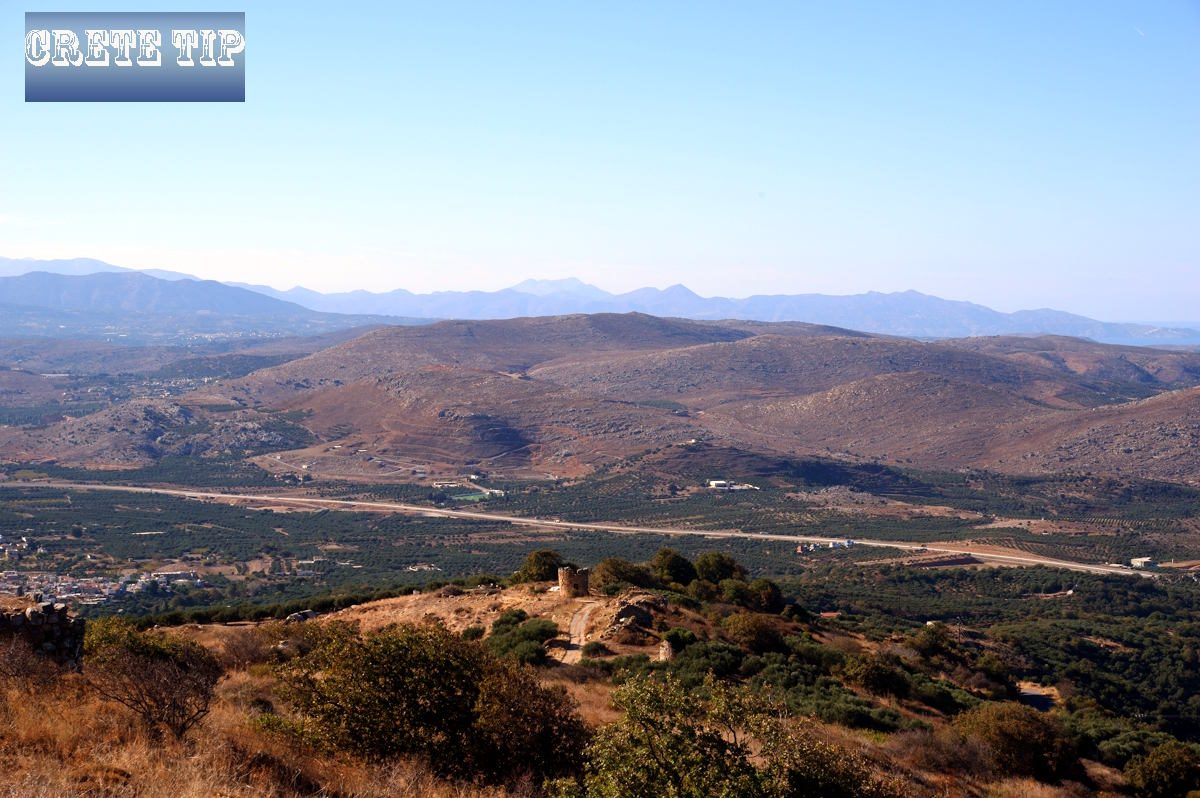
A decades-old dream for Crete’s inland villages is finally inching closer to reality: plans to upgrade the unfinished E50 road axis — which would create a toll-free alternative route from Heraklion to the new Kastelli Airport through the villages of the Pediada (Πεδιάδα) region — have taken a significant step forward.
A Road That’s Been Waiting Since 1967
The E50 road connects Kastelli Pediados (Καστέλλι Πεδιάδος, a town in the Pediada area, inland from Heraklion) with the wider area of Karteros (Καρτερός, a coastal district near Heraklion), passing through several villages including Ano Vathia (Άνω Βάθεια), Galifa (Γαλίφα), Galype (Γάλυπε), Kainourgio Chorio (Καινούργιο Χωριό, meaning “New Village”), and Smari (Σμάρι). Construction on this route began back in 1967 but was never completed — leaving the road unfinished for nearly six decades.
Completing the E50 is considered a key project not just because it would offer travelers a route to the new Kastelli Airport without highway tolls, but also because it would breathe new life into inland communities, particularly the western part of Gouves (Γούβες) and the municipal unit of Episkopi (Επισκοπή), both part of the Municipality of Hersonissos (Δήμος Χερσονήσου) on Crete’s north coast.
Local and Regional Approval Secured
The Municipal Council of Hersonissos has already given its conditional approval to the project. Now, the Decentralized Administration of Crete (Αποκεντρωμένη Διοίκηση Κρήτης) — a regional government body overseeing environmental and administrative matters — has also given a positive opinion regarding the preliminary environmental requirements, though it too attached some important conditions.
The €1.1 Million Study
A major milestone has been the commissioning of a feasibility and design study for improving the road connecting the villages of Ano Vathia, Kainourgio Chorio, and Galype, at a cost of €1.1 million. The contract for this study was signed by Crete’s Regional Governor, Stavros Arnaoutakis (Σταύρος Αρναουτάκης), on November 7, 2024.
The total budget for the study reaches €1,160,095.45 and covers a wide range of technical work, including traffic, structural, topographical, and environmental studies needed to upgrade the road. This includes designing the necessary junctions and connections to the existing road network, at-grade intersections linking provincial roads with nearby villages, bridges over streambeds, and an underpass to allow uninterrupted crossing of an existing perpendicular road.
The project centers on a single road section — the main road from Synoikismos (Συνοικισμός) through Ano Vathia to Galifa, roughly 6.2 kilometers long. It starts at the Synoikismos junction on the Karteros–Stamnoi–Episkopi provincial road and ends just past the village of Galype.
Concerns Over the Kainourgio Chorio Bypass
The project has drawn considerable public interest, and residents have raised concerns during the environmental review process — particularly regarding the planned bypass around the village of Kainourgio Chorio. In response, the Decentralized Administration of Crete has recommended that the project’s developer, if possible even before the full environmental impact study is completed, organize a public dialogue with local residents and other interested parties. This would cover the technical details of the project and its potential environmental effects, using tools such as media announcements, public information sessions, and online postings.
Still a Long Road Ahead
Officials acknowledge that upgrading this road network is neither quick nor cheap, and the project will likely take considerable time to complete — provided the Region of Crete and other involved authorities remain committed to seeing it through. Still, the ongoing study represents an important first step toward finally giving the E50 a proper, finished form after roughly 60 years of being left incomplete.
What does this mean for visitors?
For those living in or visiting Crete, this project points to a future toll-free route between Heraklion and the new Kastelli Airport that also passes through scenic inland villages rather than the main highway. However, given the scale of studies still underway — and the concerns being raised locally — this route is not likely to be ready in the short term. Travelers should:
- Continue relying on existing routes and toll roads to reach Kastelli Airport for the foreseeable future
- Expect this alternative route to take years to materialize, given the project’s history and the need for further environmental review
- Keep an eye on local news for updates, especially regarding public consultations about the Kainourgio Chorio bypass, which may affect the final route and timeline
Sources:
Neakriti.gr
CretaOne.gr



