

Newsflash from Tuesday, 14 July 2026:

Imagine having the chance to sit down and ask Charles Darwin himself about the theory of evolution. At the newly renovated Natural History Museum of Crete (MFIK), this is no longer science fiction — it’s reality.
The museum has recently completed a major renovation of its interior spaces, transforming it into a modern, interactive, and immersive experience where visitors are no longer passive observers but active participants in their journey of discovery.
A Conversation with Darwin’s Hologram
One of the most distinctive experiences the museum now offers is the opportunity to interact with a holographic representation of Charles Darwin. Visitors can pose questions directly to the legendary naturalist about the theory of evolution, the evolution of species, and natural selection — the mechanism through which organisms adapted characteristics essential for survival.
This cutting-edge technology brings history to life in an unprecedented way, allowing guests to engage with one of science’s greatest minds across centuries.

Exploring the Evolution of Life
The exhibition “The Evolution of Life” takes visitors on a comprehensive journey through adaptation and survival. Here, you’ll discover how plants and animals have adapted to Mediterranean ecosystems and climate over millions of years.
The museum also presents the human journey over the last 200,000 to 300,000 years, and traces the broader phylogenetic tree back to our earliest human ancestors in Africa, dating back 6 to 7 million years.
Through realistic reconstructions, visitors encounter:
- Homo heidelbergensis
- Neanderthals
- Modern humans
- The genetic connections linking these species to contemporary populations
Interactive displays showcase the differences in brain size across various organisms and how these changes relate to evolutionary adaptations.

Hands-On Discovery for All Ages
The museum features numerous games and interactive activities for both children and adults. Visitors can:
- Transform themselves into an Australopithecus or Homo erectus through interactive screens
- Create their own mountains and volcanoes and watch them evolve over time
- Experience earthquakes ranging from 5 to 7.6 on the Richter scale on the new and larger seismic table “Encephalus”
A Journey Through Time and Crete’s Natural History
Beyond evolution, the museum takes visitors on a fascinating trek through Crete’s geological and natural history. The journey includes:
- An ascent up a Cretan mountain
- Exploration of caves featuring stalactites and stalagmites
- A traverse through gorges
- A visit to a natural wetland
The paleontology section deserves special mention, featuring fossils that tell the story of Crete over the last ten million years. Highlights include:
- A life-sized model of Deinotherium (an extinct elephant-like creature)
- A Sirenian (an ancient marine mammal)
- Prehistoric dwarf animals unique to the island
Visitors also follow bird migration patterns and travel from the ancient Tethys Sea to modern-day Crete, discovering the natural world during the Minoan era.

A Special Space for Young Explorers
The “Research Lab” (Ερευνότοπος) is a specially designed space for children — one of the few of its kind in Greece. Here, knowledge transforms into play, and learning becomes an immersive, discovery-filled experience.
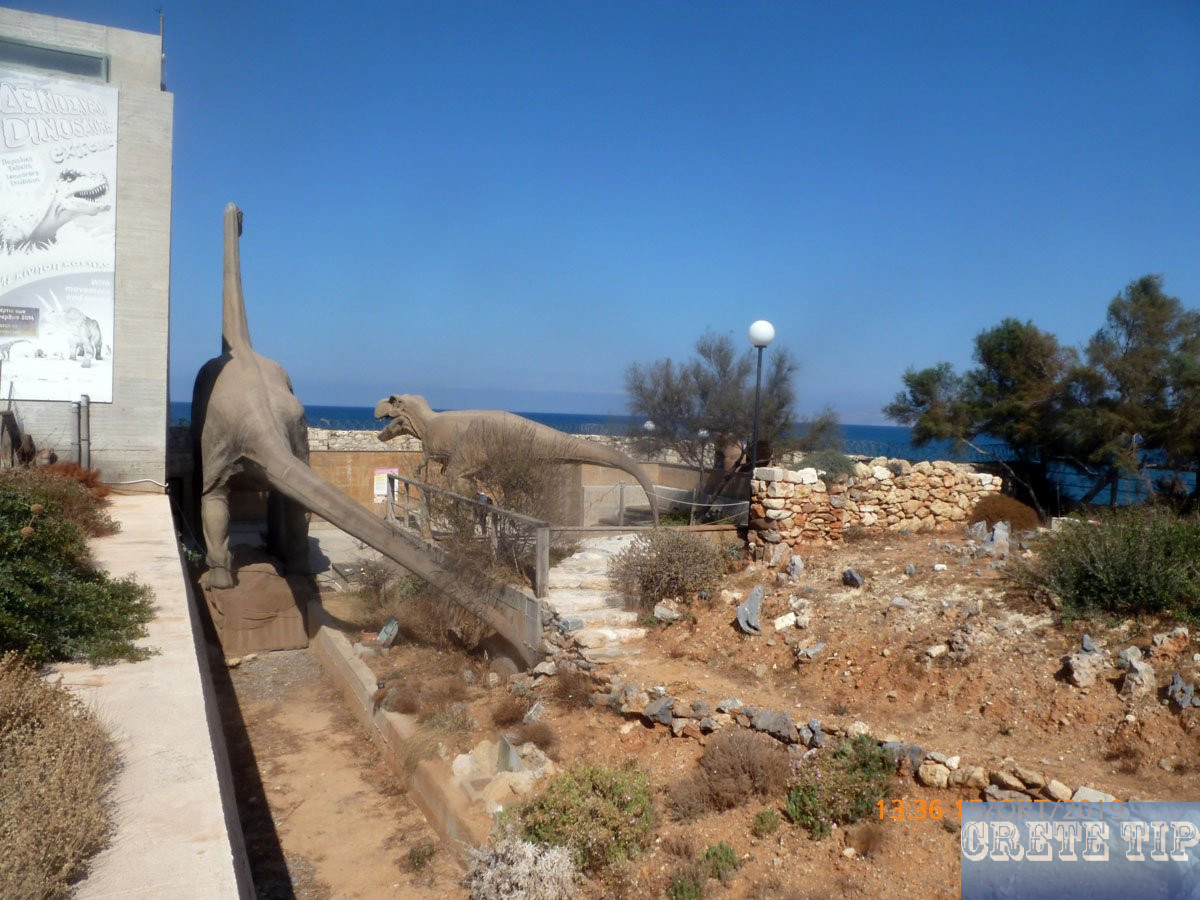
Extreme Dinosaurs Await
The adventure continues in the museum’s Botanical Garden, where “Extreme Dinosaurs” offer visitors a thrilling and immersive experience.
Museum Hours
The Natural History Museum of Crete is open:
- Weekdays: 9:00 AM – 3:00 PM
- Weekends: 10:00 AM – 6:00 PM
- Location [Google Maps]
- Admission: €8
- More about the Natural History Museum
A Modern Museum for a New Era
According to museum director Professor Nikos Poulakakis, MFIK represents a different kind of museum — one that is contemporary, experiential, and interactive. The new exhibits are already available to the public, and visitors are leaving the museum genuinely excited about their experience.
The project was funded through the Recovery Fund, reflecting a commitment to cultural and educational investment.
Source: cretalive.gr



