Newsflash from Wednesday, 11 November 2026:

Authorities are already preparing for the coming winter and for next summer, which the minister warns could be even worse.
A Grim Record Since 2006
According to rethemnosnews.gr, the area burned by wildfires in Crete in 2026 was the largest recorded on the island in the last twenty years. That makes it a negative record going back to 2006.
The figures come from the “2026 Fire Season Review.” It was prepared by the FLAME pyrometeorology team of METEO/National Observatory of Athens, WWF Greece and FireWatch, an observatory that monitors forest fires.
The review puts the total burned area at 78,880 stremmata. A stremma is a Greek land unit of 1,000 square metres. This placed Crete second in Greece, behind only Attica, the region around Athens.
Speaking at a meeting in Heraklion, reported by cretalive.gr, Minister for Climate Crisis and Civil Protection Evangelos Tournas gave a different figure. He said 59,000 stremmata burned during the fire season. Of these, 40,000 were grassland and scrubland and 12,000 were farmland.
The Two Big Fires in South Rethymno
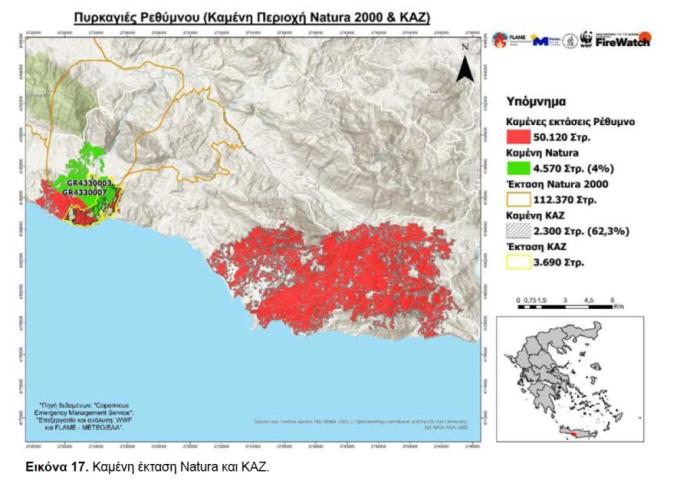
The worst damage was in southern Rethymno, the regional unit in west-central Crete. Two large fires broke out one after the other at the end of July and burned a combined 50,120 stremmata, according to the review cited by rethemnosnews.gr.
- Krya Vrysi (Kría Vrísi), a village in southern Rethymno: the fire started on 29 July at 13:25 and affected 42,210 stremmata. The review lists the power grid as the cause. Two professional firefighters lost their lives in this fire.
- Preveli (Préveli), the coastal area known for its palm forest and beach: a fire broke out on 30 July and burned another 7,910 stremmata. Its cause was still unknown when the review was written. People were evacuated from Preveli beach by sea, with help from the Coast Guard and private boats, and taken to Agia Galini (Ayía Galíni), a resort on the south coast.
Minister Tournas said he was shaken by the deaths of the two firefighters. He called it unacceptable that firefighters are still lost in the field today.
Strong Winds, Not a Hot Year
Notably, the review found that average fire weather danger in Crete in 2026 was lower than expected. Researchers say this shows how a few extreme weather episodes can drive a fire’s spread.
Very strong winds were decisive. Average wind speeds reached 50 to 52 km/h around Krya Vrysi and 45 to 50 km/h at Preveli.
At the weather station in Mariou (Marioú), a village in southern Rethymno, gusts reached as high as 145 km/h. Intense atmospheric dryness in the preceding days made matters worse.
The Same Land Burning Again and Again
One of the review’s most worrying findings is repeated burning. Of the 50,120 stremmata lost in southern Rethymno, 28,940, or 58%, had already burned at least once in the previous twenty years.
Minister Tournas made a similar point, saying the same grasslands “burn and burn again.”
Repeated fires in a short time make it hard for vegetation to regrow naturally. Loss of plant cover also raises the risk of erosion, especially on the steep slopes common in southern Rethymno. About 53% of the affected area is classified as forest land.
Blow to Protected Nature at Preveli

They also burned 2,300 stremmata of the Preveli Wildlife Refuge, which is 62.3% of its total area.
The area is a key refuge for rare birds of prey, including the bearded vulture, griffon vulture, golden eagle and Bonelli’s eagle. It is also home to the Preveli palm forest, one of only two remaining forests of the endemic Theophrastus palm.
Lessons Learned: Water Tanks and Forest Roads
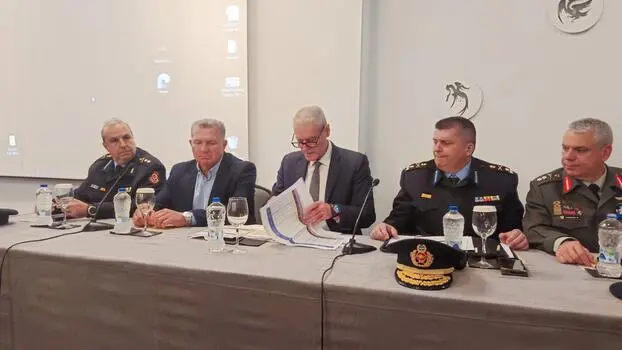
The meeting with Minister Tournas took place at the Aquila Atlantis hotel in Heraklion, Crete’s capital. Its focus was preparing the Region of Crete for the 2026–2027 winter and future emergencies, according to cretalive.gr.
The minister said prevention must carry even more weight. He praised the “antinero” fire prevention programme and said fire starts had dropped from 5,000 in previous years to 4,800. A special awareness campaign is being prepared, along with education for children in schools.
He pointed to several weaknesses seen this summer:
- Water for aircraft: Firefighting aircraft made only sparse water drops. He called for tanks in the island’s mountainous interior so aircraft can refill faster.
- Forest roads: Poor roads led to vehicles getting trapped. Escape routes also need improving.
Deputy Regional Governor for Civil Protection Giorgos Tsapakos said the planned open tanks will hold 400 to 600 cubic metres each. Around 20 suitable sites have been identified. Contracts with private operators have been updated, with 500 machines available.
“We do not have much time. Next summer will be worse,” Tournas warned, citing scientists’ predictions and the aggressive fires linked to climate change.
Winter Brings Flood Risk

The minister also warned about floods. He said extreme local weather has become more frequent and is hard to forecast precisely, though special radars are being installed to improve this.
He stressed that streams must be cleared again, as rains have filled them with debris. Many natural drainage channels in Crete have been blocked by construction.
He singled out the road from Ierapetra (Ierápetra) towards Sitia (Sitía), both in Lasithi in eastern Crete. At Ferma (Férma), a coastal village on that route, the road has been cut off with no escape route, and he said major works are needed there.
Tournas suggested a special fund for local councils for winter flood protection, plus checks on city sewer systems. Plans, lists of contractors with machinery, and volunteer groups also need updating.
Heraklion Deputy Regional Governor Nikos Syrigonakis, standing in for Regional Governor Stavros Arnaoutakis, said Crete faces special challenges due to its location, terrain, island status and tourism. He called for modern equipment, resources, clear responsibilities and good coordination, and for the meeting to lead to concrete results.
What does this mean for visitors?
Crete remains open and welcoming, but both fire and flood risks are real. A few simple habits can keep you safe.
- Know the emergency numbers: If you spot a fire, call the fire service on 199. Follow official alerts sent via the 112 emergency system, as reminded by en.rua.gr.
- Take wind seriously: The 2026 fires spread with strong winds, not extreme heat. On windy days, avoid anything that could spark a fire outdoors.
- Be ready to leave by sea: At Preveli, beachgoers were evacuated by boat. On remote south-coast beaches, know your exit and follow instructions from authorities.
- Check before hiking: Forest roads can be in poor shape, and burned slopes may face erosion. Ask locally before heading into gorges or mountain areas.
- Respect burned nature areas: Places like Preveli and the Kourtaliotiko Gorge need time to recover. Stay on paths and leave wildlife undisturbed.
- Watch winter weather: Sudden heavy rain can flood streams and roads. Avoid driving through flooded streams, especially in eastern Crete around Ierapetra and Sitia.
Sources: cretalive.gr, rethemnosnews.gr, en.rua.gr