

Newsflash from Wednesday, 9 September 2026:
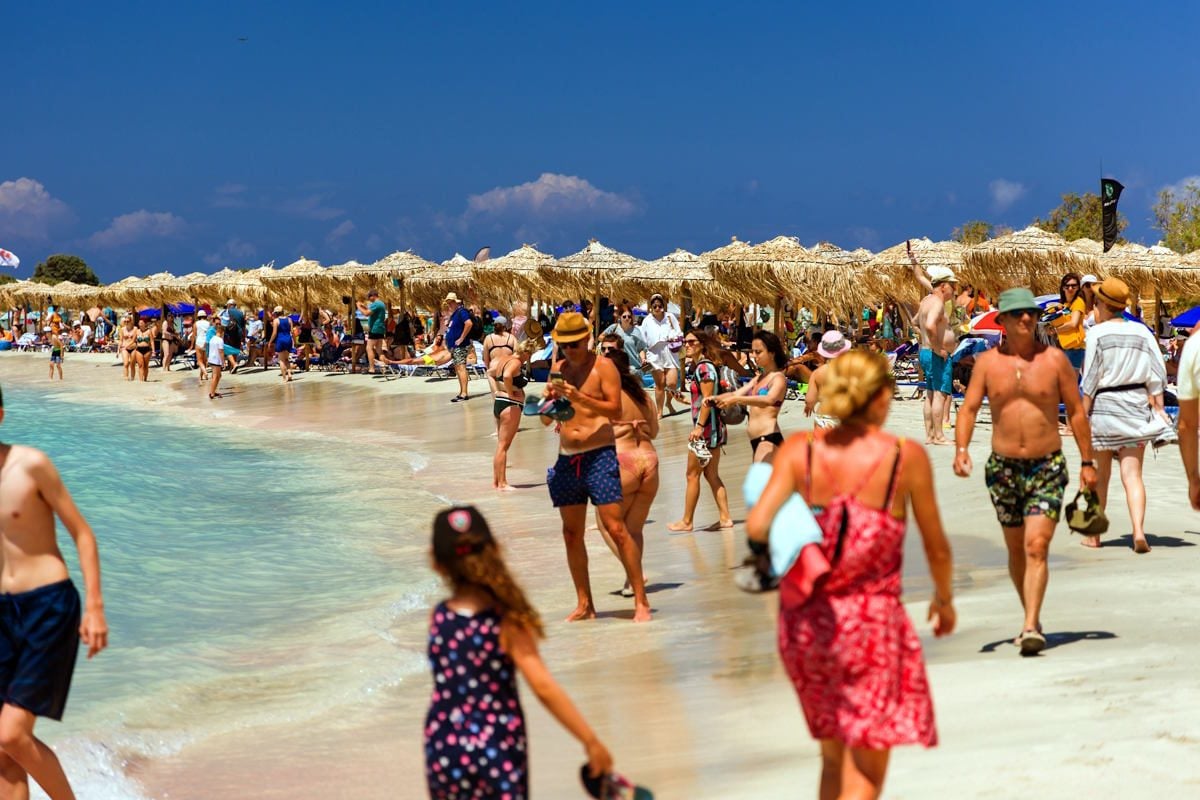
Crete continues to break tourism records year after year, but a new conversation is emerging behind the scenes: how many visitors can specific areas of the island actually sustain — and under what conditions?
While arrival numbers keep climbing, so does pressure on water supplies, roads, housing, and local infrastructure. The question of “overtourism” is no longer theoretical for Crete — it’s becoming part of the island’s everyday reality.
Record Numbers Tell the Story
In 2025, Crete recorded more than 6.3 million international air arrivals in the first eleven months of the year, according to figures attributed to INSETE (the Greek Tourism Confederation’s research institute). Heraklion’s airport alone surpassed 4 million international arrivals.
Seasonality makes the picture even more striking. Combined passenger traffic at the airports of Heraklion, Chania, and Sitia (all major Cretan cities/regions) reached approximately 14.2 million passengers in 2025 — with August alone exceeding 2.5 million.
The island currently hosts 1,643 hotels and related accommodations, offering around 197,000 beds. That’s roughly 22% of Greece’s total hotel capacity concentrated on this single island.
What Overtourism Actually Looks Like
Overtourism isn’t simply about having “a lot of tourists.” It occurs when tourism activity in a specific place, during a specific time period, begins exceeding the capacity of local infrastructure, the natural environment, and residents’ daily lives.
In Crete, the issue doesn’t affect the whole island equally. Some areas face enormous pressure in July and August, while other, sometimes nearby, areas still have significant room for growth.
The recognizable symptoms include:
- Traffic congestion and parking shortages
- Overcrowded beaches and historic centers
- Increased demand for water and electricity
- Higher volumes of waste and sewage
- Strain on municipal services
- Skyrocketing housing demand
There’s also a less visible dimension: entire neighborhoods gradually shifting toward almost exclusively tourist-oriented use. When short-term rentals limit available housing and workers struggle to find homes, the pressure becomes social as well as environmental.
The Region of Crete, through its Sustainable Tourism Development Observatory, has acknowledged these challenges — including carrying capacity limits, overconcentration of demand in popular areas, water and waste management, protection of Natura 2000 zones, and how well local communities accept ongoing tourism growth.
Chania: Pressure on the Old Town and Famous Beaches
Chania (a city and region in western Crete) illustrates the issue vividly. The Venetian harbor and old town attract enormous numbers of visitors daily during peak months — residents, overnight tourists, day-trippers, organized tour groups, and cruise ship passengers all converge in the same compact space.
The pressure intensifies further at some of the region’s most famous beaches. Balos and Elafonisi (renowned beach destinations in western Crete) exemplify a problem that isn’t just about total visitor numbers — it’s about everyone arriving within just a few hours of the day, in an especially fragile natural setting.
A similar dynamic, though different in nature, exists along the Agia Marina–Platanias corridor (a coastal strip in Chania region), which has developed one of western Crete’s largest concentrations of hotels, restaurants, and tourism businesses.
Heraklion: From City Center to Chersonissos
On the island’s eastern side, the picture looks different but is equally significant. Heraklion serves as Crete’s largest entry point. In 2025, “Nikos Kazantzakis” Airport surpassed 10 million passengers in total traffic — reflecting the sheer scale of visitor flow the region must accommodate.
Within the city, tourism pressure concentrates mainly in the historic center, the waterfront, the harbor, and of course at Knossos (the famous Minoan archaeological site near Heraklion). The simultaneous presence of residents, tourists, and tour buses adds to congestion in these key areas.
Ammoudara, Kokkini Hani, Gouves, Hersonissos and Malia essentially form one extensive tourist area. Hersonissos and Malia, in particular, are examples of overdeveloped tourist destinations where the aim can no longer be solely to increase visitor numbers.
Rethymno: A City Squeezed by Its Own Limited Space
Rethymno (a coastal city in central-western Crete) represents a unique case in the overtourism debate.
The city has very limited urban space to work with, yet it combines an extremely popular historic center with a massive hotel zone that has grown along its eastern edge.
During peak months, the old town fills to capacity with visitors, while a sharp rise in short-term rental accommodations has noticeably transformed the character of several parts of the historic district.
At the same time, the tourist corridor stretching from the city toward Platanias, Adelianos Kambos, and Skaleta (coastal areas east of Rethymno) concentrates a large share of the region’s hotel activity.
Here, the saturation problem is closely tied to the road network, traffic flow, water and waste management, and the constant need to upgrade infrastructure to keep pace with demand.
Lasithi: Elounda and Agios Nikolaos Face a Different Kind of Pressure
In Lasithi (the easternmost regional unit of Crete), tourism pressure isn’t evenly distributed or equally intense everywhere.
Elounda stands as one of the most recognizable high-end destinations in the entire Mediterranean, while Agios Nikolaos and Spinalonga (a historic island fortress) absorb a significant volume of day-trip visitors.
Here, the core issue isn’t mass tourism in the traditional sense.
Instead, it’s about the relationship between the growth of large, luxury developments, the availability of natural resources — especially water — the added burden on traffic, and the protection of an extremely sensitive coastal landscape.
This distinction is precisely why overtourism can’t be measured simply by counting heads or arrivals.
Crete’s Advantage: Room to Redistribute Demand
Crete holds one major advantage: it’s large enough to redistribute at least part of its tourism demand across different areas.
The real problem is that millions of visitors concentrate in specific locations, and mostly within a window of just five, six, or seven months.
The Region’s own data confirms this strong seasonality, with demand peaking in August and across the third quarter of the year as a whole.
What does this mean for visitors?
If you’re planning to visit popular hotspots like Balos, Elafonisi, or the old towns of Chania and Heraklion, expect significant crowds during July and August, particularly around midday.
Consider visiting these iconic spots early in the morning or later in the afternoon to avoid the most intense crowding.
Renting accommodation outside the most saturated tourist corridors (such as Agia Marina–Platanias) may offer a more relaxed experience while still keeping you close to major attractions.
If sustainability matters to you, look into exploring lesser-known areas of Crete — the article notes that some regions still have considerable room for tourism growth and offer a quieter alternative to the island’s most famous — and most crowded — destinations.
Booking accommodations and popular excursions well in advance is increasingly advisable, given the sheer volume of visitors during peak season.
Protected on Paper, Overwhelmed in Reality: The Truth About Balos Beach

Recent scenes at Balos beach, captured by a foreign tourist and shared widely across global social media, painted a troubling picture: hundreds of visitors packed shoulder to shoulder, waiting on the sand for the arrival of a boat likely to unload yet more tourists onto an already overwhelmed beach.
The images reignited a pressing question — how can one of Crete’s most protected natural areas also be one of its most overrun?

A Beach With Multiple Layers of Legal Protection
Balos sits on the Gramvousa peninsula (Grambousa, a rugged headland in western Crete near Kissamos), and it isn’t just any scenic beach — it carries some of the strongest environmental protections available under Greek and European law.
The area belongs to the Natura 2000 network, Europe’s flagship system for safeguarding biodiversity. Specifically, Balos falls within the zone designated GR4340001, officially named “Tame and Wild Gramvousa – Tigani and Falasarna – Pontikonisi, Livadi Bay – Vigla,” which holds status as a Site of Community Importance and Special Area of Conservation.
On top of that, the region is also classified as a Special Protection Area (SPA) under code GR4340017, covering the Gramvousa peninsula and the islets of Tame and Wild Gramvousa along with Pontikonisi. This designation specifically protects local bird populations.
The Region of Crete’s own official description highlights the impressive sand dunes found within Balos bay as a defining natural feature of the area.
Balos has additionally been registered as a Landscape of Outstanding Natural Beauty (Topio Idiaiteros Fysikou Kallous) — yet another formal recognition of its ecological and scenic value.
More Than Just a Pretty Beach
Taken together, these designations mean Balos isn’t simply “a beautiful beach located near a protected area.” The beach itself, along with the wider Gramvousa peninsula, sits fully within a legally established nature protection framework.
- Part of the EU’s Natura 2000 network
- Classified as a Site of Community Importance / Special Area of Conservation
- Designated a Special Protection Area for birdlife
- Recognized for its significant sand dune ecosystem
- Registered as a Landscape of Outstanding Natural Beauty
Despite all these formal protections, the viral footage from Balos shows a very different reality on the ground — one where legal status hasn’t translated into effective crowd management or environmental safeguarding during peak tourist season.
What does this mean for visitors?
If you’re planning a trip to Balos, be prepared for extremely large crowds during peak season, especially around the times when boats arrive and depart.
Since the beach is a protected Natura 2000 site with sensitive sand dunes and important bird habitats, visitors should be extra mindful of staying on designated paths and avoiding damage to the dune ecosystem.
Consider visiting outside of peak summer months or during early morning hours to experience the beach with fewer crowds and less pressure on the fragile environment.
Respecting the natural surroundings — from the dunes to the local wildlife — helps preserve Balos for future visitors, especially given how much legal protection has been placed on this landscape.
More, More, More: How Long Can Greek Tourism Keep Growing Without Cracking?

Greece wants tourism — more arrivals, more investment, more hotels, more flight capacity, more revenue. The country wants a longer season, new markets, higher-spending visitors, thematic tourism, luxury tourism, and a 365-day tourism industry.
It’s an ambitious wish list, and a reasonable one. But somewhere between the grand announcements, the record-breaking headlines, the ribbon-cuttings, and the celebratory statements, something basic keeps getting overlooked: tourism isn’t just airports, hotels, and flashy campaigns.
It’s also the street a visitor walks down at night. It’s the trash bin that doesn’t overflow. It’s whether parking exists. It’s working streetlights, clean sidewalks, functioning sewage systems, reliable water supply, manageable traffic — in short, the overall image of a place.
And in far too many cases, that image in Greece is disappointing.
Not Just Small Islands — Major Destinations Too
This isn’t only about remote or lesser-known areas. It applies to some of Greece’s top destinations — places receiving hundreds of thousands or even millions of visitors — where daily life often resembles a country caught off guard by tourism.
Except Greece wasn’t caught off guard. For decades, tourism has been known as the country’s heavy industry. Yet the country still often operates as if it were a small neighborhood shop where visitors will show up no matter what.
That mindset may be the most dangerous mistake of all.
The Numbers Tell a More Complicated Story
Bank of Greece data for June doesn’t suggest Greek tourism is collapsing — quite the opposite. In the first half of 2026, travel receipts rose by 14.8%, and inbound travel traffic increased by 15.4%.
But June sent a warning that shouldn’t be ignored. Arrivals rose by 6.9%, yet travel receipts increased by only 1.2%, while average spending per trip actually dropped by 6.2%.
This is exactly the trend that deserves attention. The goal can’t simply be attracting more and more visitors while collecting proportionally less from each one. Nor should success be measured purely by arrival numbers if visitors are cutting back on spending or questioning whether what they paid for matches what they actually experienced.
In 2025, Greek tourism generated €23.6 billion in travel receipts, with the South Aegean region (Notio Aigaio, encompassing islands like Santorini, Mykonos, and Rhodes) leading both in revenue and overnight stays.
With numbers of this scale, basic infrastructure can no longer be treated as a luxury.
To Be Fair: Some Progress Takes Time
No reasonable person expects massive infrastructure projects to appear overnight. Upgrading regional airports after their concession to private operators needed time — and it happened. Today, the difference is dramatic.
Greece’s major highways required decades, enormous capital, land expropriations, and complex procedures. Today, with the notable exception of the BOAK (Voreios Odikos Axonas Kritis — the Northern Road Axis of Crete, a long-delayed major highway project), the country has made real leaps forward in its road network.
The same good faith can be extended to the much-discussed new port project for Santorini (Santorini, a South Aegean island), which has even been announced by the Prime Minister himself. Such a project naturally requires studies, permits, environmental approvals, funding, and maturation time. All of that is understandable.
What’s Not Understandable
What’s much harder to accept is something far simpler. In many of Greece’s most beautiful and iconic destinations, visitors are forced to walk at night using their phone flashlights because there’s no basic public lighting.
When a road barely wide enough for one car functions in practice as a two-way street, creating daily traffic jams and dangerous situations, fixing that doesn’t require a decade-long study.
When there isn’t even a basic organized outdoor parking area, despite tens of thousands of cars and rental vehicles circulating in the region, blaming the state, the EU, bureaucracy, or climate change stops being a valid excuse.
Some things are simply the responsibility of local municipal government. And some things are just a matter of basic housekeeping.
A couple of streetlights. A parking lot. Basic signage. A clean street. None of this requires a national strategic plan.
Then there’s an issue considered even more infuriating: garbage — described as the chronic, long-running problem plaguing Greek tourism destinations.
What does this mean for visitors?
If you’re traveling to popular Greek destinations this season, don’t be surprised to encounter gaps in basic infrastructure — poor street lighting, limited parking, or inconsistent waste management — even in well-known, heavily visited areas.
Bringing a flashlight or using your phone’s light for evening walks in less-developed tourist spots isn’t a bad idea, particularly in smaller villages or less central areas.
If you’re renting a car, expect narrow roads in some destinations to be genuinely challenging, and always factor in extra time for parking searches in areas without organized lots.
Keep in mind that increased travel costs don’t always guarantee proportionally better infrastructure or services — so setting realistic expectations, especially outside major cities and well-established resorts, can help avoid disappointment.
Sources:
Rethemnos News
Hania News
Money Tourism



