

Newsflash from Thursday, 27 August 2026:

Crete’s Natural History Museum of Crete (Μουσείο Φυσικής Ιστορίας Κρήτης), part of the University of Crete, has installed two new water stations for wildlife in the mountains of Asterousia (Αστερούσια, a mountain range in southern Heraklion) and Dikti (Δίκτη, a mountain range in Lasithi).
This brings the total number of these special devices across Crete to five.
Why These Locations?
Both new installations are placed in areas with high concentrations of scavenging birds of prey, including griffon vultures (όρνια) and bearded vultures (γυπαετοί). They’re also close to migratory routes used by seasonal birds.
Each water station consists of a metal rainwater collector, a storage tank, and a specially designed drinking basin with adjustable flow. Day and night cameras monitor the sites, allowing researchers to record and identify which species use them.
Why Wildlife Needs Extra Help
According to the Museum, the need for these interventions is growing. Increasingly dry winters and a lack of surface water in the mountains — combined with changes in land use and the expansion of energy and tourism infrastructure — are putting additional pressure on the island’s ecosystems.
These conditions, the Museum notes, have contributed to a rise in cases of exhaustion and death among both native and migratory bird species.
Camera footage has already confirmed that wildlife is using the new water troughs, demonstrating their value. Still, the Museum stresses that such measures alone aren’t enough, calling for clearer and more binding rules to protect Crete’s sensitive ecosystems — particularly regarding tourism and energy development.
The water stations were funded by the A.G. Leventis Foundation (Ίδρυμα Α. Γ. Λεβέντη).
Notably, footage of vultures referenced by the Museum came from a camera installed in 2025 at a water station in the Thripti (Θρυπτή) area, located just a few kilometers from wind farms licensed for production at Bebonas and Kavousi.
What’s Happening to the Vultures?
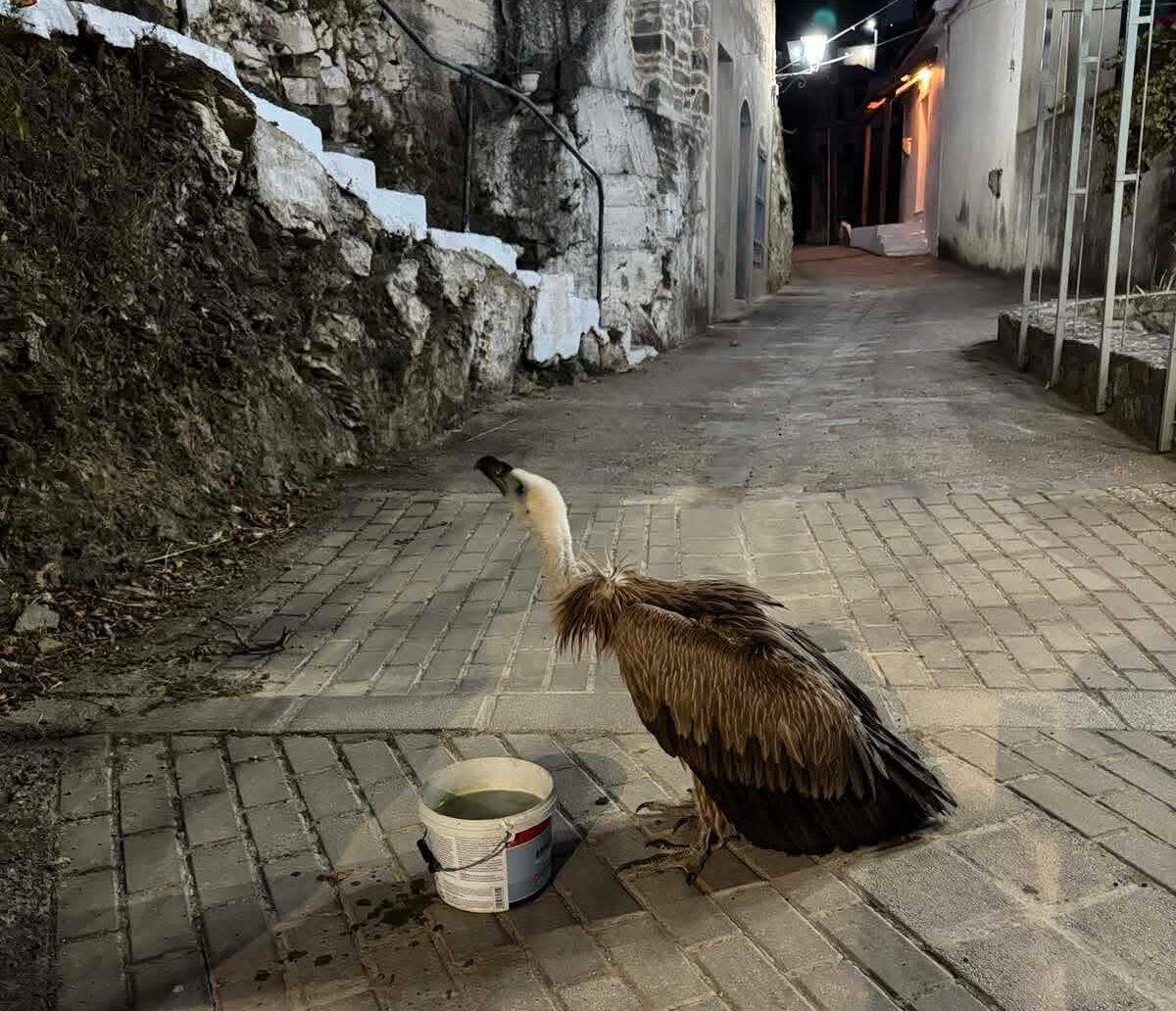
Separately, an unusual phenomenon has been drawing attention across Crete this summer: young griffon vultures falling from the sky, exhausted and dehydrated.
These birds have been turning up in roads, residential areas, and even the sea. Several have needed rescue and care at the Natural History Museum of Crete or at ANIMA, a wildlife rehabilitation organization.
According to researcher Michalis Probonas (Μιχάλης Προμπονάς) from the Natural History Museum, this isn’t a new phenomenon, and it specifically affects young vultires born in spring. These juveniles haven’t yet developed the experience needed to cope with difficulties finding food and harsh weather conditions.
Heat, drought, and wind cause young vultures to lose their sense of direction, sometimes leading them into populated areas where they wouldn’t normally be seen.
Documented incidents include vultures found in the middle of the BOAK highway (Βόρειος Οδικός Άξονας Κρήτης, Crete’s Northern Road Axis), on top of cars, and even near an aircraft. Others have been swept out to sea by strong winds and washed up dead, since once their feathers get wet, they can no longer fly.
Probonas noted this may not represent new vulture behavior, but rather increased visibility — as former rural areas have become urbanized and smartphones and social media make such incidents easier to document and share.
A Vital, Vulnerable Population
Crete maintains a significant vulture population and has, in recent years, become an important source for reinforcing populations elsewhere.
Around 400–450 young vultures are born on the island each year, though only about half survive.
Conservation efforts extend beyond Crete — vultures have previously been relocated to Cyprus, where 25 birds successfully reproduced. An ongoing program also supports vulture population recovery across the Balkan Peninsula, including transfers of birds to mainland Greece, North Macedonia, and Bulgaria.
Despite the island’s strong vulture numbers, the birds still face serious threats: secondary poisoning from poison baits, collisions with wind turbines, and electrocution from power lines, alongside the seasonal dangers of extreme heat and wind — especially for young birds taking their first flights.
What does this mean for visitors?
If you’re exploring Crete’s mountains or driving along roads like the BOAK, you may encounter an exhausted vulture — this is a real and increasingly documented occurrence during summer months.
- If you spot an exhausted or grounded vulture, keep your distance — these are wild birds, not tame animals, and stressed vultures can behave aggressively.
- Do not attempt to handle or approach the bird yourself.
- Contact the Natural History Museum of Crete, gamekeepers or ANIMA for guidance on wildlife rescue if you encounter an injured or distressed bird.
- If hiking in areas like Asterousia, Dikti, or Thripti, be aware you may be near active vulture monitoring and water stations — please don’t disturb this equipment.
- Support responsible tourism and energy development in Crete’s mountain areas, as these directly affect the island’s vulnerable wildlife.
Sources: CretaLive.gr, Nea Kriti, Anatolh.com



