

Newsflash from Thursday, 19 February 2026:
Thirsty Soil: Why Recent Rains Haven’t Solved Crete’s Ongoing Drought Crisis
While much of Greece is currently breathing a sigh of relief thanks to a surplus of moisture, the island of Crete tells a different story. Despite recent rainfall across the country, new data reveals that central and eastern Crete are still grappling with persistent drought conditions.
According to the latest analysis from METEO at the National Observatory of Athens, as of February 12, 2026, the “thirst” of the Cretan landscape remains unquenched.
A Tale of Two Layers: The Science Behind the Dryness
To understand the severity of the situation, researchers analyzed soil moisture at two distinct depths using the Standardized Soil Moisture Index (SSMI), comparing current levels to the 30-year average (1991–2020):
1. The Surface Layer (7-28 cm): This layer reacts quickly to recent weather. While recent rain cycles (from mid-January to mid-February) brought moisture to eastern mainland Greece, they were not enough to lift central and eastern Crete out of drought status.
2. The Deeper Layer (28-100 cm): This layer reflects long-term conditions over several months. While western Crete has seen a slight recovery in these deeper levels, a large portion of the island remains in a state of relative drought.
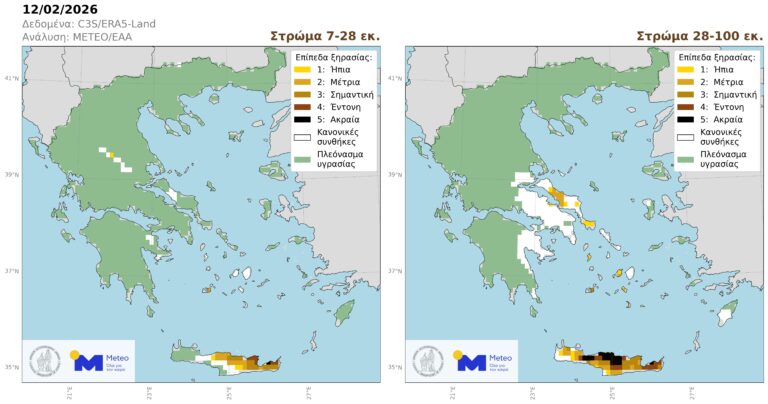
Figure 1. Drought values in Greece on February 12, 2026, in subsoil layers of 7–28 cm (left) and 28–100 cm (right). Areas experiencing relative drought are colored according to the 5-point scale at the top right of the map. Areas where soil moisture is significantly above the seasonal norm are shown in green, while areas with soil moisture close to the average are shown in white.
Why “Relative” Drought Matters
It is important to note that these drought levels (ranked 1 to 5, from mild to extreme) are relative to what is “normal” for this time of year.
Even if the ground doesn’t look bone-dry to the naked eye, if the moisture levels are significantly lower than the historical average for February, the area is classified as being under drought. For example, a region can hit Level 5 (Extreme Drought) simply because the soil is much drier than it should be during the winter months, even if some moisture is present.
The Impact on Cretan Agriculture
This lack of deep-soil moisture is a major concern for local farmers. The water content in the 28-100 cm depth is critical for the growth and yield of many agricultural crops. When soil moisture stays below normal for an extended period, it leads to prolonged water stress, which can stunt plant development and reduce the quality of the harvest.
Looking Ahead
While the rest of the country enjoys a moisture surplus, Crete remains the outlier. The data, provided via the European Union’s Copernicus service and the ERA5-Land model, serves as a stark reminder that localized weather patterns can vary wildly.
For Crete’s agricultural sector and water management authorities, the message is clear: the recent rains were a start, but they were far from a cure for the island’s water deficit.
“On the Razor’s Edge”: Crete’s Water Reserves Hit Critical Lows Ahead of Summer

Crete is facing a looming water crisis as the island’s reserves hit record-breaking lows, even surpassing the “problematic” levels of 2025. With only two months left before the start of the tourist season, authorities are sounding the alarm: if rainfall doesn’t increase significantly, the island may struggle to meet water demands this summer.
Thodoris Ninos, President of the Organization for the Development of Crete (OAK), has described the current situation as “marginal and alarming.”
“Deep Orange to Red” Alert
Despite being in the heart of winter, the island’s water status is already in a state of emergency. “We are already in the deep orange to red zone,” Ninos stated.
The primary concern is that natural systems have not been replenished due to a severe lack of rainfall. While 2025 was considered the most difficult year in recent memory, 2026 is currently trending even worse. Without a dramatic shift in weather patterns over the next 60 days, officials warn that there simply won’t be enough water to go around during the high-demand summer months.
Lake Kournas: Pushing Technical Limits
Lake Kournas, a vital water source for the Rethymno region, is at a particularly dangerous level.
* Current Level: 3.40 meters
* Last Year (Same Period): 3.75 meters
* Critical Minimum: 1.85 meters (the lowest level at which pumps can function)
Ninos revealed that the pumps were already lowered in 2018 to allow extraction at the 1.85-meter mark. There is no further room for technical intervention due to environmental regulations and water use permits. “If we don’t see the lake level approach 5 meters in the next two months, the year definitely won’t make it,” he warned.
Historic Lows at Aposelemis Dam
The situation is even more dire at the Aposelemis Dam in Heraklion. Reserves there are approaching the historic lows of 2018—a year when the tunnel connecting the dam to the Lasithi Plateau hadn’t even been activated yet. Today, despite the infrastructure being in place, the lack of inflow has left the dam in a precarious state.
A Call for Immediate Action
While the Potamon Dam remains a theoretical alternative for Rethymno, the overall message for the island is one of conservation.
“We must be extremely careful with every form of water consumption and implement best practices throughout the winter,” Ninos emphasized. The island is currently “on the razor’s edge,” and the behavior of residents and businesses over the coming months will be decisive.
What Can Be Done?
With the tourist season approaching—a time when water demand spikes due to high temperatures and increased population—the OAK is urging:
1. Strict Water Management: Prioritizing essential needs over secondary uses.
2. Public Awareness: Encouraging residents to report leaks and reduce daily waste.
3. Infrastructure Monitoring: Constant surveillance of reservoir levels to manage extraction rates.
The next two months are critical. If the island doesn’t receive significant rainfall to push Lake Kournas back toward the 5-meter safety threshold, Crete may face its most challenging summer yet.
Heraklion on the Brink: Mayor Calls for State of Emergency as Water Crisis Deepens

With the summer season fast approaching, the city of Heraklion is facing a “code red” water shortage. In a high-stakes meeting held on February 16, 2026, Mayor Alexis Kalokairinos issued an urgent appeal to declare the municipality in a state of emergency to prevent a total water collapse.
The meeting, which included local Members of Parliament and Vice Governor Nikos Syrigonakis, focused on the desperate need for immediate intervention before the tourist season begins in earnest.
Why a “State of Emergency”?
Mayor Kalokairinos argued that the current water crisis is no longer a future threat—it is an immediate reality. By declaring a state of emergency, the city could bypass traditional bureaucratic hurdles to:
* Accelerate new drilling projects that are already in the pipeline.
* Fast-track the installation of desalination units to supplement the dwindling supply.
* Secure emergency funding for critical infrastructure repairs.
The Desalination Bottleneck
One of the most significant hurdles discussed was the current legal framework. Under existing laws, desalination units are limited to a capacity of 2,000 cubic meters per day. Even with the current interpretation allowing for two such units, the total of 4,000 cubic meters falls short of the city’s needs.
“To reach a minimum limit of safe water supply—especially if the supply from the Aposelemis Dam drops to zero, which cannot be ruled out—we require approximately 6,000 cubic meters per day,” the Mayor emphasized. He is calling for an immediate legislative change to allow for larger, high-capacity units.
Infrastructure: A Race Against Time
Beyond immediate emergency measures, the Mayor highlighted two critical long-term projects: the replacement of the Malia and Tylissos pipelines. These primary arteries supply the city but are aging and prone to leaks.
Kalokairinos estimated that with coordinated government support, these essential upgrades could be completed within two years. However, he stressed the need for a unified decision-making center at the governmental level to manage these projects, rather than having responsibilities scattered across multiple ministries.
Beyond Water: A Future for Rail in Crete?
While water was the primary focus, the meeting also touched on the island’s transport future. The Mayor proposed that the government commission a techno-economic feasibility study for a fixed-track transport system (rail) in Crete.
“If there is genuine interest, we must start with an exploratory study,” he noted, suggesting that this would be the first concrete step toward integrating rail into the national transport strategic plan.
The Stakes for Summer 2026
The message from the Loggia (Heraklion City Hall) is clear: the current water management system is not built for the scale of a major urban center like Heraklion during a drought. Local MPs have pledged to take the issue to Parliament, pushing for the legislative changes and emergency status needed to keep the taps running this summer.
Water Crisis in Crete: Heraklion Municipalities Impose Drastic Irrigation Bans Mid-Winter

In an unprecedented move for the month of February, several municipalities in the hinterland of Heraklion, Crete, are implementing strict restrictive measures on water usage. As the island grapples with a deepening water scarcity crisis, local authorities are prioritizing drinking water over agricultural expansion to prevent a total “dry out” this coming summer.
Viannos at the “Eye of the Storm”
The Municipality of Viannos is currently facing the most severe pressure. In a bid to manage dwindling resources, the local council has announced a series of “hard measures” that will reshape the current cultivation season.
According to the new mandate, no irrigation water will be provided for new greenhouse or open-air crops. This specifically targets agricultural ventures looking to increase their acreage. Furthermore, the municipality has strictly prohibited “second summer crops” for vegetables and all other plant species.
Key restrictions in Viannos include:
* Deficit Irrigation: Olive groves and other orchards will receive limited water in areas where borehole levels are dropping.
* Drinking Water Priority: Irrigation from mixed-use boreholes or springs will be cut off immediately if water levels drop, ensuring that the local population’s drinking needs are met first.
* Heavy Fines: Mayor Pavlos Baritakis warned that the situation in areas like Embaros and Amira is critical, with six boreholes already dried up. Strict fines will be imposed on those violating the new regulations.
Messara Plain Under Pressure
The crisis is not limited to Viannos. The neighboring municipalities of Gortyna and Faistos are reporting a dramatic drop in water tables. There is growing concern that the summer season will bring “explosive” water shortages if current trends continue.
Grigoris Nikolidakis, the Mayor of Faistos, highlighted a frustrating irony: while some rain is falling, it is largely going to waste.
“The entire Messara plain is being tested hard,” Nikolidakis stated. “The water falling today could provide a substantial solution to our needs if we had the necessary small dams and land improvement projects to help recharge the aquifer.”
A Wake-Up Call for Infrastructure
The current situation in Heraklion serves as a stark reminder of the impact of climate change on Mediterranean agriculture. Local leaders are now calling for urgent infrastructure upgrades, arguing that without small-scale dams and better water management systems, the region’s primary economic engine—agriculture—is at risk.
For residents and farmers in the Cretan hinterland, the message is clear: water is no longer a guaranteed resource, and the “rational management” of every drop is the only way forward.
A “Breath of Life” for Aposelemis: 200,000 Cubic Meters of Rainwater Collected in Just 24 Hours
The parched landscape of Crete received a much-needed, albeit brief, relief this week. Recent rainfall has provided a vital boost to the Aposelemis Dam, the island’s largest water reservoir, injecting a significant volume of water into its dwindling reserves.
While the “gift” from nature was substantial, officials warn that the battle against water scarcity is far from over.
A Surge in a Single Day
According to Thodoris Ninos, the CEO of the Organization for the Development of Crete (OAK), the dam saw an inflow of approximately 200,000 cubic meters of water following the latest weather fronts.
In a statement, Ninos highlighted the intensity of the event. “We essentially collected about 65% of the water we expected to have available for the coming days in just a single day,” he noted. However, he clarified that the high flow was short-lived, lasting only about 24 hours before the intake slowed down again.
By the Numbers: The Current State of the Reservoir
Before the rains, the water level at the Aposelemis Dam had dropped to a concerning 1,350,000 cubic meters. Following the recent inflows, the total volume has risen to approximately 1,550,000 cubic meters.
While an increase of 200,000 cubic meters is a positive development, Ninos was realistic about the impact:
* Is it helpful? Yes, it provides a temporary “breathing room” for water management.
* Does it solve the crisis? No. The overall data regarding the region’s water supply remains critical, and the current reserves are still well below historical averages for this time of year.
Monitoring the Horizon
The management team at OAK is now monitoring the situation on a daily basis. The hope is that subsequent weather patterns will trigger further rises in the water level, allowing for more consistent distribution to the surrounding municipalities.
“We are watching it day by day to see if there is another rise in the level so we can draw more water,” Ninos explained. His closing remark served as a stark reminder of the island’s current vulnerability: “Whatever nature gives us, we take.”
What This Means for Residents
For the residents of Heraklion and neighboring areas, this news is a reminder of the volatility of our water resources. While the 200,000 cubic meter boost is a welcome relief, the need for rational water use and conservation remains as urgent as ever as we head toward the warmer months.
A “Breath of Life” for the Mesara Plain: Faneromeni Dam Surges After Recent Rains
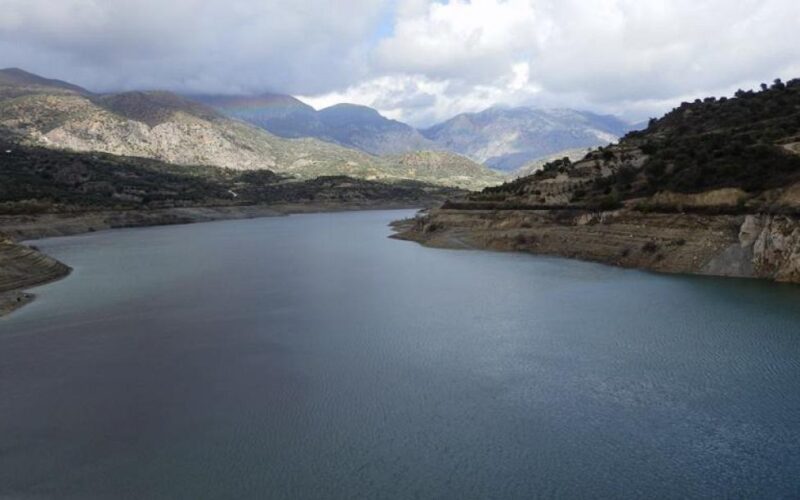
There is finally a wave of optimism washing over the Mesara Plain in Crete. After a period of intense concern regarding water reserves, the Faneromeni Dam is seeing a dramatic recovery, providing a much-needed “breath of life” to one of the island’s most vital agricultural regions.
Recent rainfall has proven to be a game-changer, with the dam’s water levels rising at an impressive rate.
Breaking the 5 Million Mark
According to the latest measurements, the Faneromeni Dam has officially surpassed the milestone of 5,000,000 cubic meters of water.
The most recent data is particularly striking: as of yesterday evening, the reservoir reached a total of 5,307,792 cubic meters. Even more impressive is the speed of the inflow—the dam recorded an increase of 417,382 cubic meters in just 24 hours.
A Vital Lifeline for Farmers
For the primary sector in Mesara, this surge in water levels is more than just a statistic; it is a survival kit for the upcoming season.
The Mesara Plain is known for its dry climate and its heavy reliance on the dam for irrigation. As the region prepares for the summer months—when water demand peaks—these new reserves offer a significant buffer for local growers and their crops.
Why this matters:
* Irrigation Security: The dam is the backbone of the local agricultural economy.
* Summer Readiness: The recent inflows provide a safety net before the high-heat months.
* Aquifer Support: Sustained surface water levels help reduce the over-reliance on deep-borehole pumping.
A Generous February
While the earlier winter months left many worried about a potential drought, February has been surprisingly generous. The recent weather patterns have delivered the consistent rainfall necessary to turn the tide for the region’s hydrological outlook.
Local authorities and experts from e-mesara.gr continue to monitor the water levels closely. The hope is that the favorable weather conditions will persist, allowing the reservoir to strengthen its reserves even further before the rainy season ends.
Looking Ahead
While the 5.3 million cubic meters currently in the dam are a cause for celebration, the situation remains a reminder of how precious water is in the Mediterranean landscape. For now, the farmers of Mesara can breathe a sigh of relief, knowing that nature has provided a vital boost just in time.
Are you noticing the effects of the dry winter in your area? Share your observations in the comments below.



