

Newsflash from Saturday, 3 October 2026:
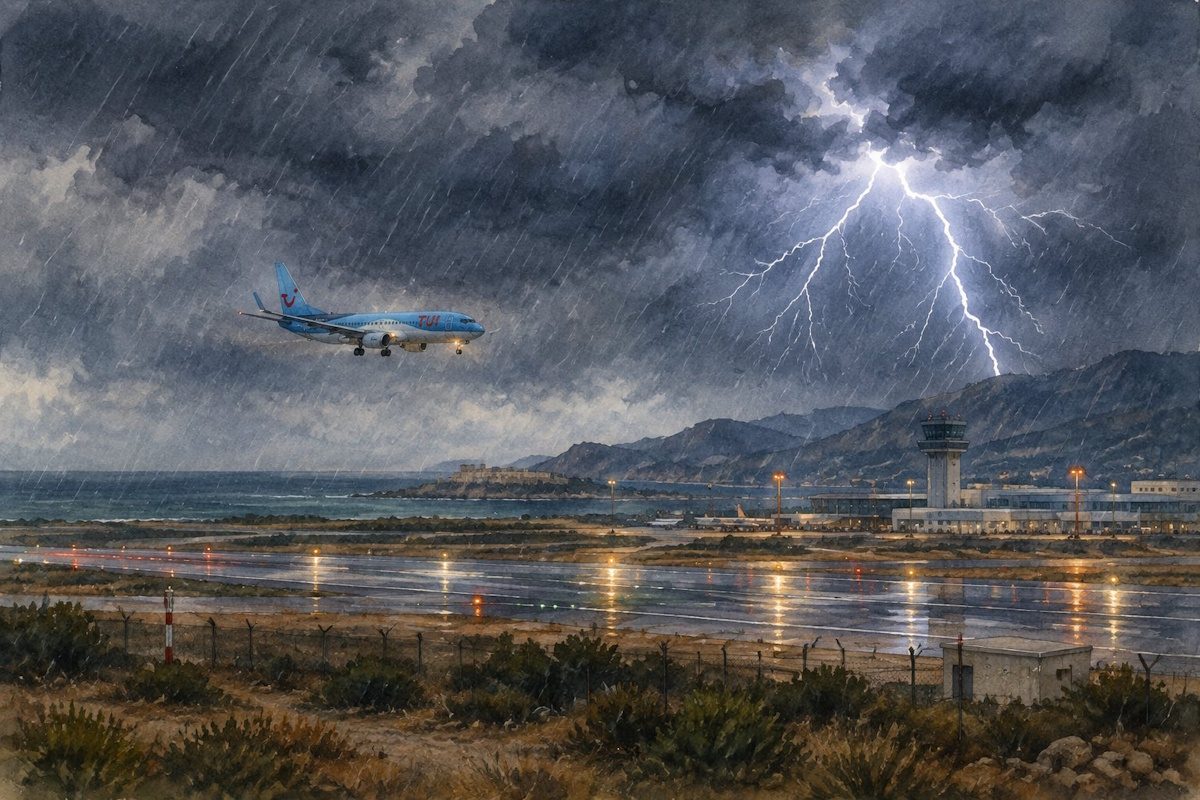
Crete is reeling after a brutal overnight storm turned roads into rivers, trapped holidaymakers in their cars, and forced multiple aircraft to divert away from the island’s main airport.
The worst-hit area was Ierapetra (Ierápetra), a coastal town in the Lasithi region on Crete’s southeastern side.
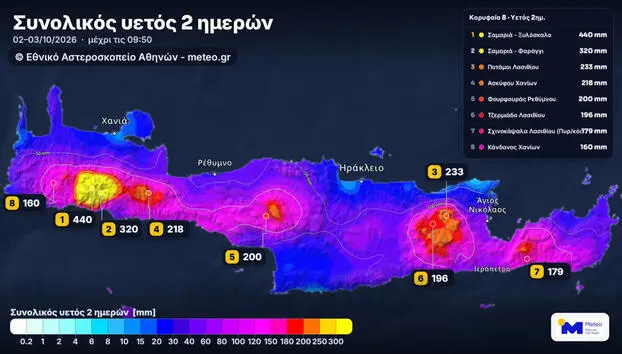
Dramatic rescues in Ferma

In the village of Ferma [Google Maps], just outside Ierapetra, which was ravaged by severe fires in the summer of 2005, water levels rose at alarming speed overnight.
More than 20 people became trapped inside their vehicles as a flooded stream swept debris through the area.
Among the 23 people rescued were four German tourists travelling in a mini-van. They called the European emergency number 112 around 11 p.m., allowing firefighters to locate and reach them quickly.
Fire crews worked through the night, pulling people from cars and flooded homes. Officials confirmed all rescues were completed successfully with no injuries reported.


A separate medical emergency added to the chaos: an ambulance had to be sent from Sitia (Sitía), a town further east, to collect a woman needing hospital transport, because flooding made it impossible for the much closer Ierapetra ambulance to reach the area. She was not in a critical condition.

Flooding spreads to Flamouriana and Makrys Gialos
Serious problems were also reported in Flamouriana, a village in the municipality of Agios Nikolaos (Ágios Nikólaos), another popular coastal town in Lasithi.
Large volumes of water swept debris onto roads there, and cleanup crews were deployed to clear the damage and restore access.
In Makrys Gialos (Makrýs Gialós), a seaside area near Ierapetra, streets were also transformed into torrents, with heavy flooding reported across the village.
Fire services across the wider Ierapetra area were overwhelmed with calls for water pumping from flooded basements and ground-floor homes and businesses.
Flights diverted from Heraklion Airport
The extreme weather also disrupted air travel. Around 7 p.m. on Friday, a powerful storm cell sat directly over the main runway at Heraklion Airport, Crete’s busiest.
Roughly ten flights bound for Heraklion were unable to land and were diverted to other airports, including Athens, Chania, and Rhodes. At least one aircraft was redirected as far as Bodrum in Turkey.
Affected flights included arrivals from Paris (diverted to Chania), as well as flights from Poland, Frankfurt and Hamburg (diverted to Athens). A flight from Istanbul was also reported as impacted.
Crete Storm Alert: Key Roads and River Crossings Shut Down Across the Island

Severe weather has prompted emergency traffic restrictions across Crete, with road closures and diversions affecting three major regions: Lasithi, Rethymno, and Heraklion.
The Hellenic Police (EL.AS.) have issued an urgent appeal to motorists, advising everyone to postpone non-essential journeys and strictly follow instructions from traffic officers on the ground.
Lasithi: Coastal route cut off
In the eastern regional unit of Lasithi (Lasíthi), movement along the main southeastern coastal route has been halted.
Traffic is completely blocked in both directions on the provincial road connecting the coastal towns of Ierapetra (Ierápetra) and Sitia (Sitía) at two locations: the 15th kilometre near Agia Fotia (Agía Fotiá) and the 22nd kilometre near Koutsouras (Koutsourás).
Further north in the same region, driving conditions are restricted on the provincial road connecting the coastal hub of Agios Nikolaos (Ágios Nikólaos) to the inland village of Exo Potamoi (Éxo Potámoi), where vehicles are limited to a single lane at the 28th kilometre.
The Myrtos–Tertsa road and the long Irish-style junction at Saratsis Kampos are closed.

Rethymno: Mountain passes affected
In central-western Crete, within the Rethymno (Réthymno) regional unit, driving routes through the mountain foothills have faced disruptions.
The provincial road linking the villages of Vistagi (Vistagí) and Platanya (Platánia), located in the inland municipality of Amari (Amári), remains shut to all traffic.
However, road conditions have improved in the nearby mountain territory, where police confirmed that access has now been safely restored on the routes from Krana (Kraná) to Zoniana (Zonianá), and from Axos (Axós) to Zoniana.
Heraklion: Low-water crossings blocked
In the central regional unit of Heraklion (Irákleio), police have closed multiple “Irish crossings” (ford) — paved road surfaces built directly across riverbeds that become hazardous when water levels rise.
Inside the municipality of Heraklion, closures remain in place at the crossing on Kastorias Street in the neighbourhood of Katsambas (Katsambás), as well as on Lykiou Street in Koroni Magara (Koróni Magará).
South of the capital, in the rural municipality of Archanes-Asterousia (Archánes-Asterousía), the Irish crossing connecting Damania (Damánia) to Melidochori (Melidochóri) has also been barred to vehicles.

What does this mean for visitors?
- Postpone non-essential travel: Avoid driving through affected areas unless strictly necessary until local authorities lift current restrictions.
- Never cross an Irish crossing: Do not attempt to drive through submerged riverbed passages, as fast-flowing water can sweep vehicles away.
- Follow traffic police directions: Obey road closure signs and instructions from officers stationed at checkpoints.
- Check official road status updates: Motorists can consult the national police website (astynomia.gr), which features a dedicated live banner detailing road closures, adverse weather alerts, and safety guidelines across Greece.
- Expect travel delays: If you must travel between Agios Nikolaos and inland Lasithi, or along alternative routes in eastern Crete, allow extra time for single-lane bottlenecks and detours.
Source: Cretalive.gr
Other areas under pressure
Conditions had already caused significant damage in Zoniana and the mountainous Mylopotamos region over the previous two days, though the situation there was reported as improving, with emergency crews still on standby.
Ammoudi Beach, Agios Nikolaos:
What does this mean for visitors?
- Check flight status before heading to Heraklion Airport — delays and diversions are possible while storms persist.
- Avoid driving through flooded roads, especially in low-lying or coastal areas like Ferma, Makrys Gialos, and Flamouriana.
- Save the emergency number 112 on your phone — it allowed rescuers to pinpoint and reach the trapped German tourists quickly.
- Monitor local news and official alerts if staying in the Ierapetra or Agios Nikolaos areas, as conditions can change rapidly.
- Expect possible disruption to transport and services in affected villages while cleanup and road-clearing operations continue.
Aposelemis Dam Under Pressure as Lightning Storms Rage and Migrant Boats Keep Arriving
Old harbour of Chania
Crete’s wild weather shows no sign of easing, with authorities now watching the island’s most important reservoir with growing concern.
At the same time, migrant arrivals continue along the south coast, and a tourist had to be pulled from a swollen river.
Aposelemis Dam on high alert
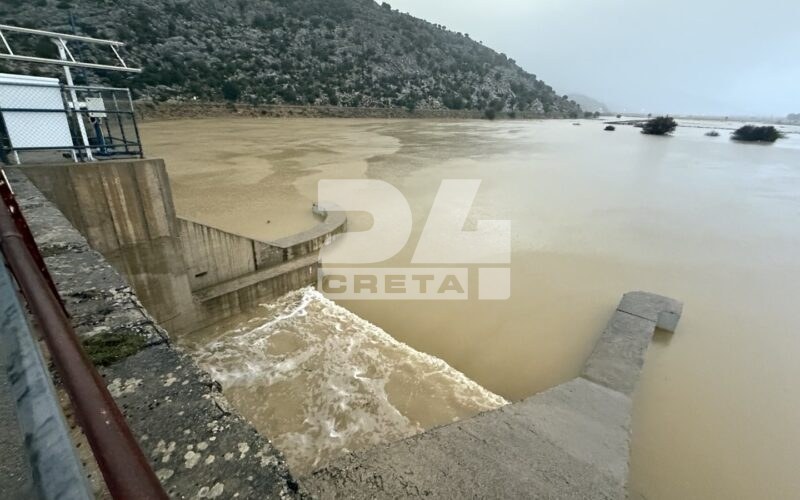
The Aposelemis Dam (Fráhtis Aposelémi), located in the Heraklion region, is under close watch after torrential rain sent massive volumes of water rushing toward the reservoir.
The heavy, prolonged downpour on Thursday dramatically changed conditions in just a few hours. The Chavgas River (potamós Chavgás), which feeds into the dam, saw its flow increase sharply.
The surge in water had already caused problems in the plain of the Lasithi Plateau (Oropédio Lasithíou), a highland agricultural area that drains toward Aposelemis.

On Friday afternoon, staff from the Crete Development Organisation (Organismós Anáptyxis Krítis, OAK) were on site at the dam, where safety valves were activated to manage the large volume of incoming water.
OAK President Thodoris Ninos told Creta24.gr that the situation is being monitored continuously, with every effort being made to manage the water volume and address problems as they arise.
Lightning lights up the night sky

In the early hours of Saturday, intense lightning activity swept across Crete as a powerful storm front moved from west to east.
Electrical activity was recorded extensively across the Chania, Rethymno, and Heraklion regions, with particularly dense lightning strikes also reported further east in Lasithi.

More migrant boats reach the south coast
Despite the severe weather, migrant arrivals on Crete’s southern shores have continued.
Overnight, three separate incidents were recorded:
- 43 people, including one woman, were found at Eligia beach near Agios Ioannis Kapetanianon (a village in the Faistos area). One man required hospital treatment and was taken to PAGNI, Crete’s main hospital.
- 36 people, including one woman, reportedly from Sudan, were located roughly 45 nautical miles southeast of Kali Limenes (Kalí Liménes). They were escorted to Heraklion by police from the Faistos station.
- A further 45 men were being transferred near Lenta, expected to arrive in Heraklion around 11 a.m.

Authorities say the ongoing severe weather is significantly complicating detection, rescue, and transport operations in the area.
Tourist rescued from the Gazanos River
Amid the flooding, a drunken British tourist was found inside the Gazanos River (potamós Gazanós) and rescued by a passerby who happened to be nearby. Footage of the rescue has circulated locally.
Sources:
Neakriti.gr
Neakriti.gr
Cretalive.gr
Creta24.gr
Neakriti.gr
Cretalive.gr
Daynight.gr



