Camping in Crete and Greece: wild camping, free standing, campsites, parking your campervan and campsites in Crete have been a topic since 2025 that initially leaves many travellers feeling confused. In everyday life in Crete, one thing applies above all else: simply sleeping somewhere is not automatically legal, whereas simply parking is more likely to be.
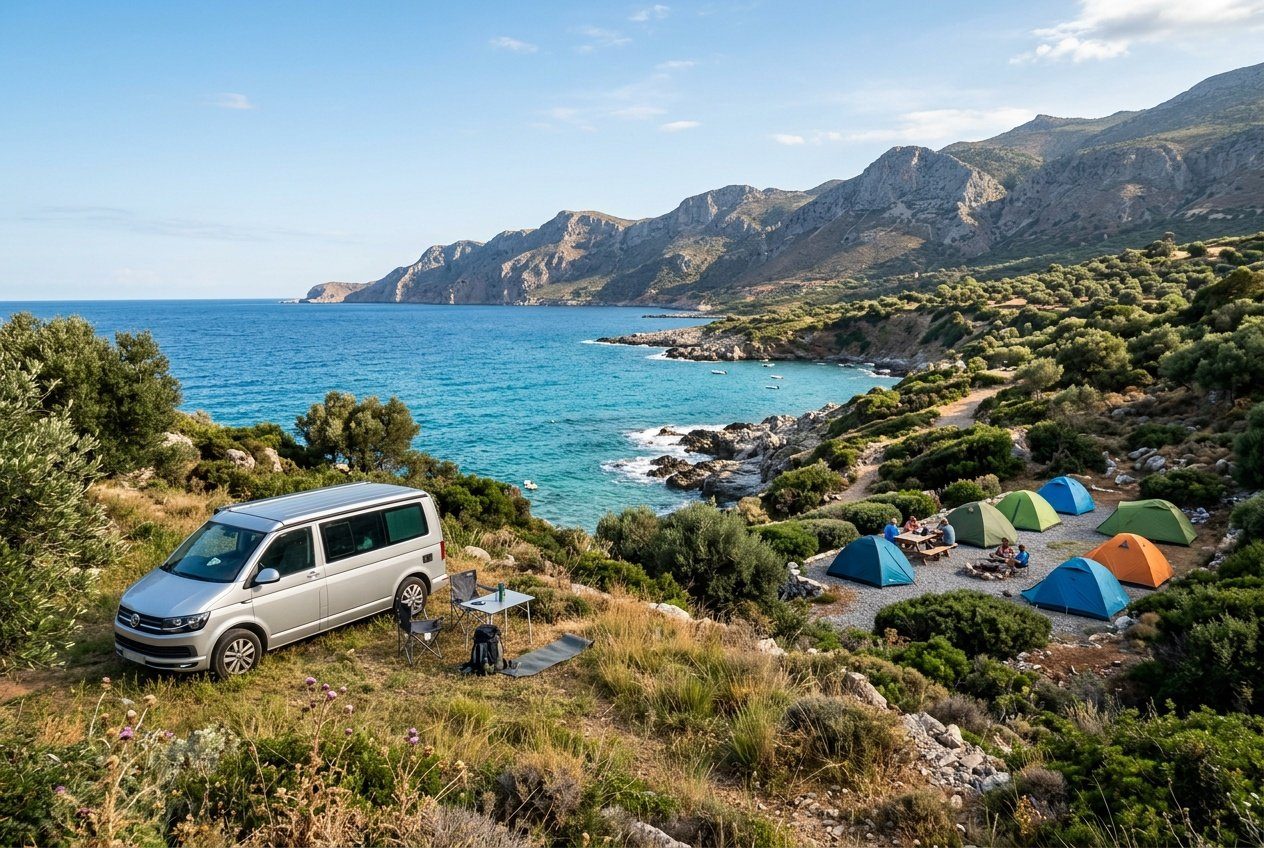
If you’re travelling to Crete in a campervan, van, caravan or tent, you should make a clear distinction between parking, staying overnight and proper camping, as this is precisely what determines whether you face trouble, fines or a relaxing holiday.
Camping in Greece attracts thousands of nature lovers every year. The local rules are often stricter than you might be used to from the past.
In practice, the situation in Crete seems more relaxed than many recent headlines suggest. Nevertheless, wild camping in Greece is a legally tricky area, particularly on beaches, at archaeological sites, on the edge of forests and in sensitive areas.
This guide outlines the current rules as they actually apply in Crete. It shows where the risk is high, what is permitted when parking a campervan, and when an official site is the better choice.
Wild camping in Crete and Greece: What is currently prohibited
The most important piece of advice for travellers to Crete is quite simple: wild camping in Greece is not generally permitted. If you are planning to go camping in Greece, you need to be aware that the laws apply nationwide.
Since the drastic changes introduced by Law 5170/2025 and subsequent clarifications, it is now the case that genuine camping behaviour outside official sites, in particular, quickly becomes problematic.
Where wild camping is expressly prohibited
Particularly critical are locations which, in Crete, are often precisely the most beautiful spots. These include beaches, coastal stretches, forest edges, woodlands, archaeological sites and many public open spaces.
If you park your tent, motorhome or caravan there in such a way that it clearly looks like camping, you are in a prohibited area. This also applies if the site appears empty and other vehicles are already parked there.
Why ‘wild camping prohibited’ in Greece should be taken seriously
In Crete, free camping was often tolerated for a long time. Since 2025, the matter has been handled more clearly and strictly, as nature, coastlines and cultural sites are to be better protected.
This does not mean that every beach is checked every evening. It simply means that the authorities have a clear basis for intervening if someone spreads out, leaves rubbish behind or uses sensitive areas.
Differences between tents, motorhomes, vans and caravans
With tents, the situation is usually the clearest. A tent in the open countryside almost always looks like classic wild camping and is legally highly open to challenge.
With vans or motorhomes, the situation is more nuanced. A neatly parked vehicle without chairs, an awning or wheel chocks is more likely to be regarded as parking. A caravan is more conspicuous and is treated more restrictively in many situations, particularly within built-up areas.
Parking a campervan in Crete: What is legal and what isn’t
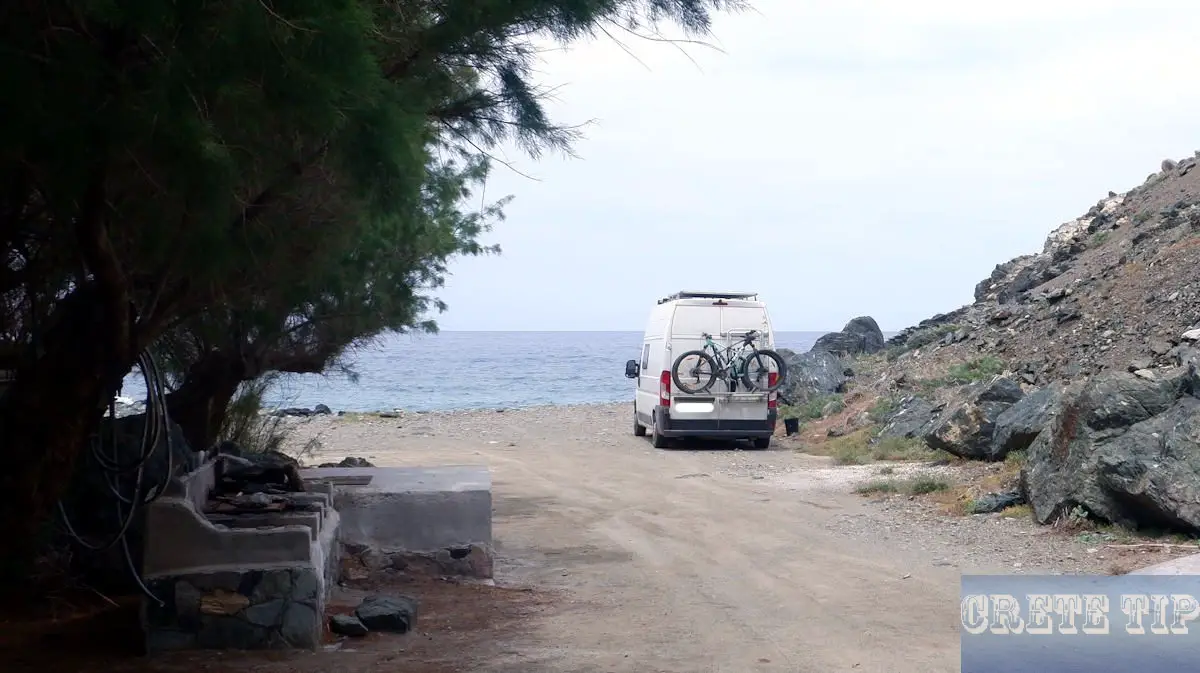
This is precisely the crux of the matter in Crete. Following the amendments to Laws 5170/2025 and 5209/2025, simple parking is once again much more feasible, provided that the parked vehicle does not become a visible mobile campsite.
Parking is not camping: the crucial distinction
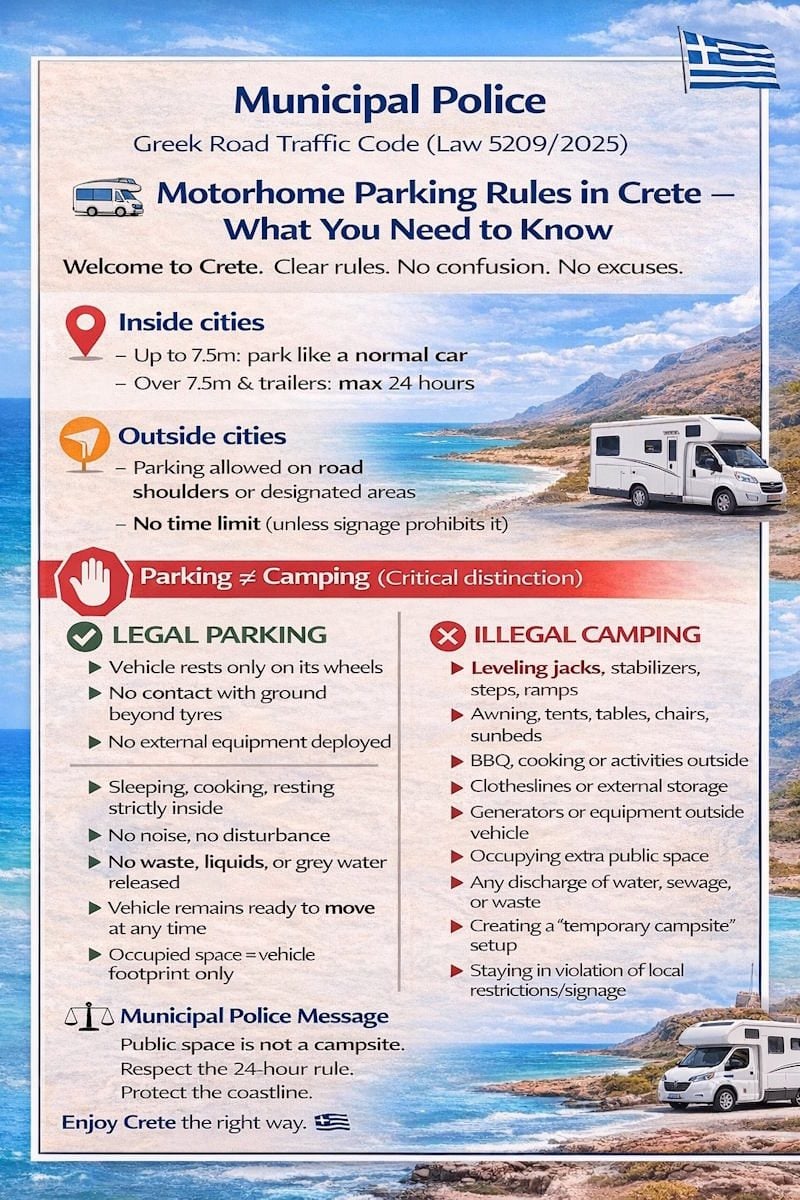
A parked motorhome is not automatically an illegal campsite in legal terms. If you park normally, don’t put anything outside and don’t occupy any space, you are much more likely to remain within the legal boundaries.
In practical terms, this means that in Crete: sleeping in the vehicle is often perceived differently from camping in front of the vehicle. As soon as tables, chairs, awnings, barbecues, wheel chocks or washing lines are set up outside, the situation quickly changes.
Rules within built-up areas by vehicle type and length
Within built-up areas, the following rules have generally applied since the clarifications:
| Vehicle | In built-up areas |
|---|---|
| Motorhome under 7.50 m (24.6 ft) | Parking permitted without a fixed time limit |
| Motorhome over 7.50 m (24.6 ft) | Maximum 24 hours |
| Caravans | Maximum 24 hours |
This only applies where parking is not specifically prohibited. Narrow old town areas in Crete, such as in Chania, Rethymno or Heraklion, often have additional local rules or simply too little space.

Parking outside built-up areas and at the roadside
Outside built-up areas, parking a motorhome or caravan is generally more relaxed. However, it must still be done in a permitted spot, i.e. in a designated parking area, on the hard shoulder or as close as possible to the right-hand edge of the carriageway and parallel to the road.
Many roads in Crete are narrow. If a camper van narrows a lane or obstructs the view, the problem is not the camping itself, but incorrect parking.
Typical camping behaviour that can cause problems
These things regularly cause trouble in Crete:
- Extending the awning
- Setting out tables and chairs
- Barbecuing next to the vehicle
- Using chocks, rugs or washing lines
- Leaving rubbish or waste water behind
- Grouping several vehicles together like a small camp
If you simply park inconspicuously, you will usually experience far fewer arguments than someone who visibly makes themselves at home.
Free standing in Crete: What is tolerated and where the risk is high
Free standing is a practical concept in Crete, not a clear legal one. Many simply mean spending a quiet night parked, without camping furniture, rubbish or noise. This is exactly what is tolerated in some places, though it is certainly not automatically legal.
Free standing in practice versus the official legal situation
In Crete, many van and motorhome drivers find that a quiet night in an inconspicuous car park often works out. The official legal situation remains stricter than this everyday experience.
Therefore, the rule is: tolerance is not a right. If the police, port authorities, local council or residents intervene, pointing out the presence of other campers on site usually does not help.
Particularly sensitive locations such as beaches, forests and archaeological sites
The risk is highest near beaches in Crete, particularly at well-known bays and hotspots. The same applies to forest edges, protected areas and areas around ancient sites.
Authorities and locals react more quickly in these areas because fire hazards, litter and land use are genuine problems. If you stay overnight in such zones, you should expect to be checked or asked to leave.
Peak season, off-season and regional differences in checks
In July and August, checks are stricter. Coastal towns are full, parking is scarce and there is significantly less tolerance for large campervans.
In the off-season, things are much quieter, especially in remote areas in the south or east of Crete.
Nevertheless, popular tourist spots such as Elafonissi, Balos, Matala, Chania or harbour areas can remain sensitive even then.
Fines, checks and new laws since 2025
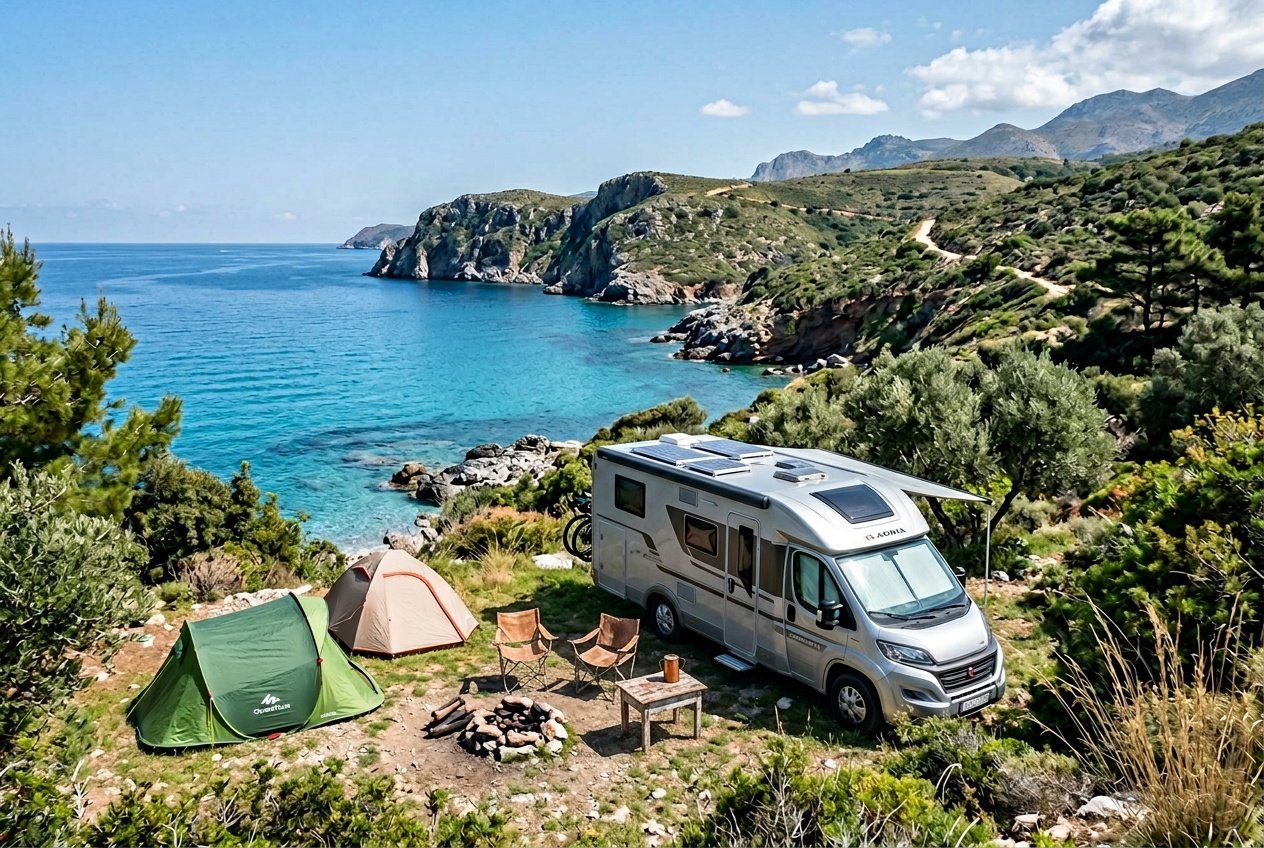
If you’re travelling around Crete in a campervan or with a tent, you shouldn’t view the legal situation since 2025 as a mere formality. Camping in Greece now requires more planning than it used to.
The laws were first significantly tightened and later clarified further. Whilst this is better for travellers, it does not eliminate the risks associated with genuine wild camping.
Fines, legal proceedings and possible imprisonment
At the start of 2025, severe penalties were on the table. Fines of up to 3,000 euros were mentioned, sometimes combined with legal proceedings and even possible imprisonment of up to three months.
In practice, it often ends sooner, for example with a warning, being asked to leave or a report being filed. If you argue, leave rubbish behind or camp in clearly sensitive locations, you usually make your situation worse immediately.
What Law 5170/2025 has changed
Law 5170/2025 caused a great deal of uncertainty in early 2025. Parking motorhomes and caravans in sensitive areas was severely restricted, and the 24-hour rule was intended to apply much more widely.
For many travellers to Crete, this initially sounded as though even a normal overnight stay in a vehicle was off-limits almost everywhere. This interpretation was the reason why the issue caused such a stir.
The role of Law 5209/2025 and official clarifications
With Law 5209/2025 and subsequent clarifications, parking has once again been better distinguished from actual camping. Since then, the following principle has been particularly important: Normal parking without visible camping equipment is more likely to be legal than many initially thought.
This does not alter the fact that wild camping remains prohibited if it results in a visible campsite or affects sensitive areas. For Crete, this means in everyday life: park tidily, keep a low profile, and do not move any infrastructure outside.
Legal alternatives: campsites and private land in Crete
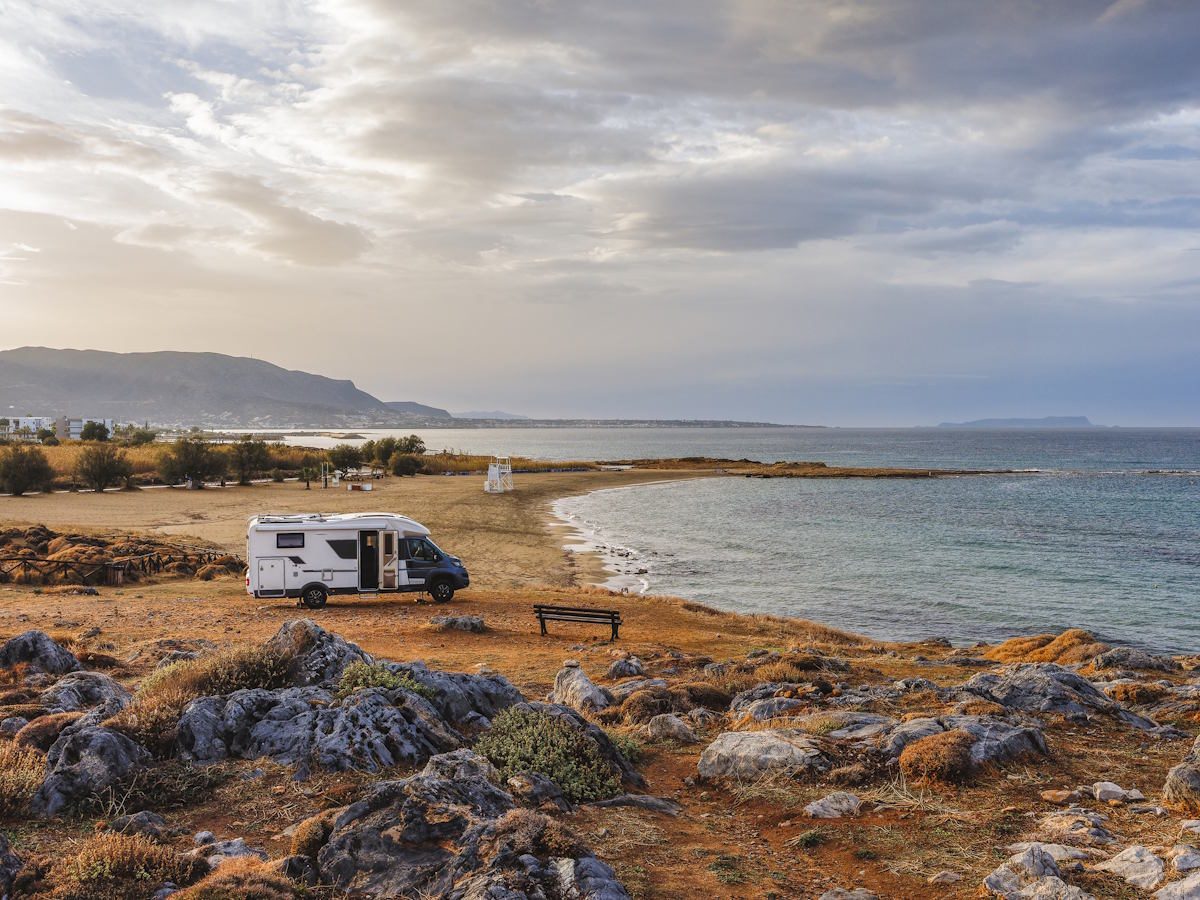
If you want to travel around Crete in a relaxed manner, you’re often better off with legal options. Especially when it comes to heat, water supply, waste disposal and longer stops, official campsites or clearly regulated private sites are usually much less stressful than grey areas.
When an official campsite is the best choice
An official site is particularly worthwhile for stays of several nights, family holidays, working on the road, or when water, electricity and shade are important. Even in high season, a reserved pitch often saves a lot of hassle.
In Crete, you quickly realise how valuable working showers, electricity and proper waste disposal are. After two days without these services at the latest, the romance of camping wears thin for many campers.
Camping on private land and the limits of permission
Private land might sound like the easy solution at first. It’s not quite that simple, though, as the owner’s permission does not automatically override all public regulations.
If the site looks like an unauthorised campsite or is in a sensitive location, problems can still arise. For a single, clearly agreed overnight stay without a major setup, the risk is usually lower than on public land.
However, only one motorhome or caravan is permitted on private land; otherwise, there will be trouble due to the establishment of an illegal campsite!
What campers should look out for regarding facilities, bookings and location
For sites in Crete, the following points are particularly important:
- Shade, especially in high summer
- Waste disposal for grey and black water
- Electricity and water access
- Proximity to the beach, town or bus
- Booking options during the season
- Access for larger vehicles
If you’re towing a caravan or driving a longer motorhome, you should also check the access road in advance. Some sites are in lovely locations but are unnecessarily narrow for large vehicles.
Campsites in Crete: great starting points for your holiday
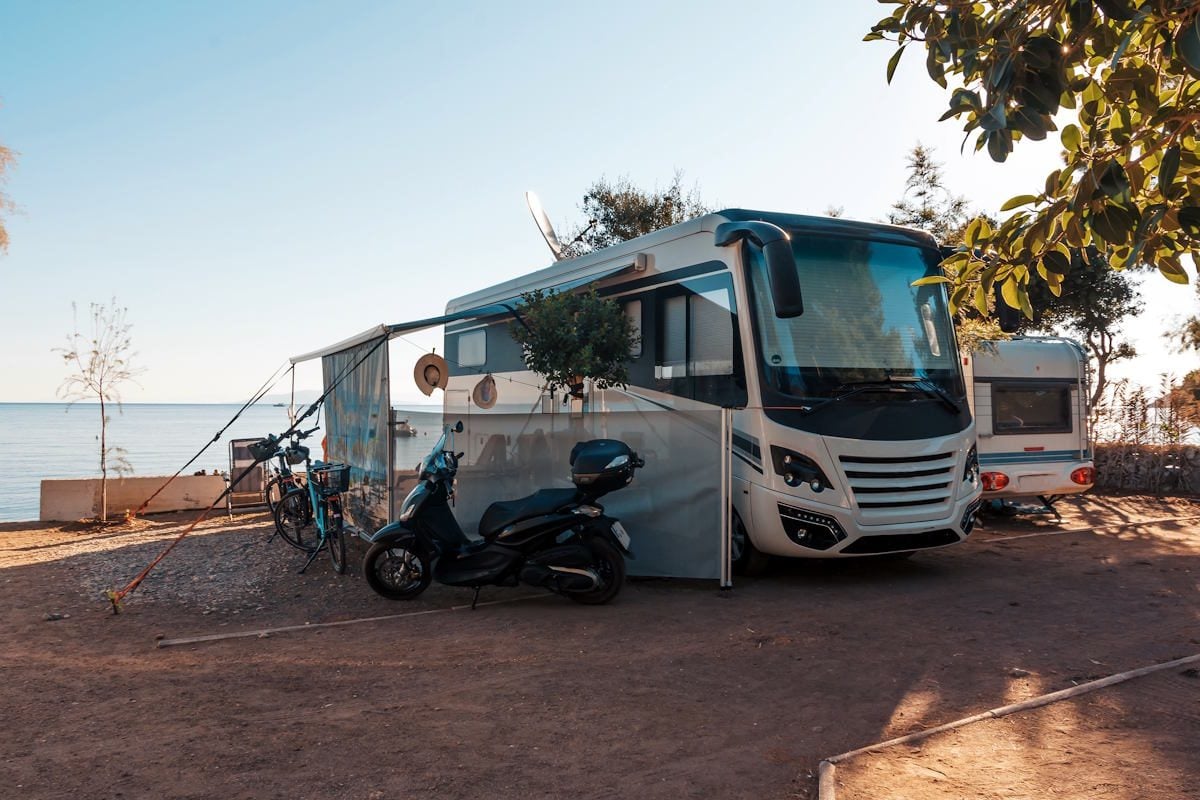
Crete doesn’t have a campsite on every corner, but many are strategically well-placed. For a road trip, it helps to choose not just by star rating or reviews, but by region, location along the road, facilities and your own travel style.
Camping Koutsounari and the south coast
Camping Koutsounari is a good starting point in the south-east for many. The location is ideal for trips around Ierapetra, beaches on the south coast and more relaxed days away from the major towns on the north coast.
Travellers looking for sun, sea and a bit more peace and quiet often end up in this area. For longer vehicles, the region is generally more pleasant than tight city centre locations.
Sites near Rethymno and other key regions
Campsites around Rethymno are practical if you want to explore the north coast flexibly. From there, Chania, Heraklion and the island’s interior are often easily accessible without having to change location every day.
The west is also popular if beaches and day trips are the focus. In the east, the quieter atmosphere and often slightly less traffic are the main attractions.
How to choose the right campsite in Crete
A simple guide to choosing:
| Destination | Ideal location |
|---|---|
| Visiting the cities of Chania or Heraklion | Outside the cities, accessible by bus or a short drive |
| Beach holiday | close to the beach, with shade and showers |
| Road trip across the island | centrally located on the north coast or with quick access to main roads |
| Peace and nature | South coast or eastern regions |
| Family | Site with sanitary facilities, electricity, mini-market and clearly marked pitches |
Not every good site is modern. In Crete, clean sanitary facilities, shade and friendly operators are often more important than a perfect appearance.
Frequently Asked Questions
Is wild camping actually permitted in Greece, and how strictly is it enforced in Crete?
Wild camping in Greece is not freely permitted, especially not with visible camping equipment in sensitive locations. In Crete, enforcement varies in strictness depending on the region, season and behaviour, but is generally much stricter on beaches, at popular spots and near tourist attractions.
Where can I park my campervan overnight without getting into trouble (car park, near the beach, in a village, at a harbour)?
The safest options are official campsites or a clearly legal car park where camping is not permitted. Areas near beaches, harbour areas and narrow villages are often riskier, especially if the vehicle stands out, blocks space or has equipment left outside.
Which campsites in Crete are really well located and have decent facilities (showers, electricity, Wi-Fi)?
Sites on the north coast are usually well-located for round trips, whilst sites such as Camping Koutsounari are ideal for quieter days in the south or east. In Crete, the most important things are shade, clean showers, electricity, water and proper waste disposal; Wi-Fi is nice, but not always reliable in everyday use.
How does parking and staying overnight in a campervan work in cities like Heraklion or Chania?
In cities, parking is usually the bigger problem than sleeping in the vehicle. It’s better for large campervans to park on the outskirts and travel into town by bus or taxi, as narrow streets, parking pressure and local signage in Heraklion and Chania can quickly become stressful.
What should I bear in mind when parking off-road so that I don’t disturb local residents or leave behind a mess?
Parking inconspicuously, not leaving anything outside, keeping the noise down and leaving early in the morning helps the most. Rubbish, grey water and black water must always be disposed of correctly, as this is precisely where the tolerance of many locals in Crete ends.
Are there enough facilities in Crete for topping up water, disposing of grey/black water and refilling gas?
There are facilities for this in Crete, but they are not available everywhere. When travelling in a campervan, it’s best to plan your water, waste disposal and gas needs around campsites, larger towns and fixed stops, rather than looking for them at the last minute.