Between the darkness of Good Friday and the joy of Easter Sunday lies one of the most spiritually powerful days in the Greek Orthodox calendar — a day of silence, ancient ritual, and breathless anticipation.
For millions of Greeks around the world, Holy Saturday is unlike any other day of the year. It is a sacred pause — a collective exhale held between the grief of the Crucifixion and the triumphant joy of the Resurrection. Churches fall quiet, altars stand bare, and an almost tangible stillness settles over towns and villages across Greece. Yet beneath that stillness, something extraordinary is building.
This is the day of waiting. And in Greece, no one knows how to wait quite like this.
The Spiritual Heart of Holy Saturday
In the Greek Orthodox tradition, Holy Saturday is far more than a simple day of mourning. It commemorates Christ’s descent into Hades — known as the Harrowing of Hell — when, according to Orthodox theology, Jesus descended to the underworld to free the souls of the righteous who had been waiting since the beginning of time.
Churches across Greece echo with the haunting words of the ancient psalm:
“Today Hades cried out groaning.”
Resurrection hymns fill the air, telling of Christ’s conquest over death. The day’s celebrations are solemnly referred to as the “First Resurrection,” and the majority of Scripture readings draw from the Old Testament — the prophecies and promises that pointed, for centuries, to this very moment.
It is a day suspended between two worlds: one of death, one of life.
A Nation Prepares

While the spiritual dimension of Holy Saturday runs deep, the day is also one of the most bustling and joyful days of preparation in the Greek household. Across kitchens, courtyards, and bakeries throughout Greece, families are busy with the ancient, beloved rituals of Easter preparation.
The Red Eggs
Perhaps the most iconic symbol of Greek Easter is the red-dyed egg. Families gather to dye eggs a deep crimson, a color that symbolizes the blood of Christ. The egg itself carries profound symbolism: its hard shell represents the **sealed tomb of Jesus**, while the cracking of the shell symbolizes His Resurrection — the breaking open of death itself.
These eggs will play a central role in the beloved tradition of tsougrisma (τσούγκρισμα) — the egg-cracking game — which begins on the night of the Resurrection Service and continues through Easter Sunday.
Magiritsa: The Midnight Soup

After the midnight Resurrection Mass, Greek families return home to break their Lenten fast with magiritsa — a rich, warming soup made from lamb or beef offal, seasoned with lemon, dill, and rice. It is one of the most distinctive tastes of Greek Easter, a flavor so deeply tied to memory and tradition that for many Greeks living abroad, it is the taste of home itself.
The Most Magical Night of the Year
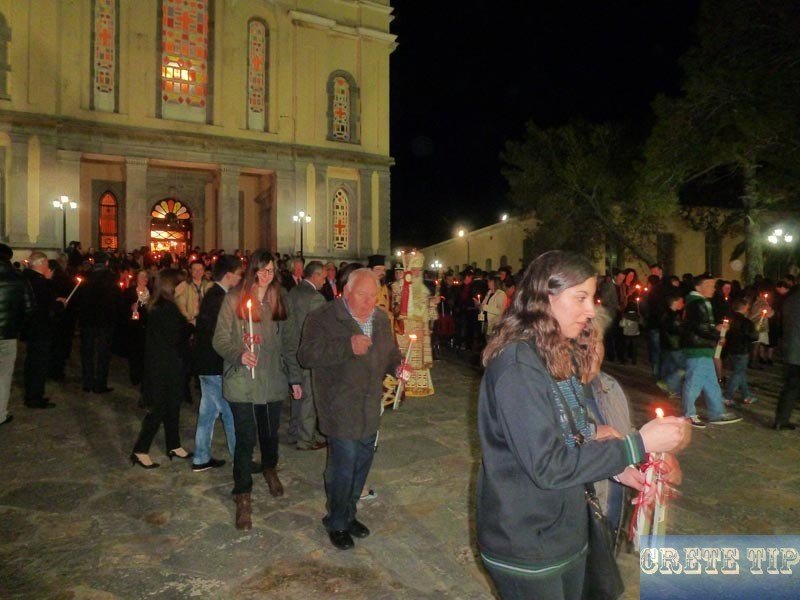
As Holy Saturday evening approaches, the anticipation becomes almost electric. In every corner of Greece — from the marble-paved squares of Athens to the whitewashed villages of the Cyclades — people dress in their finest clothes and make their way to their local church, candles in hand.
A few minutes before midnight, the church falls into complete darkness.
Then, the priest emerges from the altar, holding candles lit from the Holy Light — the sacred flame traditionally flown from Jerusalem each year and distributed throughout the Orthodox world. One by one, the flame is passed from candle to candle through the crowd, until the entire churchyard glows with thousands of flickering lights.
At the stroke of midnight, the priest steps outside and announces, in a voice ringing with joy:
“Christos Anesti!” — “Christ is Risen!”
And the congregation responds as one:
“Alithos Anesti!” — “He has truly risen!”
The night sky erupts. Fireworks and firecrackers explode overhead, filling the darkness with cascades of color and light. Church bells ring out across the country. Strangers embrace. Children laugh. And for a moment, the entire nation is united in a single, ancient joy.
Carrying the Light Home
One of the most touching traditions of Greek Easter is the carrying of the Holy Light from the church back to the family home. Greeks take great care not to let the flame go out on the journey — some shielding it with their hands, others using specially designed lanterns.

Upon arriving home, the flame is used to draw a small cross on the door sill with the candle’s smoke — a blessing and protection for the household. A candle is then lit inside the home and kept burning for thirty to forty days, a living symbol of the Risen Christ’s presence.
A Tradition That Spans Millennia
What makes Holy Saturday in Greece so extraordinary is the seamless way in which the spiritual and the human are woven together. Ancient theology and family warmth, solemn psalms and joyful fireworks, fasting and feasting — all exist side by side, as they have for centuries.
Even the historical roots of the day carry weight. As recorded in the Gospels, the chief priests and Pharisees asked Pontius Pilate to secure Christ’s tomb “until the third day,” fearing that His disciples would steal the body and claim a resurrection. The tomb was sealed. Guards were posted. And yet, the stone would not hold.
That tension — between human effort to contain the divine and the unstoppable power of what was about to happen — is felt even now, in the breathless hours before midnight on Holy Saturday in Greece.
Experience It for Yourself
If you ever have the opportunity to spend Greek Easter in Greece, do not hesitate. Few experiences in the world rival standing in a candlelit churchyard at midnight, watching the sky light up with fireworks as thousands of voices cry out “Christos Anesti!” across the darkness.
It is not just a religious observance. It is a living, breathing piece of Greek identity — a thread connecting every generation, every village, every family to something ancient, eternal, and profoundly human.
Christos Anesti. He is truly risen.
Up in Flames: Why Cretans Burn Judas Every Easter — and What It Really Means
One of Greece’s most dramatic Easter traditions lights up the night sky over Crete — but behind the fire and the fireworks lies a story of betrayal, justice, and the very human need for redemption.
Every year, as the clock ticks toward midnight on Holy Saturday, something extraordinary happens across the island of Crete. While the rest of the world associates Easter with candles, eggs, and quiet church services, Cretans take their celebration of the Resurrection in a decidedly more dramatic direction — by setting fire to an effigy of Judas Iscariot, the apostle who betrayed Jesus Christ for thirty pieces of silver.
The sky glows orange. Firecrackers explode. The crowd cheers. And Judas burns.
But this is no mere spectacle. This ancient tradition — rooted in faith, folklore, and centuries of Cretan history — carries a meaning far deeper than the flames themselves.
Who Was Judas — and Why Does He Still Burn?
Judas Iscariot has become, across two thousand years of Christian history, the ultimate symbol of betrayal. His act — handing Jesus over to the chief priests in exchange for thirty silver coins — set in motion the events of the Crucifixion. According to the Gospels, consumed by guilt, Judas later took his own life, hanging himself from a tree.
In the Greek Orthodox tradition, his name has become synonymous not just with a single historical act, but with the very concept of treachery. He is the anti-hero of Holy Week — the dark shadow against which the light of the Resurrection shines all the more brightly.
And in Crete, that symbolic role is taken very seriously indeed.
The Roots of the Tradition: A Legacy of the Ottoman Period
The burning of Judas is not a modern invention. According to historical accounts, the custom has its roots in Crete during the period of Ottoman rule — a time when the island’s people found creative and powerful ways to express their faith, their defiance, and their collective identity.
In those difficult centuries, the ritual burning of Judas served not only as a religious act but also as a cultural assertion — a declaration that betrayal would not go unpunished, and that the spirit of the Cretan people, like Christ Himself, could not be extinguished.
Today, the tradition lives on in towns and villages across the island, more vibrant and spectacular than ever.
Building the Effigy: Three Days of Preparation
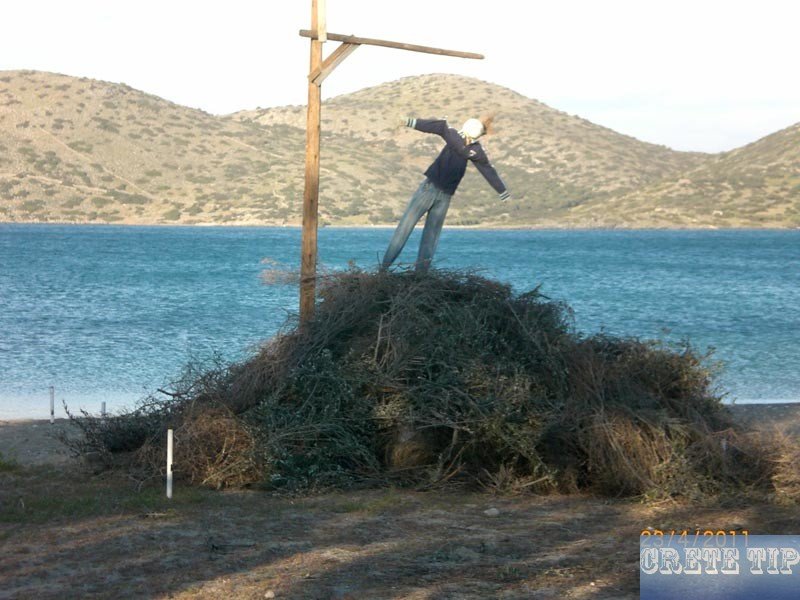
The ritual begins long before Holy Saturday night. Three days in advance, communities across Crete come together to construct their effigy of Judas — a life-sized figure painstakingly assembled from:
– Fabrics and old clothing, stuffed to give it a human form
– Straw and wood, providing structure and ensuring it burns well
– Firecrackers placed in the eye sockets, adding a dramatic and explosive finale to the burning
The finished effigy is often displayed prominently in the village or neighborhood, serving as a focal point for the community’s anticipation in the days leading up to the Resurrection service.
In older times, the effigy was paraded through the village on the back of a donkey — a detail that added a layer of humiliation to Judas’ symbolic punishment, reinforcing the traditional character of the ritual. While this particular element has largely faded in modern practice, the spirit of communal participation remains very much alive.
The Night of the Burning: Fire, Cannon, and Celebration
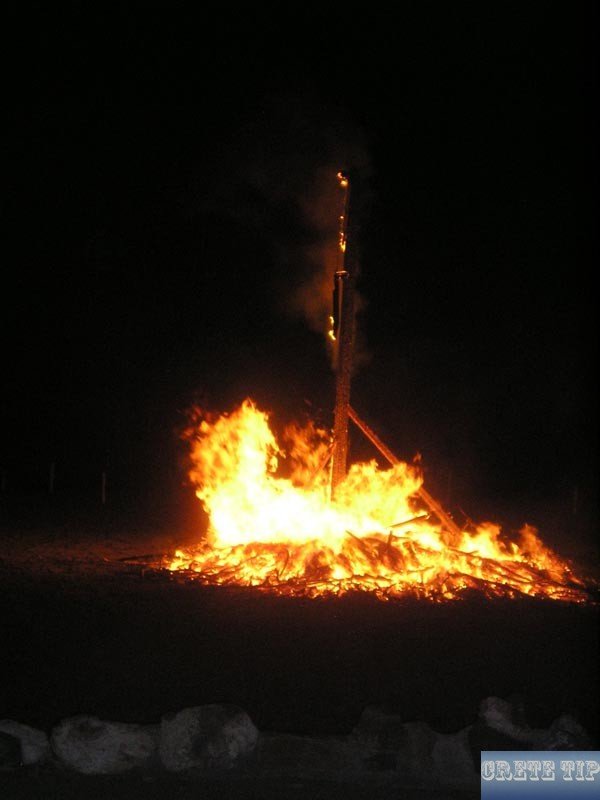
As midnight approaches on Holy Saturday and the priest announces “Christos Anesti” — Christ is Risen — the burning of Judas begins in earnest. The effigy, placed in a high, visible location so that the punishment can be witnessed by all, is set alight.
What follows is a feast for the senses:
– Enormous bonfires (founares) roar into the night sky
– Gunshots and rifle fire ring out in some areas, with locals traditionally using carabines to mark the moment
– Boats carrying lit flares circle the effigy in coastal villages before finally setting it ablaze
– The firecrackers hidden in Judas’ eyes explode dramatically as the flames reach them, drawing gasps and cheers from the crowd
The scene is one of the most visually spectacular in all of Greek Easter tradition — a combination of ancient ritual, communal joy, and raw, elemental energy that is impossible to forget once witnessed.
More Than Punishment: The Deeper Meaning

It would be easy to see the burning of Judas as simply an act of punishment — a crowd venting its anger at a historical villain. But the tradition carries a much richer spiritual and psychological significance than that.
The Purification of Holy Week
The burning marks the end of the purification cycle of Holy Week — the long, solemn journey of fasting, prayer, and mourning that culminates in the joy of the Resurrection. In this sense, setting Judas alight is an act of spiritual cleansing: the last darkness is consumed by fire so that the light of Easter can shine fully and freely.
A Mirror for the Soul
Perhaps most powerfully, the tradition reflects a deeply human need that goes far beyond religious observance. As the flames consume the effigy, many Cretans — and Greeks more broadly — see in that fire the burning away of whatever form of betrayal weighs on their own hearts.
It may be a friendship broken, a trust violated, a promise unkept. When Judas burns, so too does whatever burden of treachery — given or received — that each person carries with them. The fire is not just for Judas. It is for everyone standing before it.
Nature Itself Condemns Judas: The Folklore Connection
The condemnation of Judas runs so deep in Greek popular tradition that even the natural world is said to share in it. Folk beliefs across Greece hold that the very elements of nature despise Judas for his betrayal of Jesus.
In Lefkada, the fig tree — the tree from which, according to tradition, Judas hanged himself — is said to cast a “heavy shadow,” and folklore warns that anyone who falls asleep beneath it will die.
In Crete itself, a tree known as the vromoxilia (βρωμοξυλιά) or azógyros is called the “tree of Judas,” sharing in the curse attached to his name. A similar tradition exists in Aetolia, where the wild carob tree carries the same dark association.
These botanical legends speak to the extraordinary reach of Judas’ symbolic power in Greek culture — a figure so associated with betrayal that even the landscape is shaped by his story.
A Living Tradition in a Changing World
Like all great folk traditions, the burning of Judas has evolved over time. The donkey processions are largely gone. Modern fireworks have augmented the ancient bonfires. And yet, the essential spirit of the custom remains unchanged: a community coming together to name betrayal, to condemn it publicly, and to cast it into the flames.
In a world where trust feels increasingly fragile and betrayal increasingly common, there is something profoundly cathartic — and deeply human — about watching Judas burn.
Why You Should Witness This Tradition in Person
If you are planning to visit Crete during Easter, make every effort to find a village or coastal town where the burning of Judas is celebrated. It is an experience that combines:
✅ History — a tradition dating back to the Ottoman period
✅ Spirituality — the culmination of the Orthodox Holy Week
✅ Spectacle — bonfires, fireworks, flares, and cannon fire
✅ Community — an entire neighborhood united in a shared, ancient act
✅ Meaning — a ritual that speaks to something universal in the human experience
There is nowhere else in the world quite like Crete on Holy Saturday night.
Christos Anesti — and Judas burns.