For the Greek Orthodox world, Easter — Pascha — is not simply a religious holiday. It is the ultimate celebration of life itself. Woven from threads of ancient mythology, pre-Christian ritual, and deep Christian faith, the customs and symbolism of Greek Easter create a tapestry that is as old as civilization itself.
As Dr. Aikaterini Polymerou-Kamilaki, Emeritus Researcher and former Director of the Centre for Research on Greek Folklore of the Academy of Athens, explains: Greek Easter is a “festival of festivals” — a moment when faith, nature, and human tradition converge in the most spectacular way.
A Celebration That Begins Long Before Easter Sunday
For the Greek Orthodox faithful, the Easter season does not begin on Holy Saturday night. It begins 40 days earlier, with the start of Great Lent (Sarakosti) — a long period of physical, spiritual, and psychological preparation for “Pascha to Kainon” — the New Easter.
During this preparatory period, the lines between pre-Christian ritual and Christian worship become beautifully blurred. Ancient customs with purifying, protective, and life-affirming purposes have been seamlessly woven into the fabric of the Orthodox calendar over centuries.
The Ancient Roots: From Adonis to the Risen Christ
Long before Christianity reached the shores of Greece, the ancient world was already celebrating the death and rebirth of nature through powerful mythological narratives.
* The Myth of Adonis: The handsome god of vegetation who dies and is reborn, symbolizing the annual death and revival of the natural world.
* Persephone’s Return: Her annual journey back from the underworld marking the arrival of spring and the blooming of the earth.
* The Zafiris of Epirus: A folk drama of death and resurrection still performed in the Epirus region.
* The Gardens of Adonis: Ritual plantings of fast-growing seeds symbolizing the quick awakening of life after winter.
All of these ancient echoes find their ultimate expression in the figure of the Risen Christ — the ultimate symbol of life conquering death.
The Symbolism of Spring
Easter falls at the peak of the Greek spring — and this is no coincidence. Nature herself seems to participate in the celebration. As one beloved traditional folk song beautifully captures:
“Winter and autumn eat and drink together,
And they invited spring to come and join the feast…”
The song reminds us of the inevitable passing of seasons — even the glorious spring will one day yield to autumn — and yet, the miracle is that it always returns. This cycle of death and rebirth is at the very heart of what Easter means to the Greek people.
Holy Week: A Week Like No Other
Holy Week (Megali Evdomada) is the most emotionally charged period of the Greek calendar. Women traditionally follow the church services daily, fast strictly, and simultaneously transform their homes in preparation for the feast.
Holy Thursday — “Kokkini Pefti” (Red Thursday)
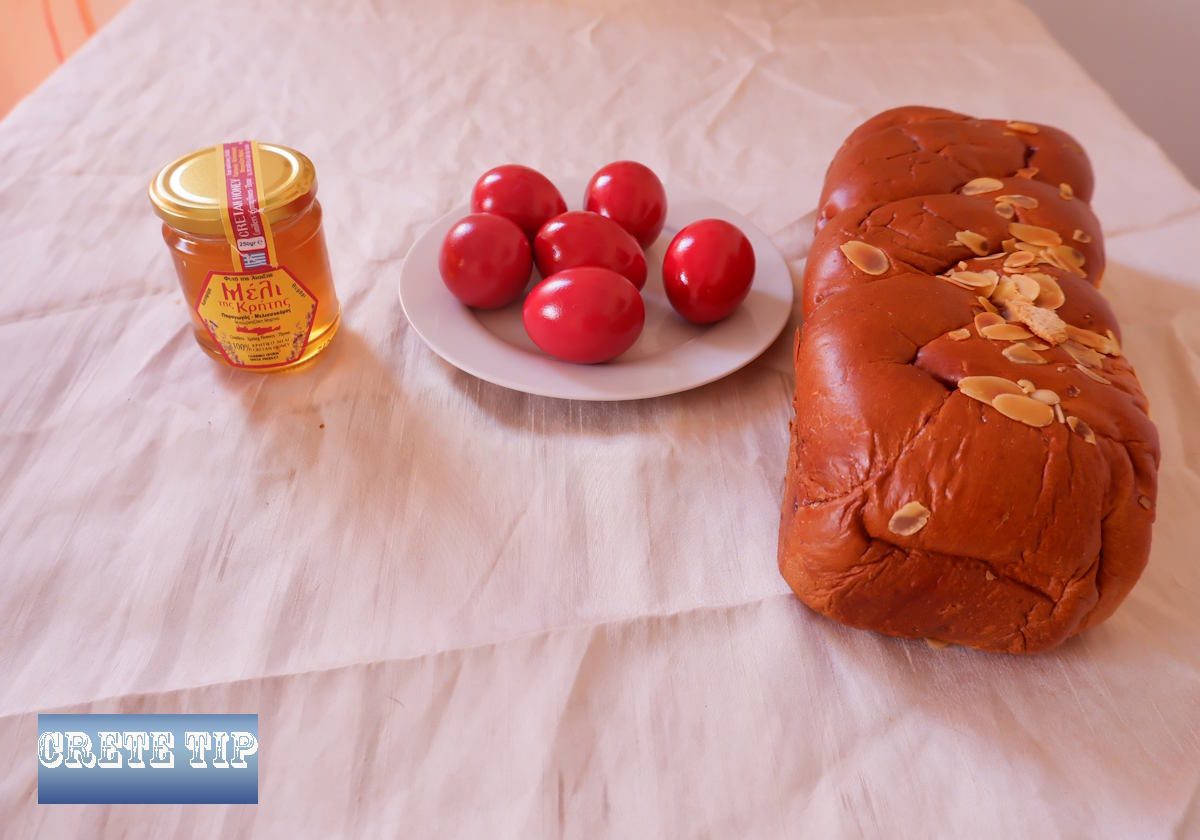
Holy Thursday is perhaps the most ritually rich day of the entire Easter period. It is the day of the dyeing of the Easter eggs — one of the most ancient and symbolically loaded customs in Greek tradition.
Key rituals of Holy Thursday include:
* The First Red Egg: The very first egg dyed is placed in the family’s icon stand (iconostasi) for protection.
* The Black Hen: Older traditions specified that the first egg should come from a black hen — believed to possess special protective powers.
* “Evangelismena” Eggs: Eggs left in the church until the Resurrection were considered especially powerful — their shells were later buried in garden soil to ensure a bountiful harvest.
* Planting the First Egg: Farmers would bury the first egg in the first furrow of their field when sowing, to ensure the grain would be “as pure and whole as an egg.”
* The Sacred Number: The number of eggs dyed was carefully chosen, and the dye water was never allowed to spill outside the house.
Why Red?
The red color of Easter eggs carries layers of meaning. Various traditions offer different explanations:
“When Christ was resurrected, they told a village woman, and she did not believe it. She said: ‘When the eggs turn red, then Christ will have truly risen.’ And they turned red. And from that day, they are dyed red.” — A tradition from Kastoria.
Others say the red represents the blood of Christ, while still others associate it with the joy of the Resurrection and the warding off of evil. Red fabrics were also hung from windows and balconies for the same protective purpose.
The egg itself — a pre-Christian symbol of life — thus becomes doubly powerful: ancient life-symbol meets the blood of divine sacrifice.
The Ritual Dances and Community Celebrations
Easter in Greece is inseparable from communal celebration. Ritual dances tied to Easter and the feast of Saint George (April 23rd) are among the oldest surviving folk traditions in the country. The swings (kounia) — set up in village squares during Easter — are another echo of ancient spring rites, symbolizing the soul’s transition between worlds.
In many villages, bands of musicians would visit the graves of the recently deceased, honoring the connection between the living and the dead during this liminal time of year.
Easter Across the Regions of Greece and Crete
One of the most fascinating aspects of Greek Easter is that every region adds its own local color to the universal celebration. From the famous rocket war (Rouketopolemos) of Chios, to the smashing of clay pots in Corfu, to the deeply moving Good Friday processions of small Cretan villages — the “festival of festivals” wears a different face in every corner of the country, while always beating with the same heart.
A Living Tradition
What makes Greek Easter so extraordinary is that it is not a museum piece. It is a living, breathing tradition that connects a grandmother dyeing eggs in a Cretan kitchen to an ancient woman performing the same ritual thousands of years ago. It connects the candlelit midnight cry of “Christos Anesti” to the ancient Greek world’s desperate, hopeful prayers for the return of spring.
As Dr. Polymerou-Kamilaki reminds us, these customs are not mere “habits.” They are the living memory of a people — the thread that connects who we are to who we have always been.
Christos Anesti — Christ is Risen. 🕯️
“We Had Less, But We Were Closer”: The Vanishing Magic of Easter in Old Crete

There are no filter-perfect Instagram photos from these Easters. No online shopping for decorations, no pre-ordered lamb from a gourmet butcher. Just the smell of incense drifting through stone alleyways, the sound of children’s voices echoing across a hillside village, and a community so tightly bound together it functioned as one large, beating family.
This is Easter in old Crete — and it was something truly extraordinary.
A World Away From Today
The memories come from Manolis Lagoudianakis, a retired educator from Smari, Pediada — a village nestled in the heartland of Heraklion — who shared his vivid recollections with the Athens-Macedonian News Agency (ANA-MPA). What emerges from his account is not simply a description of old customs. It is a portrait of a way of life where faith, community, and daily existence were completely inseparable.
“We had less, but we were closer,” Lagoudianakis says — a simple sentence that carries the weight of an entire lost world.
The Countdown Begins: Clean Monday
The journey toward Easter did not begin on Palm Sunday or even at the start of Holy Week. It began a full 40 days earlier, the moment Carnival (Apokries) ended and Clean Monday (Kathari Deftera) arrived.
On that breezy late-winter day, the children of Smari would run to the fields to fly homemade kites — not shop-bought ones with cartoon characters, but lovingly crafted, improvised paper creations that soared over the Cretan hills as a joyful signal that Great Lent had begun.
From that moment, the rhythm of life changed completely. Fasting, church attendance, and spiritual preparation became the center of gravity around which everything else orbited.
Friday Evenings and the Akathist Hymn
Every Friday evening throughout Lent, the community would gather at the village church to hear the Akathist Hymn — one of the most beloved and ancient hymns of the Orthodox Christian tradition. This was not an obligation. It was a gathering, a weekly ritual that reinforced the bonds between neighbors, friends, and families as the great feast drew closer.
Even the school played its role, with children rehearsing the Enkомia — the mournful, beautiful lamentations that would be chanted during the Good Friday procession. Learning these ancient hymns was as much a part of their education as reading and arithmetic.
The Flowers of the Cross: A Community in Bloom
On the eve of the Sunday of the Cross (the third Sunday of Lent), something quietly beautiful would happen across the village. Both young and old would head out into the Cretan countryside to gather wildflowers, which would be woven into small bouquets called “rodares.” These were brought to the church and distributed among the faithful — a fragrant, living offering connecting the natural world to the spiritual one.
Lazarus Saturday: The Children’s Day
Of all the days in the Lenten calendar, Lazarus Saturday held a special magic for the children of old Crete. From early morning, they would head into the fields to collect “perdikes” — the local name for the wild Cretan orchids that bloom in abundance across the island each spring.
These flowers were woven into “Lazaros” — a floral wreath fixed to a reed — a symbolic representation of the resurrection of Lazarus from the tomb. Armed with their floral creations and a small basket, the children would then set off through the village lanes, singing the Lazarus carols from door to door. In return, they collected **eggs** from each household — a scene of joyful, innocent community life that seems almost impossibly distant today.
Holy Thursday: Knots, Eggs, and Sacred Thorns
Holy Thursday was a day loaded with ritual and symbolism. As the church bells called the faithful to the reading of the Twelve Gospels, the children of the village participated in one of the most touching customs of the season.
With a piece of cord in hand, they would tie a knot for every Gospel reading — twelve in total — creating a bracelet of faith that was then worn on the wrist as a protective amulet throughout the Easter period.
Simultaneously, the women of the house were busy dyeing Easter eggs red, while a special cross decorated with “sparaggia” — a type of thorny Cretan shrub — was prepared, ready to be carried through the village the following morning.
Good Friday: The Whole Village Mourns Together
Good Friday (Megali Paraskevi) was the most solemn and emotionally powerful day of the year. In the morning, the children would walk through the village carrying their thorn-decorated crosses, chanting the “Pathí tou Christou” — the Sufferings of Christ — from house to house, in a moving ritual that brought the Gospel narrative directly to the doorstep of every family.
But it was the evening that truly defined Easter in old Crete.
Without electricity, the village was lit by improvised oil lamps, candles, and the glow of burning incense. Families lined the narrow streets and stood outside their front doors, waiting in the dark and the fragrant, smoky air for the Epitaphios procession to arrive.
And when it did, something extraordinary happened at every single house along the route: the procession stopped completely. The Epitaphios — the ornate bier symbolizing the tomb of Christ — was lifted up, and every member of the household would pass beneath it, receiving a blessing.
The procession then moved to its final, most poignant destination: the village cemetery. There, amid the graves of their loved ones, the community of the living met the memory of the dead in a ceremony of profound emotional depth. “A community tightly bound as one family,” as Lagoudianakis describes it.
Great Saturday: Fire, Judas, and the Awaited Moment
Throughout Holy Week, the children of the village had been doing one particular thing whenever they had a spare moment: gathering wood. By Great Saturday, they had assembled impressive piles of timber for the “founara” — the ritual bonfire.
The target? Judas.
In a tradition common across Crete and much of Greece, an effigy of the betrayer would be placed atop the woodpile and burned in a symbolic act of communal condemnation. The bonfire would be lit at the precise moment the priest’s voice rang out with the words “Christos Anesti” — Christ is Risen.
Every child had something tucked in their pocket for that moment — a red egg or a “kalitsounia” (a traditional Cretan cheese or honey pastry) — to be eaten the instant the great news was proclaimed.
After the midnight liturgy, families would gather around the table for the Easter meal, and the following day, a “Second Resurrection” service at the church would mark the formal, joyful close of the celebrations.
The Secret Ingredient: Belonging
Looking back across the decades, what Manolis Lagoudianakis misses most is not the specific rituals themselves — it is the feeling* that lived inside them.
“Behind the customs, there was always something deeper,” he reflects. “It was the cohesion of the community.”
The shared preparations, the processions through the lanes, the flowers gathered from the same hills, the carols sung at the same doors year after year — none of this was merely “tradition.” It was the mechanism through which people felt they belonged somewhere and to someone. It was how an entire village became greater than the sum of its parts.
Even today, Lagoudianakis and his neighbors in Smari continue to preserve as many of these customs as they possibly can — not as a museum exercise, but as a living return to that precious sense of togetherness.
Because some things, once lost, are very hard to find again.