

From flower-adorned tombs to men marching into the sea — Greece’s Good Friday is a deeply moving spiritual experience that has captivated the world for centuries.
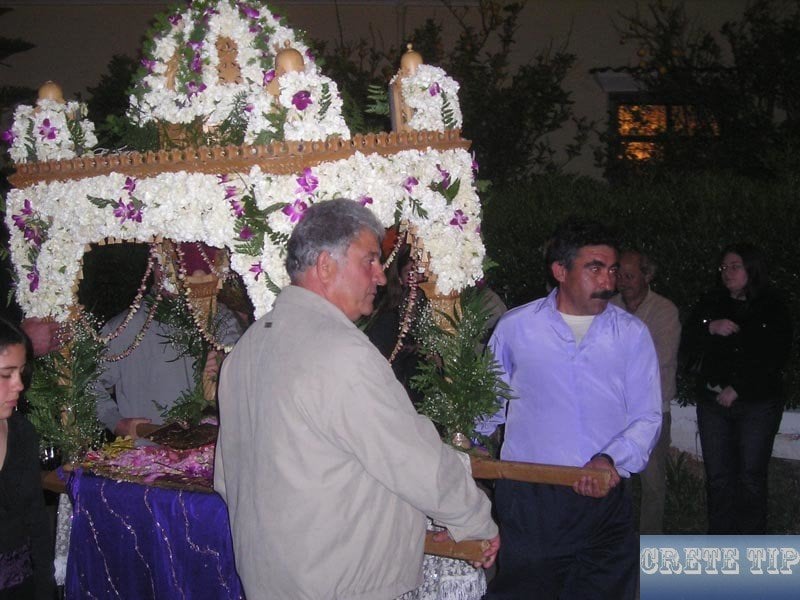
If you’ve ever witnessed Holy Friday in Greece, you already know: there is nothing quite like it anywhere else in the world. Across the country — from the busiest city neighborhoods to the most remote mountain villages — an extraordinary hush falls over the land. Church bells ring a mournful toll. Candlelight flickers in the darkness. And thousands of faithful Greeks take to the streets in one of Christianity’s most powerful and visually stunning commemorations.
This is the Epitaphios — and it is the heart and soul of Greek Orthodox Holy Friday.
What Is the Epitaphios?
The word epitaphios comes from the Greek adjective meaning “funerary, happening on a grave.” It is the same root that gives us the English word epitaph, and it is also the title of Thucydides’ famous account of Pericles’ Funeral Oration — a testament to how deeply this word is woven into Greek culture and history.
Within the Greek Orthodox faith, the Epitaphios is a richly embroidered icon, typically made of cloth, depicting the body of Christ being tenderly laid in the tomb — often surrounded by the Virgin Mary and several of His disciples. It is one of the most sacred objects in the Orthodox Christian tradition.
On the morning of Good Friday, this sacred icon becomes the centerpiece of an elaborate and deeply moving ritual that unfolds in churches across the entire country.
The Morning Ritual: A Tomb Covered in Flowers
Long before the evening procession begins, the faithful gather in the early hours of Good Friday morning to decorate the Epitaphios with fresh spring flowers — predominantly white, red, and purple blooms that completely cover the sacred bier.
The tomb is lovingly adorned with:
– 🌸 Fresh spring flowers**, meticulously arranged
– 🕯️ Candles, casting a warm, golden light
– 🌹 Rose petals and rosewater, sprinkled with reverence
– 🙏 Incense, ceremonially wafted as a mark of deep respect
As the decorations are completed, the priest and the faithful take turns venerating the Epitaphios while the choir chants the hauntingly beautiful “Epitaphic Lamentation” — a series of hymns that have echoed through Greek churches for centuries.

The Epitaph Procession: Greece Comes to a Standstill
As evening falls across Greece, something remarkable happens. Entire communities — young and old, devout and casual believer alike — pour into the streets for the Epitaph procession.
Church bells ring the funeral toll. Voices rise together in the Lamentations. The clergy carry the flower-covered bier through the city streets, leading a candlelit procession that winds through neighborhoods, squares, and alleyways.
For many visitors, witnessing this procession is an unforgettable, profoundly moving experience — a rare moment in modern life where an entire society pauses together to reflect on something greater than itself.
At the conclusion of the procession, the Epitaphios is carried back into the church. In many parishes, the clergy pause just inside the entrance and hold the bier above the doorway, so that every person entering the church passes beneath it — a powerful symbolic gesture of blessing and protection.
Regional Traditions: Where Holy Friday Gets Extraordinary
While the core observance is consistent across Greece, it is in the regional variations that Holy Friday truly becomes something spectacular. Each corner of the country adds its own unique flavor to this ancient commemoration.
🌊 Hydra & Tinos: Walking Into the Sea

Perhaps the most breathtaking tradition of all takes place in certain coastal towns and islands, most notably Hydra and Tinos. Here, the men carrying the Epitaphios don’t stop at the water’s edge — they march straight into the sea.
Wading in until they are at least waist-deep in water, they may remain there for several minutes, often lifting the sacred bier high above their heads to protect it from the waves. During this time, prayers are offered for the safe return of the many seafarers who belong to these maritime communities — a tradition that beautifully blends Orthodox faith with Greece’s eternal relationship with the sea.
🔥 Nafpaktos: A Procession of Fire
In Nafpaktos, in western Greece, Holy Friday takes on a spectacular visual dimension. As the Epitaph procession winds through the port, locals line the castle walls with burning torches, and additional torches are arranged in the middle of the harbor in the shape of a large, blazing cross — a breathtaking sight that draws visitors from across the region.
🐌 Crete: An Ancient Bitter Tradition
On Crete, the island’s unique character shines through even on the most solemn day of the year. Locals observe the ancient tradition of boiling snails and drinking their bitter juice — a practice rooted in the symbolism of bitterness and mourning that echoes the suffering of Christ.
🚫 Koroni & Village Traditions: Fasting and Restraint
In Koroni, in the Peloponnese, the fast is absolute — people consume nothing the entire day. In many Greek villages, men refrain from any manual labor, particularly work involving nails — a poignant reminder of the crucifixion.
💋 Naxos: No Kissing Allowed
On the island of Naxos, there is a tradition as thought-provoking as it is touching: no one kisses on Good Friday. The reason? Because it was with a kiss that Judas betrayed Jesus — and on this day, that kiss is too painful to reenact, even in affection.
Holy Saturday: The Vigil Continues
The veneration doesn’t end when the procession returns to the church. Throughout Holy Saturday, the faithful continue to visit the decorated tomb, pray, and venerate the Epitaphios. In many communities, women can be found cleaning and tending to the church and the bier with quiet devotion.
This sustained, community-wide act of mourning and remembrance is one of the most distinctive aspects of Greek Orthodox Holy Week — a collective grief that is simultaneously ancient and deeply personal.
Why Holy Friday in Greece Is Worth Experiencing
Whether you are a devout Orthodox Christian, a curious traveler, or simply someone who appreciates the depth of human tradition and culture, Holy Friday in Greece offers something rare and precious: a living connection to two thousand years of faith, community, and meaning.
In a world that moves faster every year, watching an entire nation slow down — lighting candles, singing ancient hymns, and walking together through the dark streets — is a reminder of what has always mattered most.
If you ever have the opportunity to witness the Epitaphios procession in Greece, do not miss it. Whether it’s on the island of Hydra, where men carry Christ’s bier into the Aegean Sea, or in a tiny mountain village where a handful of faithful sing the Lamentations under the stars — it will stay with you forever.
Χριστός Ανέστη — Christ is Risen. 🕯️


