For millions of Greeks around the world, the image of a whole lamb slowly turning on a spit over glowing charcoal is the unmistakable symbol of Easter Sunday. The rich aroma drifting through neighborhoods, the crackling of the fire, and the gathering of family around the table — it is a scene deeply embedded in Greek culture and identity. But why a lamb? And why roasted whole on a spit? The answer stretches back thousands of years, weaving together ancient Jewish tradition, Christian theology, and the enduring power of communal celebration.

The Lamb as a Sacred Symbol
The tradition of eating lamb at Easter is far more than a culinary preference — it carries profound religious and spiritual significance. In the Gospel of John (1:29 and 1:36), John the Baptist refers to Jesus Christ as the “Lamb of God” — the one who would take away the sins of the world through his ultimate sacrifice. Since Easter, or Pascha as it is known in the Orthodox tradition, commemorates the crucifixion and resurrection of Christ, eating lamb becomes an act of remembrance and reverence.
The symbolism, however, predates Christianity itself.
Roots in the Old Testament and Jewish Passover
To truly understand the Easter lamb tradition, one must travel back to the Old Testament and the story of the Jewish Exodus from Egypt. As the Jewish people prepared to flee their bondage, God — through Moses — instructed each family to sacrifice a lamb. The blood of the lamb was to be painted on their doorposts, serving as a divine signal to spare their firstborn children from the plague that would befall unmarked homes that night.
The sacrificial lamb was then consumed by each family — roasted, with its bones left unbroken — alongside unleavened bread and bitter herbs. This ancient Passover ritual carried enormous weight: the lamb represented salvation, protection, and the mercy of God.
When Christianity emerged, it adopted this powerful symbolism. Jesus, crucified on the cross, became the ultimate sacrificial lamb — the one whose death rendered all further sacrifice unnecessary. The parallels were unmistakable, and the lamb became one of the most enduring icons of the Christian faith.
Easter Sunday in Greece: A Communal Celebration
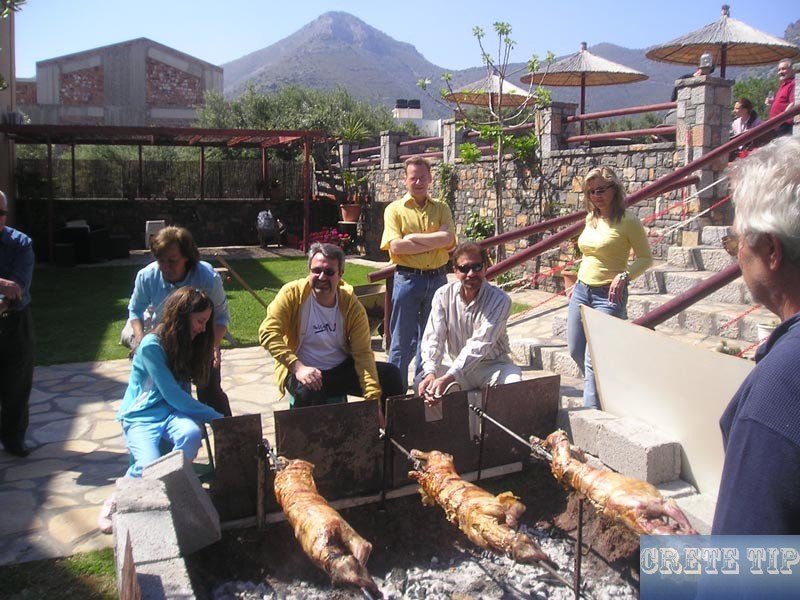
In modern Greece, the tradition of roasting a whole lamb on the spit on Easter Sunday is as much about community and togetherness as it is about religious observance. Preparations often begin in the early hours of the morning, with families and friends gathering around the fire to slowly turn the spit — a process that can take several hours and demands patience, care, and conversation.
By midday, the whole family assembles around the table to share the meal together — a joyful culmination of the 40-day Lenten fast. The experience is described as deeply bonding, a sacred ritual that connects generations and reinforces a shared sense of identity.
On Easter Sunday and for 40 days afterward, Orthodox Christians greet each other with:
“Christos Anesti!” — “Christ is Risen!”
“Alithos Anesti!” — “Truly, He is Risen!”
The lamb on the table is a living echo of these words.
A Tradition Under Scrutiny

In recent years, the Easter lamb tradition has attracted growing criticism from animal welfare groups, who stage annual protests in Athens and other Greek cities. Each year across Greece, hundreds of thousands of lambs are slaughtered in preparation for Easter — often in open settings, sometimes in front of children, and not always following humane procedures.
The late and legendary Greek composer Mikis Theodorakis was among the most prominent voices to speak out against the practice. He wrote:
“Easter is coming again. The days of the massacre of innocent animals are approaching for the sake of a barbaric feast that ought to have vanished long ago.”
Theodorakis and others argue that the spiritual message of Easter — one of compassion, sacrifice, and renewal — can be honored without perpetuating what they consider unnecessary suffering.
Tradition, Faith, and the Future
The debate surrounding the Easter lamb reflects a broader tension found in many cultures: how do we honor ancient traditions while evolving our values? For many Greeks, the spit-roasted lamb is an irreplaceable expression of faith, family, and heritage. For others, it is a custom ripe for reexamination.
What remains undeniable is the deep spiritual and historical weight that this tradition carries. From the doorposts of ancient Egypt to the family tables of Greece today, the lamb has long served as a symbol of sacrifice, salvation, and the hope of new life — the very themes at the heart of Easter itself.
Whether you observe the tradition or simply marvel at its history, the story of why Greeks roast a whole lamb at Easter is a fascinating journey through faith, culture, and the enduring human need to gather together and share a meal.
Happy Easter — Christos Anesti! 🐑🔥