US bases in the Mediterranean, the Middle East and Europe, and their significance.

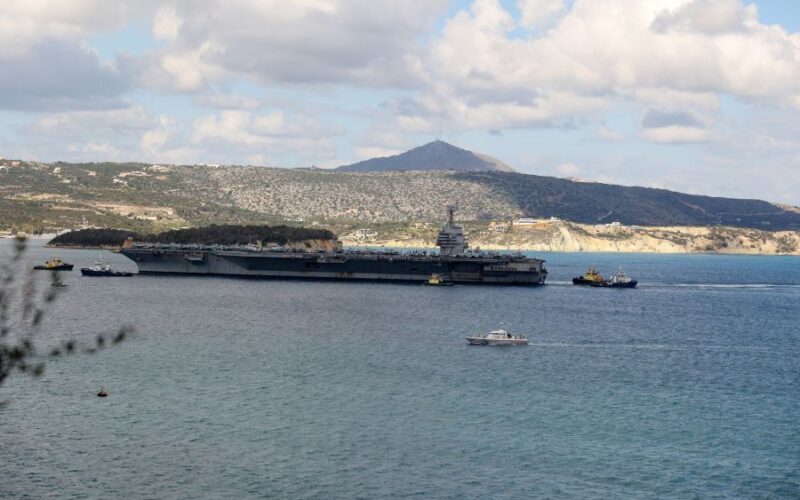
When the USS Gerald R. Ford—the most advanced aircraft carrier on Earth—pulled into the sleepy Greek port of Souda Bay in early 2026, it wasn’t just another port call. For those paying attention, it was a masterclass in 21st-century military strategy.
Here’s what most people missed: Souda Bay is the only place outside the United States where America’s most sophisticated warships can be properly maintained. That’s not hyperbole. That’s a fact that reshapes how we understand global power projection.
The Game-Changer: A Port the World Needs
Imagine owning the only gas station for 1,000 miles in any direction. Now multiply that by the complexity of maintaining a 100,000-ton nuclear-powered aircraft carrier.
During the USS Gerald R. Ford’s visit, the ship underwent critical maintenance work on its sophisticated systems. Where else could this happen? Nowhere. The Souda base houses the only facilities outside American soil capable of handling such advanced technical work on supercarriers.
But there’s more.
Geography Is Destiny
The ancient Greeks understood something timeless: control the crossroads, control the region. Souda Bay sits at the intersection of three continents’ concerns:
– The Middle East: Two hours by air
– The Suez Canal: 24 hours by sea
– North Africa: Within striking distance
– The Persian Gulf: Reachable for power projection
From Crete, the U.S. 6th Fleet can respond to crises faster than from any other Mediterranean position. When tensions spike in the Middle East, in the Balkans, or along African shipping lanes, forces based at Souda can be in the fight within hours.
More Than a Navy Port
This isn’t just about ships. The base features:
– A 3,350-meter military runway capable of hosting strategic bombers, heavy transport aircraft, and aerial refueling tankers
– Fuel storage, ammunition depots, and supply facilities that can support sustained operations
– Approximately 1,000 American military and civilian personnel operating around the clock
– Deep natural harbor—one of the deepest in the Mediterranean
The synergy is what matters. Few installations in the world combine world-class naval support with strategic airlift capacity. Souda does both seamlessly.
Why This Matters to American Power
The last decade has seen a dramatic increase in the frequency of U.S. warship visits and military aircraft operations at Souda. This trend reflects a simple reality: America’s ability to respond to global crises depends on bases like this.
Whether it’s evacuating civilians, deterring aggression, or projecting force, having a fully capable forward operating base in the Eastern Mediterranean isn’t a luxury—it’s essential.
The Strategic Partnership
The U.S.-Greece relationship, formalized through the Mutual Defense Cooperation Agreement (MDCA), has been upgraded repeatedly (most recently in 2019 and 2021) and is now of indefinite duration. Greece, spending over 2% of its GDP on defense, has become NATO’s “pillar of stability” in Southeast Europe.
For Greece, hosting Souda amplifies its geopolitical weight. For America, it ensures continued access to what may be the most strategically valuable piece of real estate in the Mediterranean.
The Bottom Line
The visit of the USS Gerald R. Ford to Souda Bay was a reminder that America’s global reach depends on a network of small, often overlooked bases scattered across the world. Souda isn’t flashy. There are no nuclear weapons visible in port. No massive military bases that dominate the landscape.
But in the calculus of power, it’s invaluable.
The Invisible Empire: How 130+ U.S. Military Bases Across Europe and the Middle East Shape Global Power

When you think of American military might, you probably picture aircraft carriers and fighter jets. But the real secret to American global dominance isn’t flashy—it’s strategic geography.
The United States maintains over 130 military installations across Europe and the Middle East. This network of bases, spread across dozens of countries, represents the largest military footprint of any nation on Earth. Understanding this geography is crucial to understanding how America maintains its position as a superpower.
Let’s map the empire.
Europe: NATO’s Fortress

Germany: The Stronghold
Germany hosts more American troops than any other country outside the U.S.—over 30,000 soldiers. The concentration is staggering:
– Ramstein Air Base: One of the most important U.S. air facilities globally, serving as a hub for transatlantic operations
– Spangdahlem Air Base: A critical fighter jet operations center
– U.S. Army Garrison Bavaria: The largest Army installation outside the United States
Why Germany? Simple. It’s the geographic and economic heart of Europe, and hosting American forces reassures NATO allies nervous about Russian expansionism.
Italy: The Mediterranean Pivot
Italy’s strategic position at the crossroads of Europe, Africa, and the Middle East makes it invaluable:
– Aviano Air Base: A powerhouse for air operations across the Mediterranean and Middle East
– Naval Station Sigonella (Sicily): Hosts anti-submarine helicopters and maritime patrol aircraft—critical for monitoring Russian submarine activity in the Mediterranean
– Vicenza: Army facilities supporting European operations
United Kingdom: The Atlantic Bridge
The U.K. hosts numerous RAF bases used by American forces, maintaining the “special relationship” and ensuring rapid transatlantic coordination.
Spain, Portugal and Turkey
- Spain: Rota Naval Base and Morón Air Base.
- Turkey: Incirlik Air Base.
- Portugal: Lajes Field in the Azores.
Poland, and the Eastern Flank
As NATO has expanded eastward, the U.S. has strategically positioned forces in Poland and other Eastern European nations to reassure allies worried about Russian aggression.
The Middle East: The Power Projection Engine
While European bases ensure NATO stability, Middle Eastern bases are about power projection and energy security.
Bahrain: Command Central
The small Gulf kingdom hosts the U.S. 5th Fleet headquarters and a major naval base—one of the oldest continuous American military installations, operating since 1948. Here’s why it matters:
– The 5th Fleet controls the Persian Gulf, the Strait of Hormuz, and the Arabian Sea
– Roughly 20% of global oil passes through waters patrolled by the 5th Fleet
– This isn’t just about military dominance; it’s about keeping global energy markets stable
Qatar: The Mega-Base
Al Udeid Air Base is the largest U.S. military installation in the Middle East—and arguably one of the most important bases anywhere:
– Hosts CENTCOM (U.S. Central Command), which oversees operations from Egypt to Kazakhstan
– Stations approximately 10,000 American troops
– Houses command centers, fighter aircraft, aerial refueling tankers, and intelligence operations
– The base has been continuously expanded and upgraded
Iraq: The Complicated Footprint
The U.S. maintains a reduced but significant presence in Iraq:
– Camp Arifjan: Houses the forward headquarters of Army Central Command
– Ali Al Salem Air Base: Critical for operations in Iraq and Syria (just 40 km from the Iraqi border)
– Balad Air Base: Hosts aircraft and maintenance facilities
– Ain Al Asad Air Base: Support for Iraqi security forces
In 2020, this base became a target when Iran launched missile strikes in retaliation for the killing of General Qassem Soleimani. The attack underscored how contested these bases have become.
Saudi Arabia: The Delicate Alliance
Despite the complex U.S.-Saudi relationship, America maintains critical military presence:
– Prince Sultan Air Base: 60 km south of Riyadh, hosting strategic air operations
– These bases are crucial for deterring Iranian expansion and protecting global energy supplies
Kuwait: The Staging Ground
Multiple bases support operations across Iraq, Syria, and the Persian Gulf, making Kuwait a critical logistics hub.
Jordan: The Quiet Player
Muwaffaq Al Salti Air Base near Amman serves as a crucial hub for operations in Iraq and Syria, though the American footprint there has significantly reduced as the fight against ISIS has evolved.
Syria: The Contested Presence
The U.S. maintains several installations to counter ISIS, but these are increasingly precarious. Recent reports suggest American forces are withdrawing from Syria—a process expected to complete within months.
Cyprus: The Overlooked Strategic Asset
While the U.S. doesn’t officially acknowledge permanent bases in Cyprus, the island hosts important intelligence facilities and serves as a waypoint for operations across the Middle East and Mediterranean. During recent tensions, British bases at Akrotiri became targets for Iranian missiles—a reminder of how contested this region has become.
Akrotiri and Dhekelia Sovereign Base Areas are two areas on the island of Cyprus that are under British administration as British overseas territories.
The foundations were laid by the British after Cyprus gained independence and transitioned from a Crown colony to an independent sovereign state.
The United Kingdom demanded and achieved the occupation of part of Cyprus in the form of military bases, due to Cyprus’ strategic location in the Mediterranean, to the advantage of British interests.

NATO’s Southern Anchor: Why the U.S. is Betting Big on Greek Military Bases
In the high-stakes game of global geopolitics, location is everything. As tensions simmer across the Middle East and Eastern Europe, the United States has increasingly turned its gaze toward a familiar ally: Greece.
Once seen as a secondary theater, Greece has rapidly transformed into a “pillar of stability” and the primary logistical gateway for U.S. and NATO operations. From the deep waters of Crete to the northern port of Alexandroupoli, here is why the American military footprint in Greece is more critical now than ever before.
1. Souda Bay: The “Crown Jewel” of the Mediterranean
If there is one name every naval strategist knows, it’s Souda Bay in Crete. This isn’t just another naval base; it is a strategic asset that has no equal in the region.
* The Supercarrier Hub: Souda is the only port in the Mediterranean—and one of the few in the world outside the U.S.—capable of docking and providing advanced maintenance for “supercarriers” like the USS Gerald R. Ford.
* Deep Water Advantage: Its natural deep-water harbor allows the largest ships in the U.S. 6th Fleet to dock safely, providing a “forward support hub” that can reach the Suez Canal or the Middle East in record time.
* Air Power Integration: Adjacent to the pier is a massive military airfield with a 3,350-meter runway, supporting everything from strategic bombers to aerial refueling tankers.
2. Alexandroupoli: The Gateway to the North
While Souda guards the south, the port of Alexandroupoli in Northern Greece has emerged as a game-changer for NATO’s eastern flank.
In the wake of the conflict in Ukraine, Alexandroupoli has become a vital bypass for the Bosporus Strait. It allows the U.S. to move tanks, troops, and supplies directly into the Balkans and Eastern Europe via rail and road, significantly shortening supply lines and enhancing NATO’s deterrence posture against regional threats.
3. The “Unsinkable” Infrastructure: Larissa and Stefanovikeio
The U.S. presence in Greece extends far beyond the coast:
* Larissa Air Base: Now home to sophisticated U.S. MQ-9 Reaper drones, this base provides critical surveillance and reconnaissance capabilities across the Aegean and Black Seas.
* Stefanovikeio: This base serves as a primary training and staging ground for U.S. Army aviation, specifically attack and transport helicopters, facilitating complex joint exercises with Greek forces.
4. The MDCA: A Permanent Partnership
What makes this expansion possible is the Mutual Defense Cooperation Agreement (MDCA). Updated in recent years, this agreement moved away from annual renewals to an indefinite duration.
This legal “green light” allows the U.S. to invest millions of dollars into Greek infrastructure, upgrading piers, hangars, and fuel depots. For Washington, it provides long-term certainty; for Athens, it provides a “security umbrella” in an increasingly volatile neighborhood.
5. A Shield Against Regional Volatility
The importance of these bases was highlighted during recent Iranian retaliatory strikes in the Middle East. While British bases in nearby Cyprus (like Akrotiri) were reportedly targeted or involved in missile interceptions, the Greek bases provided a stable, secondary layer of operational security.
As the U.S. navigates complex relationships with other regional players, Greece has positioned itself as the most reliable and strategically located partner in the Eastern Mediterranean.
The Bottom Line
The U.S. military presence in Greece is no longer just about “hosting” troops; it’s about integration. By linking the Mediterranean to the Black Sea and the Middle East, Greek bases have become the “linchpin” of Western security strategy.
As long as the “Arc of Instability” exists to the east and south, expect the stars and stripes to remain a permanent fixture on the Greek horizon.
The Strategic Logic: Why This Network Matters
These bases aren’t random. They’re positioned to accomplish specific objectives:
1. Forward Presence = Deterrence
American troops in Europe deter Russian aggression. American forces in the Middle East deter Iranian expansion and protect energy supplies.
2. Rapid Response
With bases strategically positioned, the U.S. can respond to crises within hours rather than days or weeks.
3. Alliance Management
Hosting American troops reassures allies and gives the U.S. enormous diplomatic leverage.
4. Intelligence Collection
Many bases serve as signals intelligence (SIGINT) and human intelligence (HUMINT) collection points, feeding into the vast American surveillance apparatus.
5. Logistics & Supply
These bases allow the U.S. military to sustain operations globally without relying solely on carriers and long-range transport.
The Risks: A Network Under Strain
This system isn’t invulnerable. Consider the threats:
– Iran’s Growing Capabilities: Iranian missiles have demonstrated the ability to strike American bases across the region, as shown by recent attacks on Iraqi installations
– Domestic Political Pressure: Many American bases in Europe and the Middle East face local opposition and periodic calls for closure
– Shifting Alliances: Political changes in host nations could jeopardize access (recent tensions with Turkey over NATO basing come to mind)
– Rising Powers: China’s military modernization means the U.S. may need to reposition forces to the Indo-Pacific, potentially weakening commitments elsewhere
The network of American military bases across Europe and the Middle East represents the physical infrastructure of American global power. It’s not about conquest or colonization—it’s about strategic positioning for an interconnected world where crises can erupt anywhere and affect everyone.
When you understand where America’s bases are, you understand American foreign policy. When you understand American foreign policy, you understand global politics.
The next time you read about international relations, think about the map of bases. Often, that invisible network explains more than any headline.
What do you think about America’s forward military presence in the Mediterranean? Share your thoughts in the comments below.