Stand on a Cretan clifftop in April with binoculars, and you might watch a golden eagle riding a thermal without a single wingbeat. Crete has resident birds and passing migrants in equal measure, from eagles, falcons and vultures to swallows skimming village rooftops.

Spring and autumn migration brings the widest variety, when the island becomes a vital stepping stone for birds crossing between Africa and Europe.
Crete’s mix of coastline, mountains and gorges gives it remarkable habitat diversity. That variety is exactly why bird watching in Crete rewards patience rather than luck. Knowing where to look matters far more than chasing rumours of a rare sighting.
Which Birds Can You See on Crete?

Crete supports over 300 recorded bird species, split between year-round residents and seasonal visitors on migration. The island’s position between three continents makes it an exceptional Mediterranean corridor.
Resident Birds and Everyday Sightings
Some birds are part of daily life on Crete, whether you’re birdwatching or not. The blue rock thrush is a common sight on rocky slopes, displaying a striking slate blue in the morning light. Little owls perch on fence posts and ruined stone buildings at dusk, often giving away their position with a sharp, questioning call.
A kingfisher will often flash along streams and reservoir edges, more often heard as a shrill whistle than seen clearly. Around wetlands, the squacco heron crouches motionless in the reeds, its hunched shape easy to miss until it moves.
The greater flamingo turns up on coastal lagoons and salt pans, usually in small groups rather than the vast flocks seen elsewhere in the Mediterranean.
Migratory Birds and Seasonal Visitors
Migratory birds pass through Crete twice a year, using coastal ridges and mountain valleys as natural flyways. Swallows arrive in strong numbers from March, skimming low over fields as they feed on the wing.
Spring migration, from February to May, brings the greatest diversity as birds head north from Africa. Many species pass over quickly, so early morning field visits yield the best sightings.
Autumn migration follows a more compressed pattern, with many species moving through during early September. This can make for busy, exciting days at coastal watch points.
An overview of the key points regarding birds and birds of prey in Crete

What birds can be found in Crete?
Crete has a surprisingly rich birdlife for an island. Its habitats include coastal cliffs, wetlands, olive groves, gorges, and high mountains such as the Lefka Ori (White Mountains), Psiloritis, and Dikti. Visitors can see resident species such as the Sardinian warbler, Cretan-race coal tit, chukar partridge, alpine chough, and blue rock thrush. Summer visitors include bee-eaters, hoopoes, and swallows. Passage migrants such as herons, waders, and warblers stop on the island to rest during spring and autumn. The island is also known for its large birds of prey.What is the difference between resident and migrating birds in Crete?
Resident birds live on Crete all year. Examples include griffon vultures, bearded vultures, golden eagles, Bonelli’s eagles, common buzzards, kestrels, little owls, and many songbirds.Migrating birds fall into three groups:- Summer breeders, such as Eleonora’s falcon, scops owl, bee-eaters, and swifts.
- Winter visitors, such as robins, chiffchaffs, and some ducks.
- Passage migrants that stop briefly on the island while travelling between Europe and Africa.
Which birds of prey (raptors) live in Crete?

- Griffon vulture: very common in the mountains.
- Bearded vulture (lammergeier): rare.
- Golden eagle: a resident of the high mountains.
- Bonelli’s eagle: found on lower cliffs and in gorges.
- Common buzzard: the raptor you are most likely to see.
- Falcons: several species, covered in the next question.
- Migrating raptors: honey buzzards, marsh harriers, Montagu’s harriers, and booted eagles, which pass through in spring and autumn.
What falcons can be seen in Crete?
Crete’s best-known falcon is Eleonora’s falcon. It arrives in spring and nests in colonies on offshore islets, such as the Dionysades islands off northeastern Crete. It breeds unusually late, in late summer. For most of the year it feeds mainly on insects. During the autumn migration, it hunts small songbirds to feed its chicks.Other falcons on the island include:- Peregrine falcon (resident)
- Lanner falcon (rare resident)
- Common kestrel (widespread resident)
- Lesser kestrel, red-footed falcon, and hobby (seen on migration)
What vultures live in Crete, and where can I see them?
Crete has two resident vulture species.Griffon vulture (Gyps fulvus): Crete holds the largest island population of griffon vultures in Greece, estimated at several hundred birds. They are often seen soaring over:- The Psiloritis range
- The Lasithi Plateau
- The Kourtaliotiko and Imbros gorges
- The Lefka Ori
Are there owls in Crete?

- Little owl: the most common and easiest to see. It often perches on walls, ruins, and rooftops, sometimes during the day.
- Eurasian scops owl: a small owl, mostly a summer visitor. It is heard more often than seen, thanks to its repetitive “tyoo” call on warm nights.
- Barn owl: a resident of farmland, old buildings, and villages.
- Long-eared owl: a scarce resident that also appears as a winter visitor, found in wooded areas.
Which swallows and martins can be seen in Crete?
Swallows are among the first signs of spring in Crete, usually arriving in March. The main species are:- Barn swallow: nests in villages and farm buildings.
- Red-rumped swallow: builds bottle-shaped mud nests under bridges and in caves.
- House martin: nests in colonies on buildings and cliffs.
- Crag martin: a resident of gorges and cliffs, present all year.
- Sand martin: seen mainly on migration.
When is the seasonal bird migration in Crete?
Crete lies on a major flyway between Europe, Africa, and Asia. Millions of birds cross it every year, and for many it is the first landfall after crossing the Mediterranean or the Sahara.
- Spring migration (mid-March to mid-May): This is the peak season. Exhausted birds such as warblers, flycatchers, herons, waders, harriers, and bee-eaters rest along the coasts and in wetlands.
- Autumn migration (late August to October): Birds head south to Africa. This period coincides with the breeding season of Eleonora’s falcons, which hunt the passing migrants.
- Winter (November to February): Wintering ducks, gulls, cormorants, and songbirds arrive, while resident raptors remain active in the mountains.
Where are the best birdwatching spots in Crete?
Popular locations include:
- Agia Lake near Chania, for wetland birds and migrants.
- Georgioupoli and the Almyros River, for wetland birds and migrants.
- Samaria Gorge and the Omalos Plateau, for vultures and eagles.
- The Lasithi Plateau and Psiloritis, for griffon vultures and choughs.
- Frangokastello and the south coast, where spring migrants make landfall.
- Elounda salt pans, for waders and flamingos.
- Gramvousa and Balos, for seabirds and raptors.
What is the best time of year for birdwatching in Crete?
April and early May offer the greatest variety of species, thanks to the spring migration. September and October are also excellent, with autumn migrants and hunting Eleonora’s falcons. If you mainly want to see vultures and eagles, you can visit at any time of year, since they are resident. Clear mornings, when thermals begin to rise, are usually best for spotting soaring raptors.Birds of Prey in Crete: Eagles, Falcons, Vultures and Owls

Crete holds one of the richest concentrations of raptors in Europe, with golden eagles, Bonelli’s eagles, bearded vultures and griffon vultures breeding alongside falcons and owls. These birds are not occasional visitors.
Crete’s rugged mountain massifs and limestone gorges provide prime nesting cliffs and hunting grounds, supporting healthy raptor populations.
Golden Eagles and Bonelli’s Eagles
The golden eagle (Aquila chrysaetos) is Crete’s most impressive resident raptor, boasting a wingspan that can stretch well over two metres. Research on the golden eagle (aquila chrysaetos) recorded around 16 breeding pairs, roughly 60 birds, in the Lefka Ori (White Mountains), Psiloritis and Dikti ranges.
Golden eagles favour open, high-altitude terrain away from human disturbance, nesting on sheer cliffs with sparse surrounding vegetation.
Bonelli’s eagle (Hieraaetus fasciatus) shares the island but occupies different territory. Research shows Bonelli’s eagles breed at lower altitudes, closer to the coast and human settlements, often hunting around olive groves and garrigue.
Studies tracking Hieraaetus fasciatus indicate that pairs remain territorial year-round, patrolling scrubland and rocky valleys for chukar partridges and hares.
Crete and Sicily are the only Mediterranean islands where both eagle species breed alongside each other. Spotting both a golden eagle and a Bonelli’s eagle during a single trip is entirely achievable with careful planning.
Bearded Vultures and Griffon Vultures

The bearded vulture (Gypaetus barbatus), or lammergeier, is one of Europe’s rarest birds of prey. Crete holds the only breeding population left in the Balkan region, with surveys recording around four breeding pairs and roughly 28 individuals. It is a massive bird with a wingspan up to 2.8 metres.
Often called the bone-breaker, Gypaetus barbatus drops skeletal remains from height to shatter them for marrow. Bearded vultures roam high summits in summer and move down to lower pastures in winter.
The griffon vulture (Gyps fulvus) is far more numerous and easily spotted. A comprehensive population survey estimated around 379 individuals on Crete across more than 20 colonies, representing roughly 141 breeding pairs.
This makes Crete home to the largest island population of griffon vultures in the world. Flocks of Gyps fulvus often gather around communal feeding areas in remote uplands. Watching a dozen circle a gorge on a rising thermal is an unforgettable wildlife experience.
Peregrine Falcons and Eleonora’s Falcons
The peregrine falcon (Falco peregrinus) nests on sea cliffs and inland crags across the island. A resident peregrine falcon commands a wide hunting territory along the rocky coastline.
Using high-speed stooping dives to capture birds mid-air, the peregrine falcon is frequently spotted near gorge entrances and coastal bluffs. Field observers note that Falco peregrinus pairs defend extensive stretches of vertical limestone against rival raptors.
Eleonora’s falcon (frequently cited as Falco eleonora or Falco eleonorae) is a standout summer visitor to Greece, which holds over 85% of the global breeding population.
An Eleonora’s falcon breeds late in the season, timing chick-rearing with the autumn songbird migration to nourish its brood. Adults display two colour phases, either a dark soot-brown or a pale streaked breast.
Both morphs show the long, scythe-shaped wings characteristic of an agile Eleonora’s falcon in flight. Remote marine crags provide safe havens where Falco eleonora nests in loose colonies above the waves.
Buzzards, Kestrels, Other Raptors and the Little Owl
Common buzzards and common kestrels are the raptors you will see most easily without searching. Buzzards soar over cultivated valleys, while kestrels hover above roadside verges scanning for lizards and mice.
Short-toed eagles and the booted eagle pass through on migration, and some breed locally over scrubby slopes. A booted eagle can often be distinguished by its rapid, agile wingbeats and contrasting underwing patterns as it hunts above mixed woodland.
The lanner falcon shares craggy inland habitat with the peregrine falcon, though it remains far rarer.
Birdwatchers scanning open scrub and rocky bluffs might spot a lanner falcon hunting game birds in low, agile flights. At dusk, little owls frequent drystone terraces and abandoned stone cottages.
How to Tell Crete’s Large Raptors Apart in Flight

Silhouette and flight style are key identification markers. Griffon vultures show broad, rectangular wings with prominent primary feathers, while bearded vultures have longer, pointed wings and a wedge-shaped tail.
Golden eagles hold their wings in a shallow V with a bulky forward profile. In contrast, Bonelli’s eagle is slimmer, faster on the wing, and usually seen at lower elevations.
| Bird | Wing shape | Typical altitude |
|---|---|---|
| Golden eagle | Broad, slight V | High mountains |
| Bonelli’s eagle | Slim, angled | Lower, coastal hills |
| Griffon vulture | Broad, rectangular | Gorges, thermals |
| Bearded vulture | Long, pointed, diamond tail | High peaks, midland pastures in winter |
Where Are the Best Places to Watch Birds on Crete?

Crete’s birdwatching sites fall broadly into three regions, each combining wetland, mountain and coastal habitats. Bird watching in Crete is rewarding because over 30% of the island falls within the Natura 2000 network, covering 53 protected reserves.
Western Crete: Wetlands, the White Mountains and Coastal Lookouts

The Agia Reservoir, also known as Lake Agia or Agia Lake, south of Chania, is widely regarded as the premier freshwater birding location on Crete. Its reedbeds support over 200 species, including Baillon’s crake, little bittern, squacco heron and purple heron.
The globally near-threatened ferruginous duck is a notable visitor here, frequently recorded swimming along the open water channels. Visiting Lake Agia during spring migration gives birdwatchers exceptional views of crakes, herons and songbirds resting along the water’s edge.
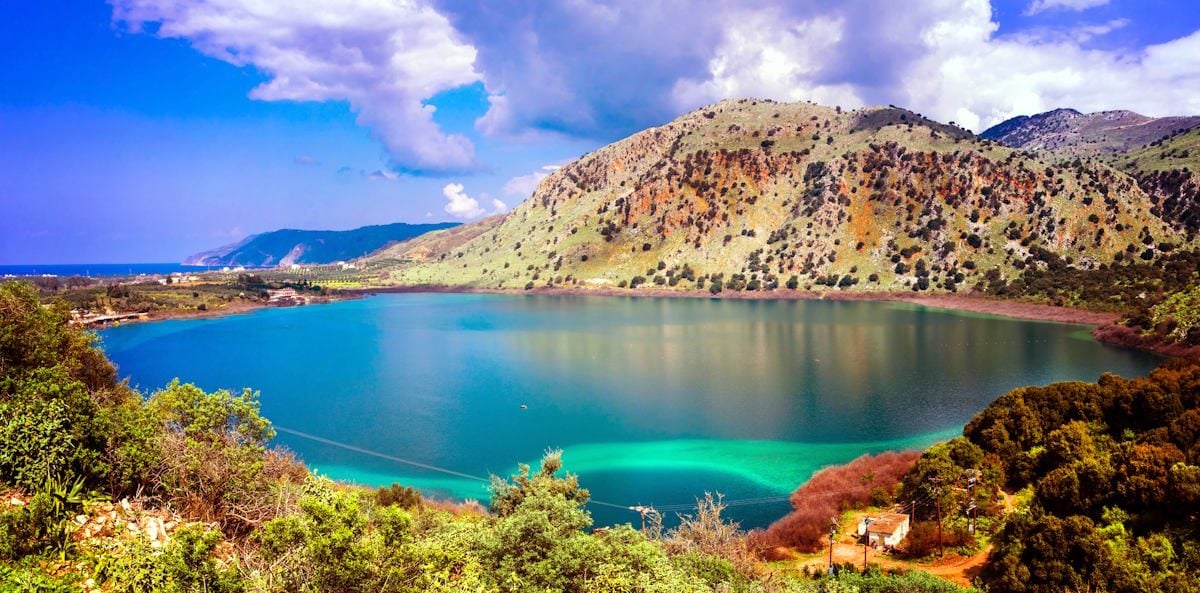
Lake Kournas and Georgioupolis Lake offer additional freshwater habitat nearby for grebes, herons and ducks. Patient observers can also catch a kingfisher darting along the overhanging willow branches.
Higher up, the White Mountains (Lefka Ori) and deep clefts like Samaria Gorge and Imbros Gorge host golden eagles and griffon vultures. Trekkers traversing Samaria Gorge often spot raptors soaring high above the sheer canyon walls. The protected landscape of Samaria Gorge makes it an exceptional haven for cliff-nesting species.

Walkers following the path through Imbros Gorge frequently see griffon vultures riding rising air currents above narrow rock passages. The rugged cliffs of Imbros Gorge also provide nesting ledges for kestrels and crag martins. Lower hillsides offer good chances to watch Bonelli’s eagle hunting above scrub.
Coastal headlands like Akrotiri Peninsula, Souda Bay, and Frangokastello provide excellent vantage points for migratory birds.
On the Akrotiri Peninsula, rocky scrub and coastal cliffs create a natural landfall for fatigued songbirds and migrating raptors. Nearby, the sheltered waters and shoreline of Souda Bay attract feeding waders, gulls and wintering grebes.
Looking across Souda Bay during spring and autumn can also reveal migrating raptors tracking the coastline.
Just off the southern coast, Gavdos Island acts as Europe’s southernmost landfall. Migrating flocks regularly touch down on Gavdos Island to recover after exhausting Mediterranean crossings.
Central Crete: Psiloritis, Gorges and Reservoirs

Psiloritis Mountain, also called Mount Ida or simply Psiloritis, forms the rugged heart of central Crete and supports golden eagles and bearded vultures. Across the vast Psiloritis range, high limestone ridges and quiet pastures provide undisturbed nesting sites for apex raptors.
Hiking trails across Mount Ida provide superb vantage points for scanning the skies. On clear mornings, raptors frequently circle the upper crags of Mount Ida as thermals develop.
Kourtaliotiko Gorge and nearby Preveli Beach pair sheer cliffs with a freshwater river mouth, attracting raptors and wetland species. Wind funnels naturally through Kourtaliotiko Gorge, creating powerful updrafts that griffon vultures use to gain altitude effortlessly.

Sizable colonies of the griffon vulture (Gyps fulvus) take advantage of these vertical walls to roost and nest safely. The towering limestone cliffs of Kourtaliotiko Gorge also shelter breeding peregrines and crag martins above the riverbed. Here, Falco peregrinus takes advantage of sharp canyon updrafts when hunting across the river valley.
The palm-fringed estuary at Preveli Beach creates a unique wetland microclimate where river meets sea. Birders visiting Preveli Beach can spot herons in the shallows alongside falcons patrolling coastal bluffs.
Rouvas Gorge, on the southern flank of Psiloritis, is an excellent location for forest-dwelling species. Hiking through Rouvas Gorge reveals ancient oak forests alive with passerines and overhead raptors.
Potami Dam Reservoir (Potami Dam) and the arid Asterousia Mountains further south expand the raptor watching opportunities.
Rising abruptly above the southern coast, the Asterousia Mountains form a vital corridor for cliff-nesting raptors. Remote canyons across the Asterousia Mountains support significant vulture colonies and occasional Bonelli’s eagles hunting across rocky slopes.
Keen observers may even catch sight of an elusive lanner falcon traversing these arid, sunbaked gorges. Nesting ledges provide ideal conditions for Gyps fulvus to raise young undisturbed by human foot traffic.
Eastern Crete: Lassithi, Bramiana and Coastal Habitats

The Lassithi Plateau combines traditional agriculture with dramatic rim mountains, making it a reliable spot for hunting raptors.
Bramiana Reservoir, close to Ierapetra, is a top eastern wetland for migrating waders and wintering waterfowl. During migration periods, diving waterfowl such as the ferruginous duck regularly pause on Bramiana’s deeper open waters.
Zakros Gorge at the far eastern tip and the Aposelemis River offer diverse gorge and riparian habitats. Carved through rugged red limestone, Zakros Gorge provides a sheltered passage down to the eastern coast.

Exploring Zakros Gorge often reveals blue rock thrushes along the path, while Eleonora’s falcons patrol the upper cliff rims.
Around Elounda and Spinalonga, shallow coastal inlets attract herons, while Gouves Lagoons near Heraklion provides quick access to shoreline migrants.
The salt pans near Elounda frequently attract passing shorebirds. Patient observers in Elounda can sometimes spot a greater flamingo wading through the quiet shallows.

The sheltered gulf waters surrounding Spinalonga also provide calm feeding conditions for migrating waders and visiting seabirds.
When and How Should You Go Birdwatching?

Spring and autumn offer peak bird numbers, making them prime seasons for bird watching in Crete. However, summer and winter each provide distinct birding rewards for those who tailor their trips accordingly.
What Changes During Spring and Autumn Migration?
Spring migration, running from February through May, brings waves of northbound birds. Crete is often their first resting point after crossing the Mediterranean, packing coastal headlands with exhausted migrants.
Autumn migration is more concentrated, peaking in early September. Sea crossings require greater effort, so soaring birds like buzzards and eagles funnel tightly along Cretan ridges and coastal cliffs.
What Can You See in Summer and Winter?
Summer is the breeding season for resident birds. An active Eleonora’s falcon colony along sea cliffs is a summer highlight, while griffon vultures feed chicks within deep gorges.
Winter brings quieter birding across the island. Bearded vultures move to midland pastures following livestock herds, while Agia Reservoir and coastal bays shelter overwintering ducks, grebes and waders.
What Should You Bring, and How Can You Watch Without Disturbing Birds?
A spotting scope is invaluable for scanning distant crags for roosting vultures or reading rings on wetland waterfowl. Quality binoculars, solid walking shoes and a sun hat cover field essentials. Always maintain a respectful distance from nesting cliffs and water margins.
Many Cretan sites are recognised as an Important Bird Area by the Hellenic Ornithological Society or protected within Natura 2000 boundaries, so sticking to designated trails is vital.
Finding the Right Habitat for the Birds You Hope to See
Focusing on specific habitats produces far better results than random searching. Freshwater sites like Lake Agia (Agia Reservoir) and Bramiana Reservoir suit herons, crakes and ducks.
High mountain walls across Mount Ida, Psiloritis and the Lefka Ori support large raptors, where Aquila chrysaetos patrols rugged alpine territory.
Coastal cliffs provide the ideal vantage point to see an Eleonora’s falcon pursuing prey in late summer. Coastal wetlands also draw waders, where a greater flamingo may pause to feed.
Open plateau ground on Lassithi gives excellent views of hunting kestrels, common buzzards, the booted eagle and short-toed eagles.
Conclusion

Bird watching in Crete is uniquely satisfying for enthusiasts who match their itineraries to the terrain and seasons. From wetlands like Agia Reservoir to the peaks of the White Mountains (Lefka Ori), the island’s habitats are remarkably varied.
Breeding populations of golden eagles, Bonelli’s eagles, bearded vultures and griffon vultures place Crete among Europe’s premier raptor watching destinations.
Pack binoculars, explore with patience, and discover the island’s wild avian heritage.
Frequently Asked Questions

Are there golden eagles on Crete?
Yes, golden eagles breed on Crete, with roughly 16 breeding pairs (around 60 birds) across the Lefka Ori, Psiloritis and Dikti massifs. Known scientifically as Aquila chrysaetos, these apex raptors nest on steep, undisturbed cliff faces away from settlements.
What are the most common birds of prey in Crete?
Common buzzards and common kestrels are seen most frequently across farmland and open hillsides. The peregrine falcon also hunts actively along sea cliffs and deep gorges. In the mountains, the griffon vulture (Gyps fulvus) is a dependable sight circling gorges, with a healthy island population of around 379 individuals.
Where can you see bearded vultures on Crete?
Bearded vultures patrol high mountain peaks during summer and descend to midland pastures in winter. Tracking data for Gypaetus barbatus highlights isolated alpine massifs across the island. Remote gorges and high ridges around Psiloritis Mountain, Mount Ida, the wider Psiloritis area, the Asterousia Mountains and the Lefka Ori offer the best viewing opportunities.
When is the best time for birdwatching in Crete?
Spring migration (February to May) and autumn migration (September) bring the widest variety of species. Summer offers views of breeding residents like Eleonora’s falcon, while winter is best for waterfowl and lammergeiers at lower altitudes.
What birds can you see around Crete’s lakes and reservoirs?
Agia Reservoir, also known as Lake Agia or Agia Lake, hosts over 200 species, including the squacco heron, crakes and the rare ferruginous duck. A kingfisher is frequently spotted hunting along the reeds, while Bramiana Reservoir, Lake Kournas and Georgioupolis Lake also attract abundant waterfowl and waders during migration.